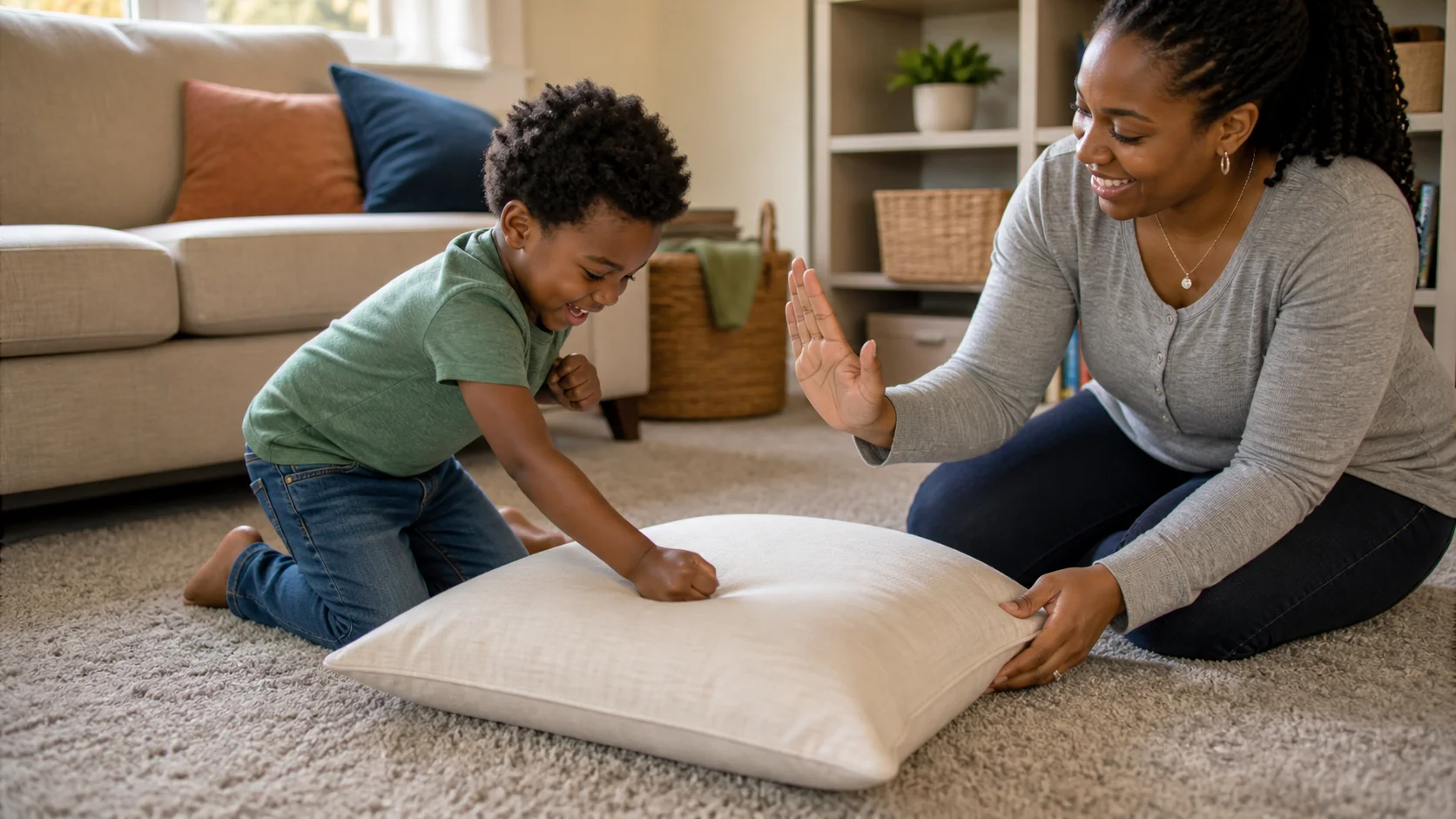
A young child kneels on a carpet and punches a large soft pillow while a grown-up sits close with one hand near the pillow.
Gross motorAutism supportPush Against ResistanceIndoor

Punch a Pillow.

Can your child land a few punches on a soft pillow, then freeze when you say stop? Short punch-and-pause rounds give big arm movements one clear target while practicing start-and-stop control.

Play time
1-5+ min
Age
2-5 years
Energy
Medium To High
Mess
No
Effort
Low
Where
Indoor
Start here

The recipe.

Low parent effort
2 things

What you need

  • 1 large soft pillow
  • 1 soft, stable floor surface, such as carpet or a mat
1 min minimum

Setup

Then start the loop
Step 01
Choose a large, soft pillow with no hard buttons or trim on the striking side.
Step 02
Place it flat on a carpet or mat with clear floor space around it.
"Pillow only."
The loop

How play unfolds.

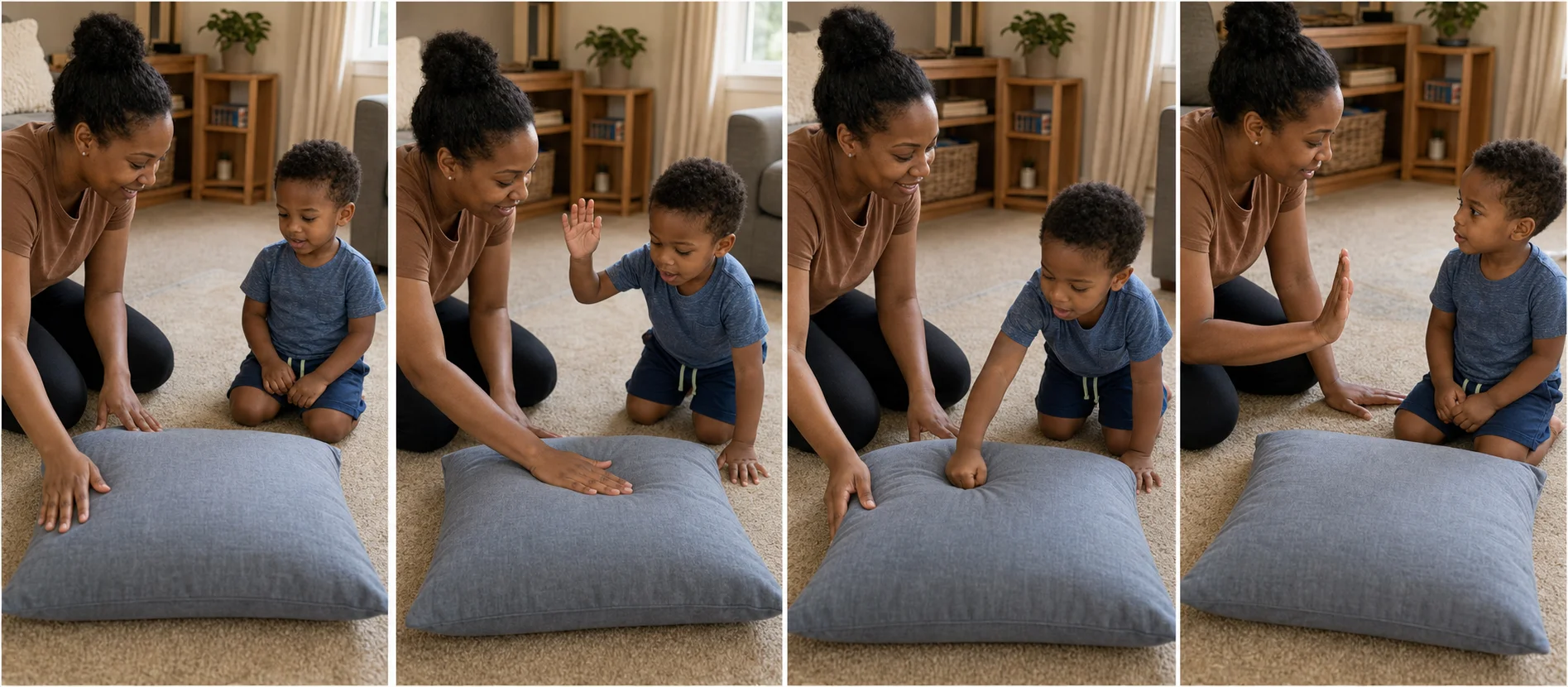
Four panels showing a pillow placed on a carpet, a grown-up modeling one pillow punch, the child punching the pillow, and both hands stopping after the cue.
  1. 01
    Have your child land 3 punches on the pillow.
  2. 02
    Say, "Stop," and hold your hands still. Wait for your child to freeze their hands too.
  3. 03
    When you are both ready, repeat with 3 more punches.

Safety Check

  • Stay with your child the whole time.
  • Use open hands or soft fists only.
  • Keep the pillow on a soft, stable floor surface for the safest version.
  • Stop if punches aim at people, pets, walls, or furniture.
  • Stop if the pillow starts sliding, flying, or turning into a jumping target.
  • Choose another heavy-work activity if pillow punching makes your child more wound up.
Skill spotlight
Push Against Resistance

Aiming strong movement at a safe target, Stopping after a strong movement burst

This helps a child use strong arm movement on purpose, feel where the body is in space, and practice stopping after a high-energy action.

  • The pillow gives strong movement one clear, soft target.
  • The punch-stop loop helps your child feel the difference between moving hard and holding still.
  • The activity can run with very few words, which keeps the job easy to understand.
Real-world transfer
  • Using strong body energy without hitting people or hard objects.
  • Stopping and restarting during active play.
  • Feeling when movement is getting too big for the space.
Supporting the play

What to say in the moment

Match what you say to what you see.

Prompt ladder
Level 1 (Start)
"Pillow gets the punches."
Level 2 (Keep going)
"Punch, punch, stop."
Level 3 (Stretch)
"Can your hands freeze?"
Level 4 (Extend)
"Strong round or slow round?"
If your child seems...
What you'd see
Focused
What to do
Say
"Your punches stayed on the pillow."
Add
Name one action, such as punch, stop, or freeze.
Extend
Let your child choose a strong round or a slow round.

Make it easier

Younger end
  • -Have your child sit or kneel so the punch target stays close.
  • -Use 2-punch rounds instead of open-ended bursts.
  • -Keep your own hand on one pillow corner so the target does not slide.

Make it harder

Older end
  • +Add a longer freeze after the stop cue.
  • +Invite your child to choose left hand, right hand, or both hands.
  • +Let your child call "stop" for the grown-up's pillow punch.

If it's not working

If you see
If child ignores it
Do 2 big slow open-hand punches on the pillow, then move your hands away and say, "Your turn."
If you see
If child misuses it
Hold the pillow, say, "Pillow only," and restart with 1 slow punch. If hands aim at people or furniture again, end the round.
If you see
If child gets frustrated
Switch to slow open-hand pats and count 3 pats as the whole round.

Parent questions