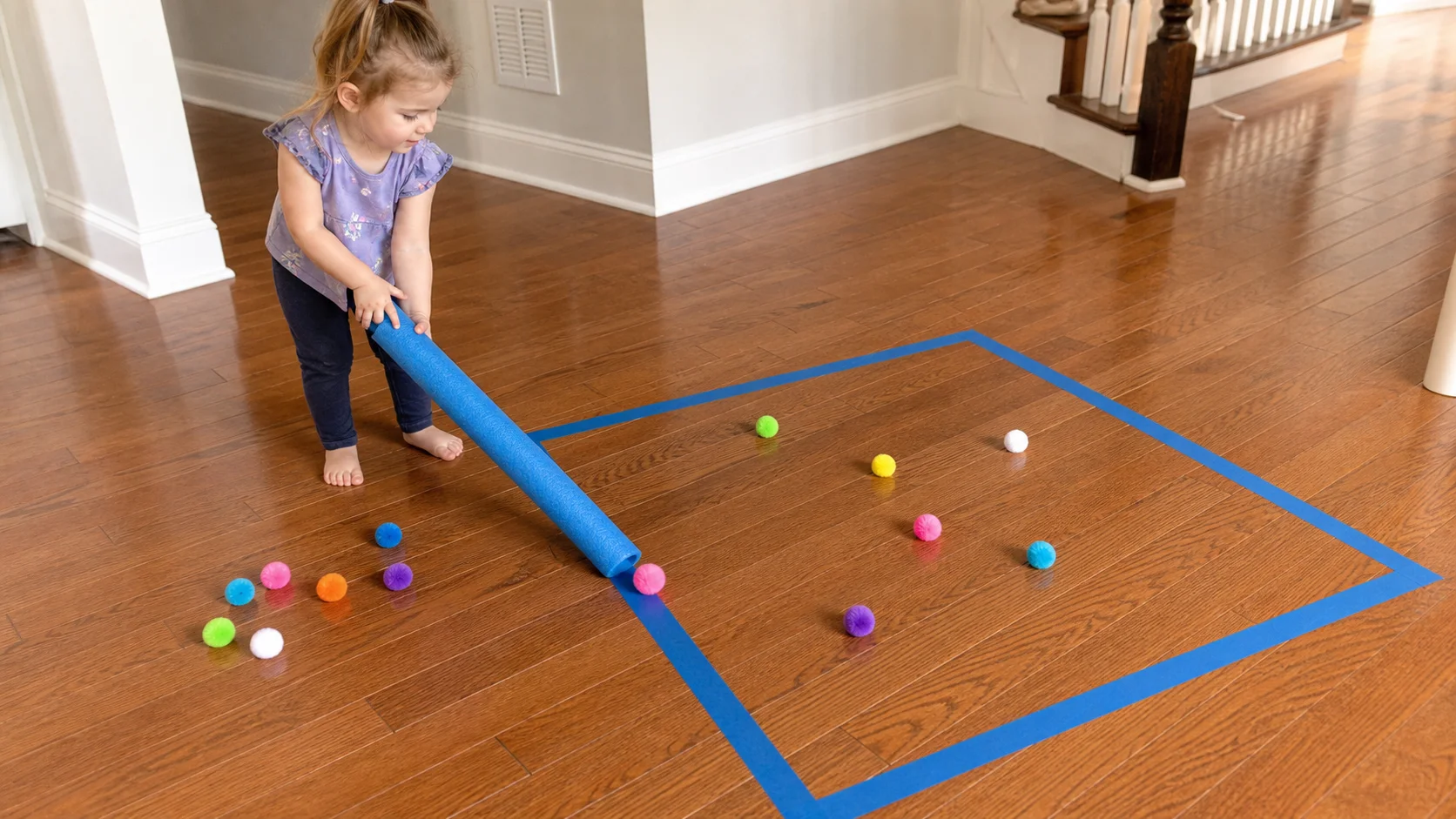
A toddler kneels beside a taped floor square and pushes a bright pom-pom toward it with a pool noodle.
Gross motorStrike With ToolIndoor Floor

Pom Pom Push.

A taped floor square and a pool noodle turn loose pom-poms into a simple indoor aiming game.

Play time
5-10+ min
Age
2-3 years
Energy
Medium
Mess
Low
Effort
Low
Where
Indoor Floor
Start here

The recipe.

Low parent effort
6 things

What you need

  • 1 pool noodle
  • painter's tape
  • a handful of pom-poms
  • 1 open patch of indoor floor
  • 1 child
  • 1 adult for supervision
5 min minimum

Setup

Then start the loop
Step 01
Tape 1 large square on a clear patch of floor.
Step 02
Leave open space around the square so the pool noodle can slide without bumping furniture, pets, or another child.
Step 03
Scatter a handful of pom-poms just outside 1 side of the square.
Step 04
Set the pool noodle on the floor beside the pom-poms or hand it to your child.
Step 05
Bring your child to the tape edge where 1 forward push can send a pom-pom toward the square.
"Noodle down."
The loop

How play unfolds.

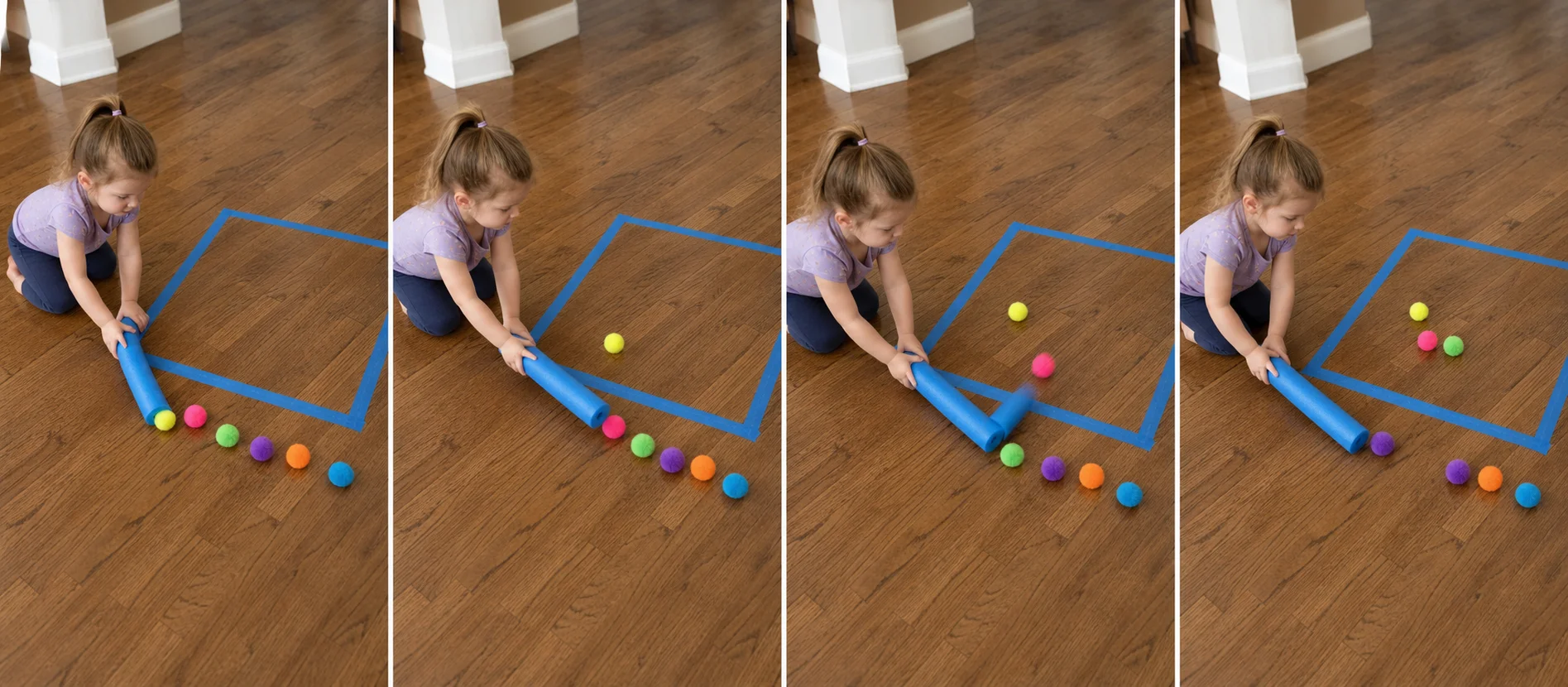
Four panels show a grown-up taping a square on the floor, pom-poms scattered near the edge, a child pushing one with a pool noodle, and the pom-poms swept back out for another round.
  1. 01
    Tap 1 pom-pom with the pool noodle and say, "Can you push this pom-pom into the square?"
  2. 02
    Let your child choose a pom-pom and push it toward the square.
  3. 03
    If it lands inside, leave it there and pick a new target. If it misses, let your child try that same pom-pom again or move to a closer one.
  4. 04
    When most of the pom-poms are inside, count or name them, sweep them back outside the square, and start another round.

Safety Check

  • Small pom-poms can be a mouthing or choking risk for younger toddlers, so stay close and supervise.
  • Keep enough clear floor space for the pool noodle to slide or tap without hitting another child, furniture, or a pet.
Supporting the play

What to say in the moment

Match what you say to what you see.

Prompt ladder
Level 1 (Start)
"Push one pom-pom into the square."
Level 2 (Keep going)
"Pick another pom-pom and send it in."
Level 3 (Stretch)
"Try a tiny push and see where it stops."
Level 4 (Extend)
"Can you get two in before we reset?"
If your child seems...
What you'd see
Focused
What to do
Say
"You are aiming at the square."
Add
"Name the color after it lands."
Extend
"Invite one slow push and one quick push."

Make it easier

Younger end
  • -Use only three pom-poms for the next round.
  • -Place the pom-poms in a short line leading toward the square.
  • -Let the child kneel close to the square so the push is shorter.

Make it harder

Older end
  • +Start each pom-pom one noodle-length away from the square.
  • +Ask for one soft push that stops inside the square.
  • +Count only the pom-poms that land fully inside the tape.

If it's not working

If you see
If child ignores it
Push 1 bright pom-pom into the square yourself, then hand over the noodle and point to the next closest one.
If you see
If child misuses it
If the noodle becomes a hitting toy, pause the turn, put the noodle on the floor, and restart with one slow floor push.
If you see
If child gets frustrated
Move three pom-poms right next to the square edge and make the goal "get one in" before resetting.
Skill spotlight
Strike With Tool

Tool aiming and pushing

Aiming with a tool helps a child judge distance, control force, and keep their body organized during simple games and shared play.

  • Pushing a pom-pom with a long soft tool helps your child practice aiming without needing a hard hit.
  • The taped square gives a clear inside-or-outside result, so your child can see what changed after each push.
  • Leaving missed pom-poms in play turns mistakes into easy retries instead of stopping the round.
Real-world transfer
  • Joining simple turn games.
  • Moving objects with a tool instead of grabbing them.
  • Judging how much force to use.
  • Watching where something goes after they move it.

Parent questions