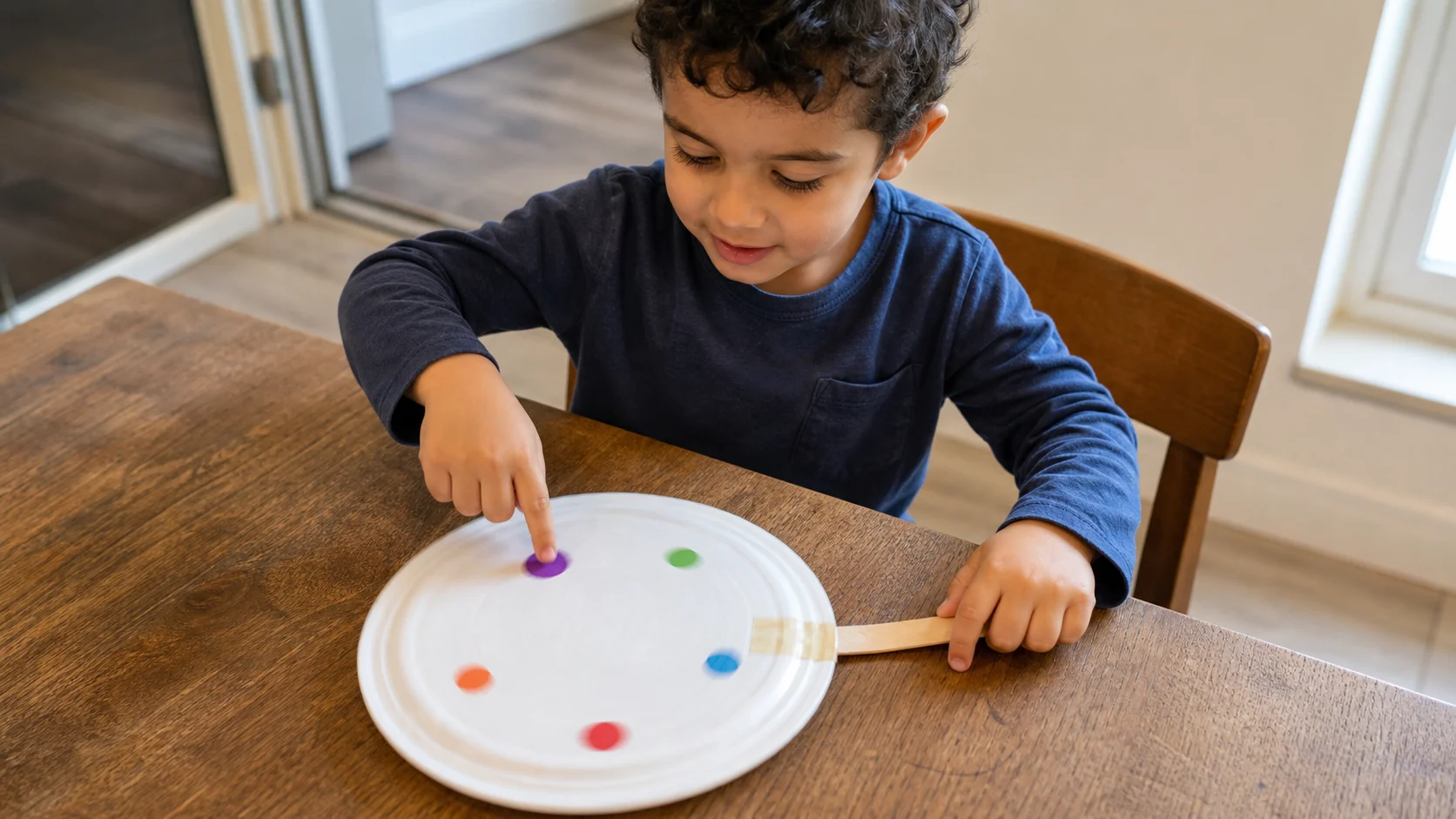
A child spins a paper plate with a craft-stick handle on a table and taps one bright dot while a grown-up watches nearby.
Fine motorOT-adjacent supportTwo Hand CoordinationIndoor Table

Plate Spin Dot Tap.

A spinning paper plate and one color dot make two-hand coordination practice quick and playful.

Play time
5-10+ min
Age
3-5 years
Energy
Low To Medium
Mess
Low
Effort
Low
Where
Indoor Table
Start here

The recipe.

Low parent effort
7 things

What you need

  • 1 paper plate
  • 1 craft stick
  • Markers
  • Masking tape
  • 1 table or other flat surface
  • 1 adult for setup and close supervision
  • 1 child
5 min minimum

Setup

Then start the loop
Step 01
Draw 4 to 6 small bright dots across the front of the paper plate, leaving space between them.
Step 02
Flip the plate over and tape the craft stick firmly across the center back so it works like a short handle.
Step 03
Set the plate face-up on the table in front of your child with the handle easy to reach.
Step 04
Check that both hands can reach the plate without heavy leaning.
Step 05
Give the handle 1 gentle test spin to make sure the tape holds and the plate stays flat on the table.
"Spin, watch, tap."
The loop

How play unfolds.

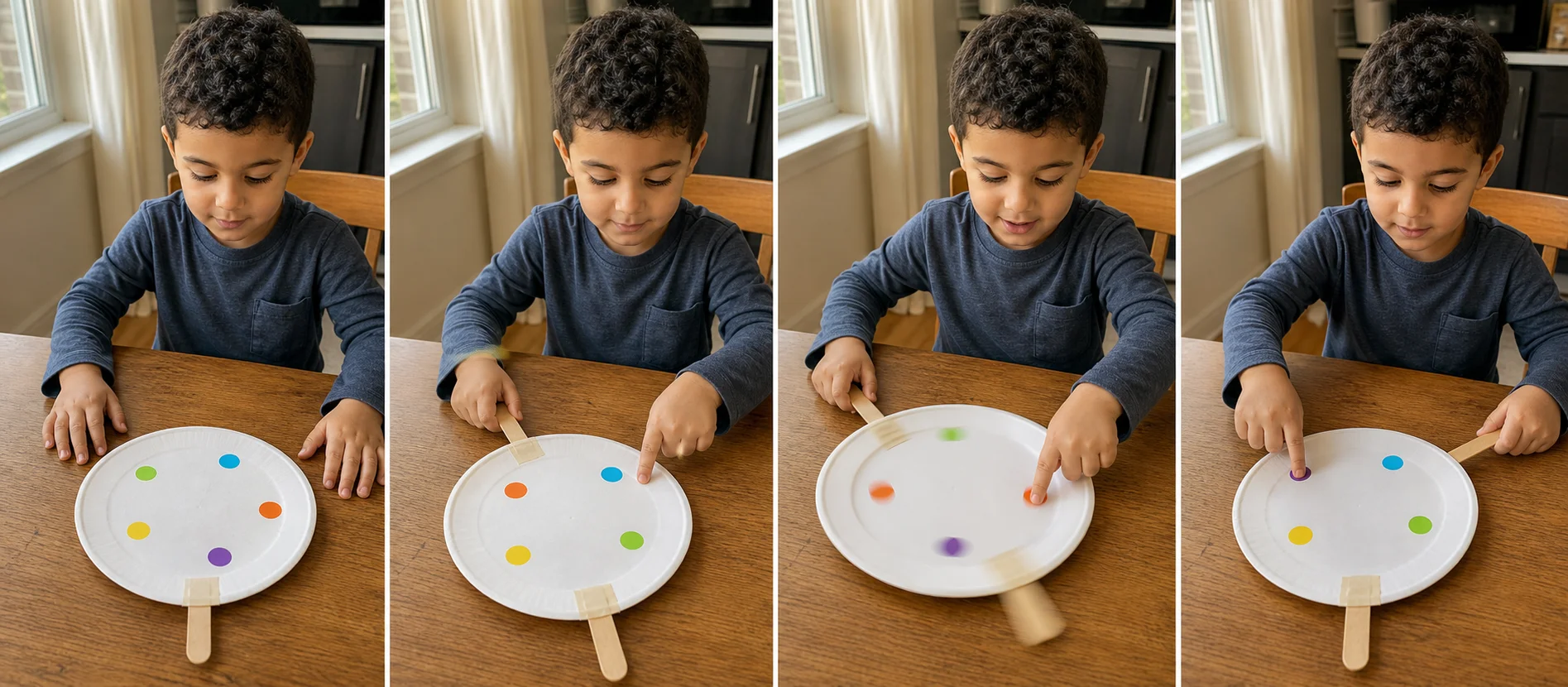
A step-by-step play sequence showing bright dots drawn on a paper plate, the taped handle, one spin, a dot tap, and a hand switch for another round.
  1. 01
    Point to 1 dot, give the handle a slow spin, and say, "Spin it, watch the dot, then tap it with this finger."
  2. 02
    Let your child spin the plate with 1 hand and tap a moving dot with the pointer finger of the other hand.
  3. 03
    Invite another spin and a new dot. After a few taps, switch hand jobs so the other hand spins and the first hand taps.
  4. 04
    End the round after both hand pairings, flatten the plate, and spin again if your child wants another turn.

Safety Check

  • Start only when the craft-stick handle stays attached during a gentle wiggle and test spin.
  • Supervise closely so fingers stay clear of the spinning edge and the plate stays flat on the table to avoid small scrapes.
  • Stop and retape if the handle loosens or the plate starts sliding across the table.
  • Choose another activity if your child mouths craft sticks or tape, throws the plate, or finds moving targets upsetting.
Supporting the play

What to say in the moment

Match what you say to what you see.

Prompt ladder
Level 1 (Start)
Spin it slowly and tap any dot before it stops.
Level 2 (Keep going)
Pick 1 color, spin, and try to tap that color.
Level 3 (Stretch)
Switch hands and see if the new tapping finger can find a dot.
Level 4 (Extend)
Try 1 tiny spin, 1 medium spin, and 1 fast spin.
If your child seems...
What you'd see
Focused
What to do
Say
"That dot moved fast."
Add
Invite 1 color name before the next spin.
Extend
Try a slower spin and a faster spin.

Make it easier

Younger end
  • -Use only the 2 easiest-to-see dots for the next few spins.
  • -Let your child tap after the plate slows instead of while it is fast.
  • -Keep the same hand jobs for a full round before switching.

Make it harder

Older end
  • +Call a color after the spin starts.
  • +Ask for 2 taps before the plate stops.
  • +Try a gentle spin that lasts longer without wobbling.

If it's not working

If you see
If child ignores it
Do 1 slow parent spin and tap a dot yourself, then offer a choice: "Red dot or blue dot next?"
If you see
If child misuses it
Pause the plate with your hand and say, "This one spins on the table. Fingers tap the dots, not the edge."
If you see
If child gets frustrated
Slow the spin, choose the biggest or brightest dot, and count any touch near the dot as a successful turn.
Skill spotlight
Two-Hand Coordination

Two-hand spin and tap control.

This helps a child use 2 hands for different jobs while the eyes guide 1 finger to a moving target. That same control shows up in drawing, tabletop games, tool use, and self-care tasks where 1 hand steadies while the other works.

  • The spin-and-tap loop gives your child a clear reason to use 1 hand to start the motion and the other hand to aim.
  • Watching one moving dot before tapping helps your child practice tracking and timing without a lot of extra directions.
  • The setup resets fast, so a miss becomes another quick try instead of a full rebuild.
Real-world transfer
  • Using 2 hands together during small tabletop tasks
  • Keeping 1 hand steady while the other hand works
  • Aiming a finger or tool toward a clear target
  • Watching moving pieces during games or cleanup