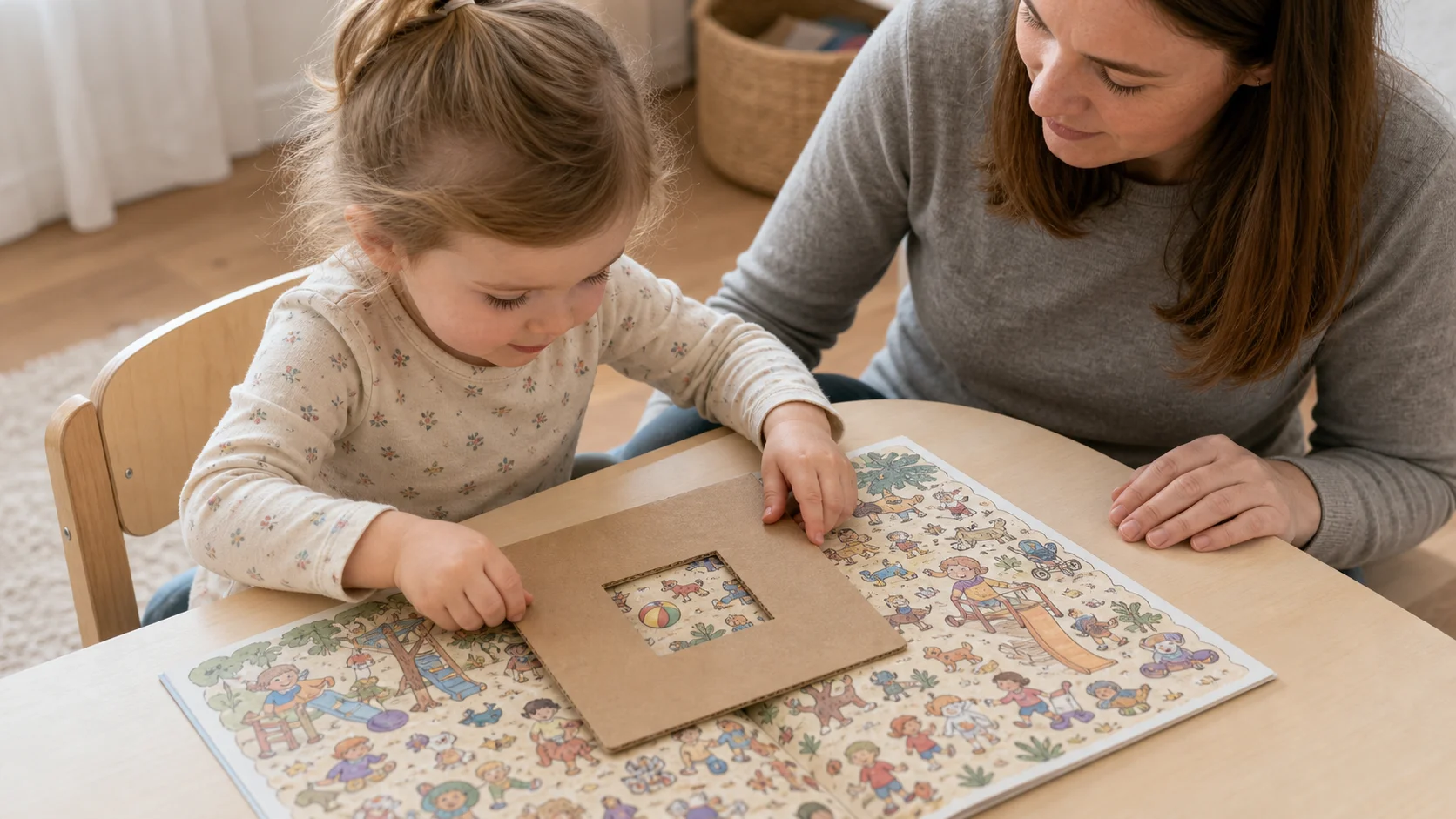
Toddler sliding a cardboard window over a busy picture page while a grown-up sits nearby.
ThinkingSensory-friendly supportObject To TargetIndoor

Picture Window Search.

A cardboard window turns a crowded picture page into one small search spot at a time.

Play time
5-10+ min
Age
2-3 years
Energy
Low
Mess
No
Effort
Low
Where
Indoor
Start here

The recipe.

Low parent effort
5 things

What you need

  • 1 busy picture book page, magazine page, or printed picture scene
  • 1 cardboard window with 1 cut-out opening
  • 1 table or floor space
  • 1 adult
  • 1 child
5 min minimum

Setup

Then start the loop
Step 01
On a table or floor, choose one picture page with familiar items your child can name or point to, such as a ball, hat, spoon, or car.
Step 02
Away from your child, cut one smooth opening in the cardboard. The opening should show one small part of the picture page at a time, not the whole page.
Step 03
On the table or floor, lay the picture page flat.
Step 04
On top of the page, place the cardboard window within your child's reach.
Step 05
Beside your child, sit where you can slide the window slowly without blocking the view.
"Window on."
The loop

How play unfolds.

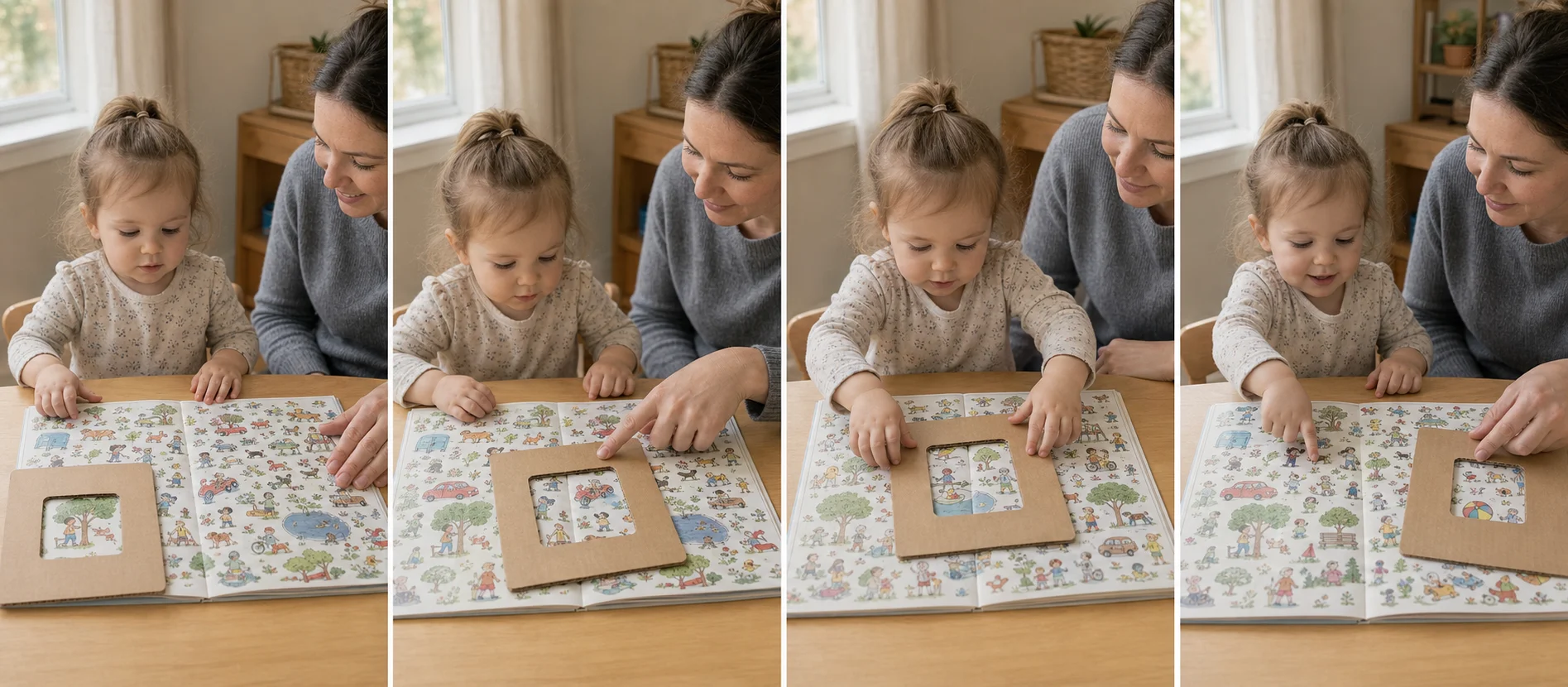
Panels showing a grown-up model the window, a child slides and stops, finds a picture, and resets for another search.
  1. 01
    Slide the window yourself until an easy target is visible. Tap the picture and say, "Find the ball. Slide, look, find."
  2. 02
    Name one target picture that is definitely on the page.
  3. 03
    Let your child slide the cardboard window, stop, and look through the opening.
  4. 04
    If the target appears, say, "You found it," then choose one new target. If it is not there, say, "Not there. Slide again," and help slow the window.
  5. 05
    End after a few finds, one calm search round, or the first clear sign that your child is done.

Safety Check

  • Adult cutting is required before play.
  • Smooth rough cardboard edges before handing the window to your child.
  • Watch for mouthing, tearing, paper cuts, or cardboard scratches.
  • Use a simpler page if the picture feels crowded or your child looks overwhelmed.
  • Do not use this activity to judge vision or attention concerns.
Supporting the play

What to say in the moment

Match what you say to what you see.

Prompt ladder
Level 1 (Start)
Slide the window slowly to one picture and say, "Look here."
Level 2 (Keep going)
Name one target and wait while your child moves the window.
Level 3 (Stretch)
Ask your child to search one small area before sliding again.
Level 4 (Extend)
Let your child choose the next picture for you to find.
If your child seems...
What you'd see
Focused
What to do
Say
"You found it. Pick the next spot."
Add
Ask one naming or matching prompt while the window is still.
Extend
Let your child name a picture for the adult to find.

Make it easier

Younger end
  • -Let your child point instead of saying the picture name.
  • -Search from left to right so the window only moves one direction.
  • -Pause for a quiet two-count at each stop before asking anything.

Make it harder

Older end
  • +Ask your child to find another picture with the same color.
  • +Start the window away from the target and let your child choose the path.
  • +After a find, move the window away and ask where the picture was.

If it's not working

If you see
If child ignores it
Do one full adult turn first: slide, stop, point, and say, "I found the dog." Then offer your child one easy target beside your hand.
If you see
If child misuses it
If your child bends, mouths, tears, or waves the cardboard, take a short turn yourself and give it back flat on the page. If it keeps happening, end and save the page for later.
If you see
If child gets frustrated
Make the page easier, name a target already visible in the window, or switch to "What do you see?" instead of asking for a specific picture.
Skill spotlight
Object To Target

Find a named picture., Slow visual search.

This helps a child handle a busy picture in small pieces, follow one simple search cue, and keep trying without feeling swamped by the whole page.

  • The cardboard window makes a crowded page easier to enter by showing one small area at a time.
  • The repeated pattern is simple: hear one target, slide, stop, look, and try again.
  • A miss stays low-pressure because "not there" just becomes the next slide.
  • Pointing can count as a full answer, so your child does not need much language to join in.
Real-world transfer
  • Finding a picture in a book.
  • Looking for one item on a busy shelf.
  • Following one simple direction at a table.
  • Staying with a small search after the first miss.

Parent questions