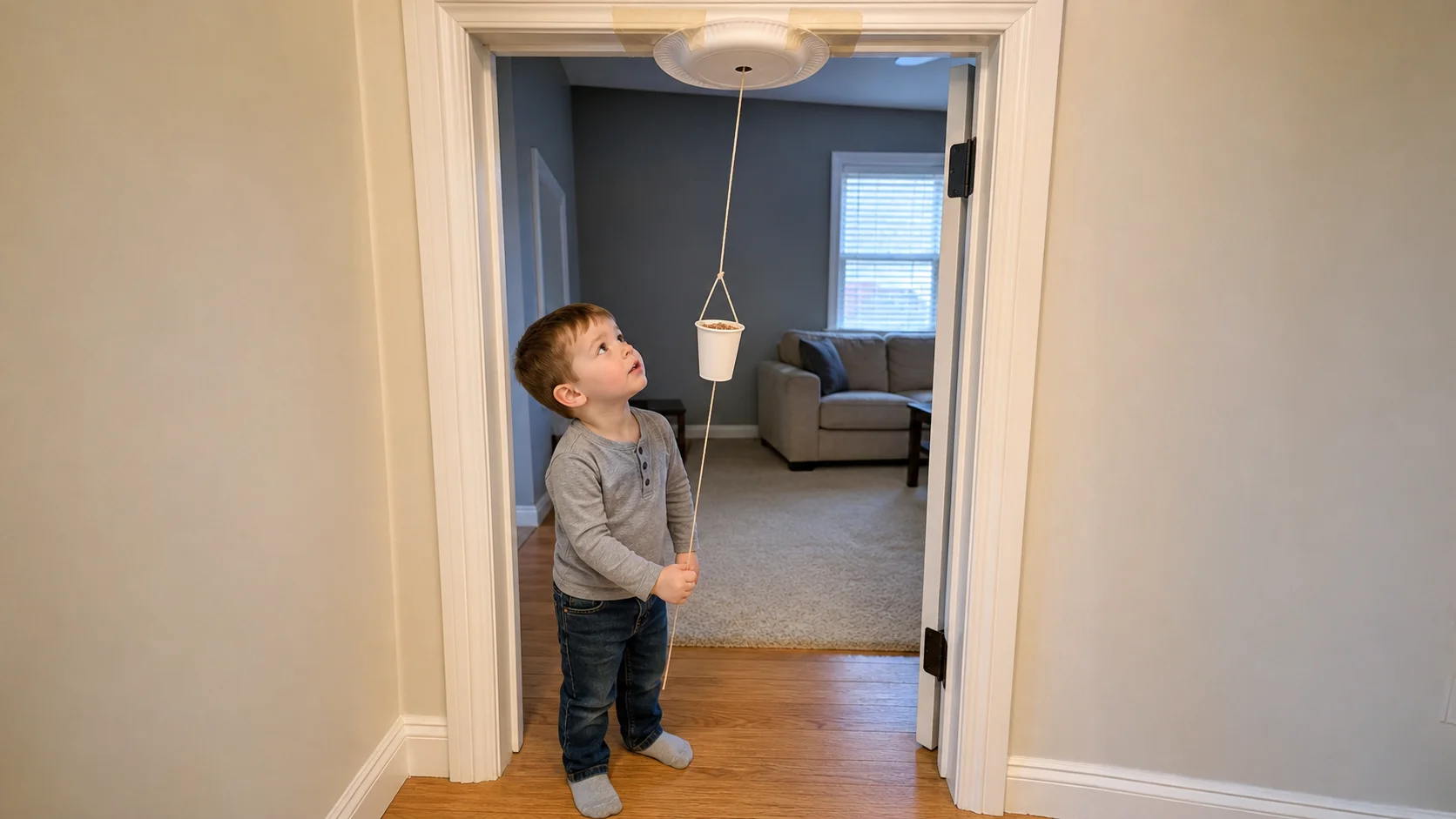
A child pulls a loose string under a doorway while a bean-filled paper cup lifts through a taped paper-plate pulley and a grown-up stands nearby.
Gross motorOT-adjacent supportPull Against ResistanceIndoor Doorway

Paper Plate Pulley Lift.

Tape a paper plate over a doorway, hang a bean cup, and let your child pull the string to lift and lower the cargo.

Play time
5-10+ min
Age
2-4 years
Energy
Low
Mess
Low
Effort
Medium
Where
Indoor Doorway
Start here

The recipe.

Medium parent effort
9 things

What you need

  • 1 paper plate
  • 1 hole puncher
  • Masking tape
  • 1 string
  • 1 paper cup
  • 1 handful of beans
  • 1 stable door frame
  • 1 adult for setup and direct supervision
  • 1 child
5 min minimum

Setup

Then start the loop
Step 01
On a table or counter, punch one hole in the middle of the paper plate.
Step 02
Punch two small holes near the rim of the paper cup.
Step 03
Thread one end of the string through the cup holes and tie it so the cup hangs like a bucket.
Step 04
Tape the paper plate flat across the top of the stable door frame so the center hole sits over the play space.
Step 05
Thread the loose end of the string through the plate hole so the cup hangs on one side and the loose end hangs on the other.
Step 06
Put one handful of beans in the cup as cargo.
Step 07
Check that the cup hangs freely, the loose string reaches your child's hands, and the taped plate stays flat during one adult test pull.
Step 08
Stand next to your child with the loose string end within reach.
"Pull down."
The loop

How play unfolds.

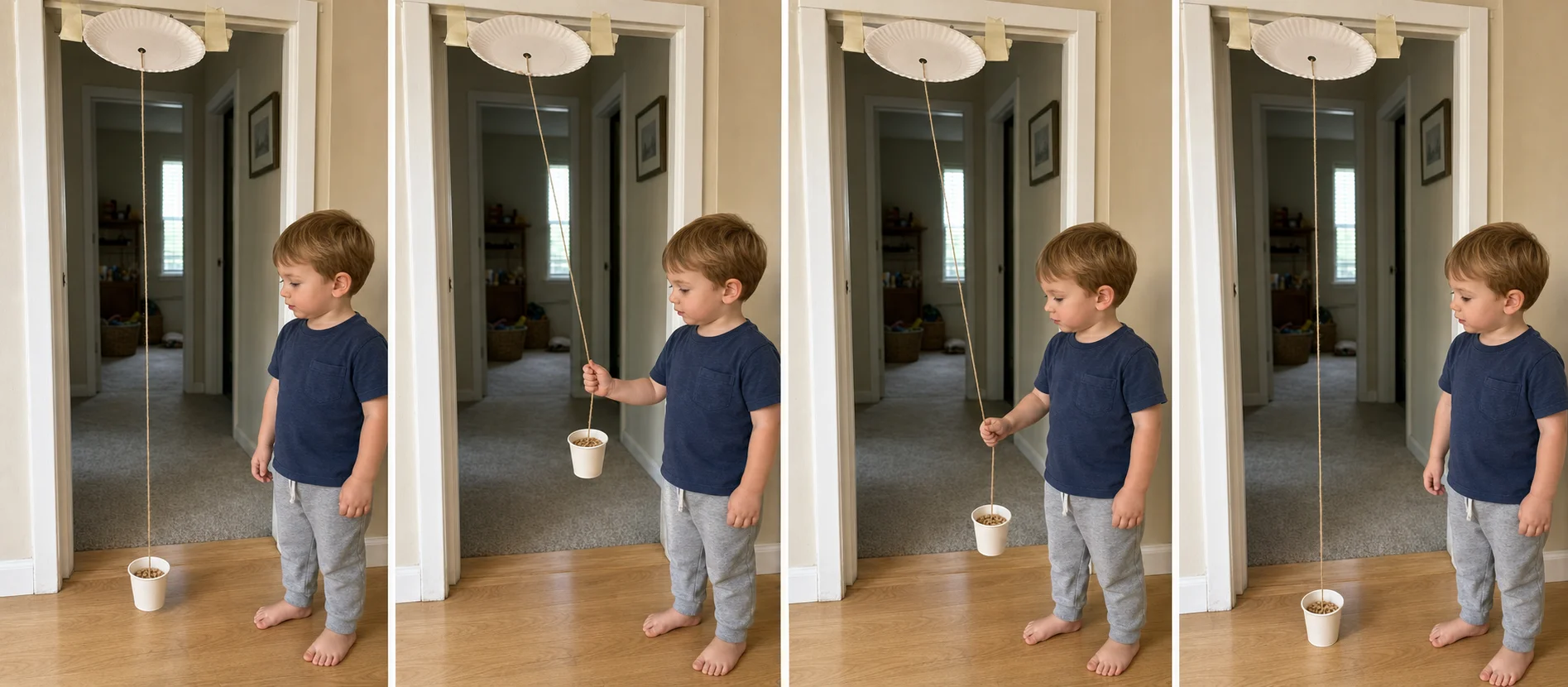
A step-by-step play sequence showing a taped paper-plate pulley, a bean-filled cup lifting with one pull, a slow lower, and a reset for another turn.
  1. 01
    Pull the loose string once and say, "Pull down to make the bean cup go up."
  2. 02
    Hand your child the loose end and let them pull to lift the cup.
  3. 03
    Help them watch the cup and let the string slide back slowly so it lands without crashing.
  4. 04
    Straighten the string if it twists, then hand the loose end back for another lift.

Safety Check

  • Stay next to your child the whole time. Long string requires adult supervision because it can become a strangulation hazard.
  • Start only when the paper plate and masking tape stay secure during an adult test pull.
  • Stop and untangle the string right away if it wraps around a hand or body.
  • Keep beans away from children who still mouth small objects.
Supporting the play

What to say in the moment

Match what you say to what you see.

Prompt ladder
Level 1 (Start)
Pull down and watch the cup go up.
Level 2 (Keep going)
Pull again and lower it slow.
Level 3 (Stretch)
Make the cup land softly at the floor.
Level 4 (Extend)
Try 2 smooth lifts in a row.
If your child seems...
What you'd see
Focused
What to do
Say
"Pull, watch, then slow."
Add
Ask, "Up or down?" before the next turn.
Extend
Try 2 lifts where the cup touches down softly.

Make it easier

Younger end
  • -Use fewer beans so the cup lifts with less force.
  • -Count the turn as a win when the cup goes up and comes back down with your help.
  • -Start each round with the cup hanging low enough that the first pull makes a quick change.

Make it harder

Older end
  • +Ask for a quiet stop just before the cup touches the floor.
  • +Try 2 smooth lifts in a row without the cup swinging sideways.
  • +Switch which hand pulls the loose string on the next turn.

If it's not working

If you see
If child ignores it
Do one lift yourself first so the moving cup becomes the invitation, then hand over the loose end right away.
If you see
If child misuses it
If they yank sideways, wrap the string around their hand, or swing the cup, pause, untangle the string, point the cup straight down, and restart with "Pull down, then slow."
If you see
If child gets frustrated
Hold the loose end together for one shared lift, then help with the slow lower so they still finish a full up-and-down turn.
Skill spotlight
Pull Against Resistance

Pulling with control

This helps your child match force to a job, use shoulders and hands together, and control a pull before it turns into a drop.

  • The pull-to-lift loop gives your child a clear reason to use hand grip and shoulder effort together.
  • Watching the cup rise and come back down helps your child connect force with a visible result.
  • The same setup makes retries easy, so a fast drop becomes another chance to slow the next turn.
Real-world transfer
  • Pulling pants, socks, or sleeves with steadier force.
  • Using both hands for simple helping jobs.
  • Slowing down when something needs careful handling.