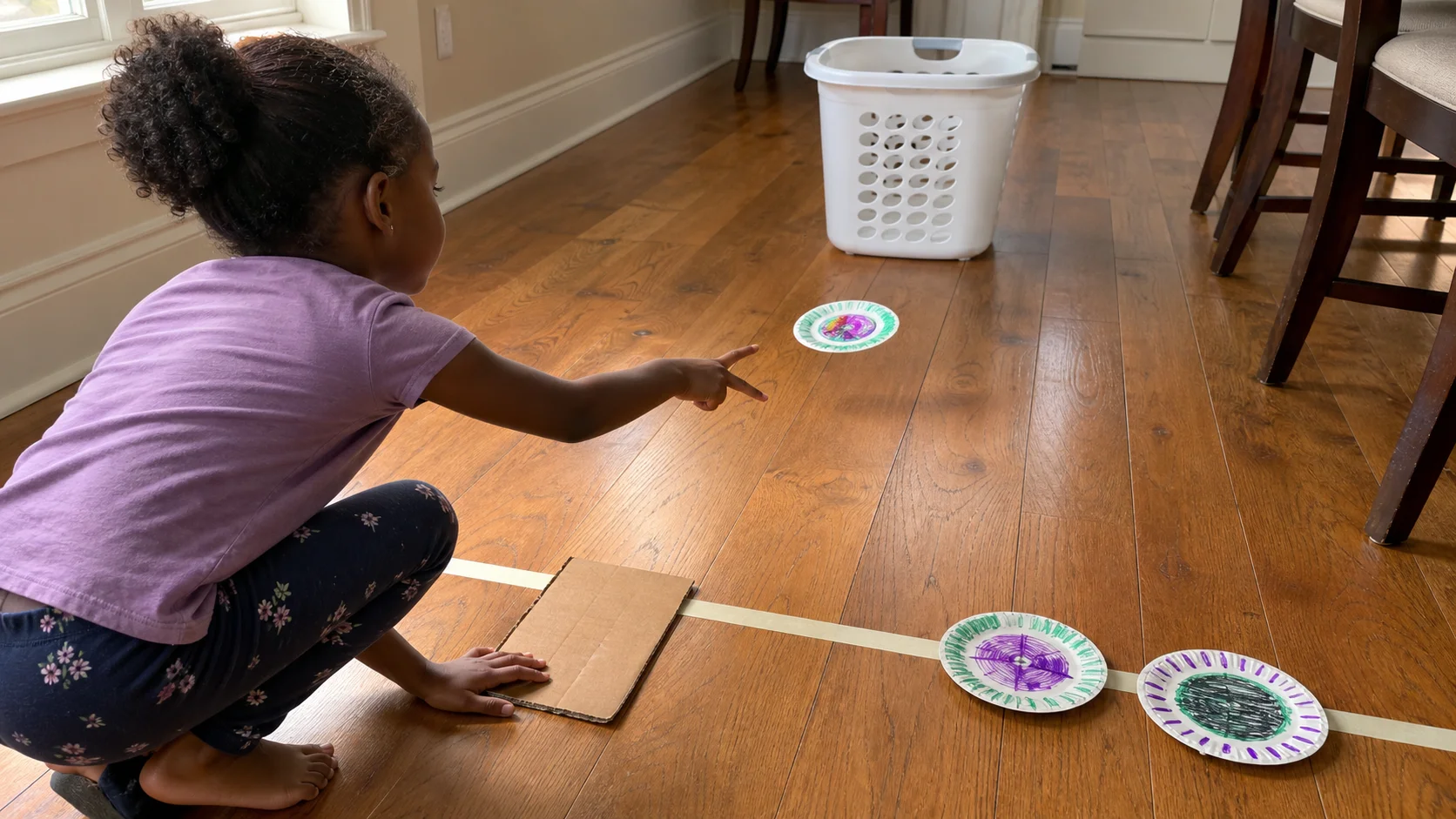
A school-age child stands behind a taped line and flicks a paper disc from a small cardboard launcher toward a laundry basket.
Fine motorOT-adjacent supportTwo Hand CoordinationIndoor Clear Floor Area

Paper Disc Basket Flick.

A paper plate, cardboard launcher, and laundry basket turn finger flicks into a quick indoor target game.
Play time
5-10+ min
Age
6-9 years
Energy
Low To Medium
Mess
Low
Effort
Low To Medium
Where
Indoor Clear Floor Area
Start here

The recipe.

Low To Medium parent effort
9 things

What you need

  • 1 paper plate
  • Scissors
  • Markers
  • 1 laundry basket
  • Masking tape
  • 1 small piece of cardboard
  • 1 clear floor area
  • 1 adult for setup and direct supervision
  • 1 child
5 min minimum

Setup

Then start the loop
Step 01
At a table or prep surface, cut 3 circles from 1 paper plate and decorate them with markers so they are easy to see.
Step 02
On the clear floor, place the laundry basket in the middle of the play area.
Step 03
On the floor a few feet from the basket, tape 1 straight start line with no breakable items along the launch path.
Step 04
Behind the start line, place the cardboard launch pad flat on the floor.
Step 05
Behind the start line within your child's reach, set the 3 paper discs.
Step 06
Behind the taped line, position your child facing the basket.
"Ready, flick."
The loop

How play unfolds.

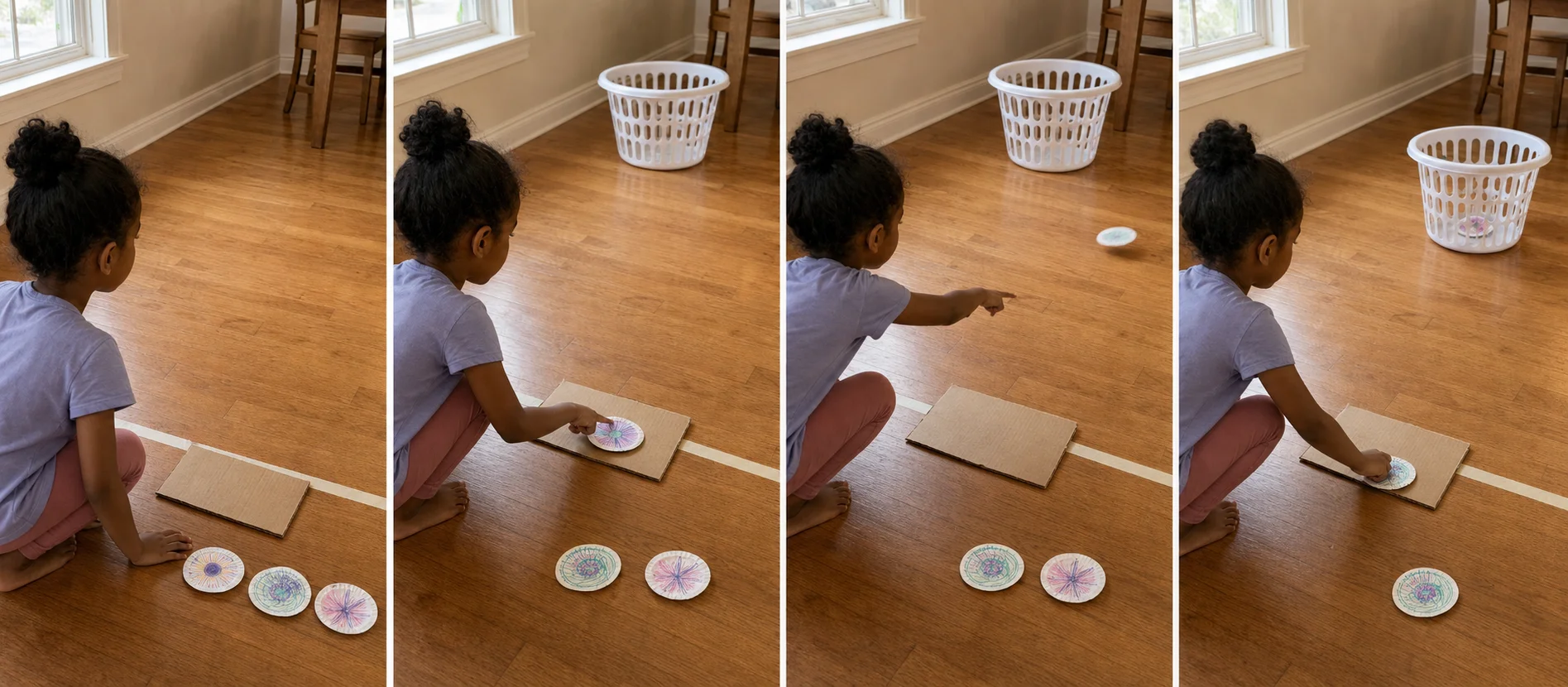
Four panels show a grown-up cutting paper plate discs, taping a start line in front of a laundry basket, a child steadying cardboard and flicking a disc, and discs being retrieved for another round.
  1. 01
    Set the cardboard just behind the tape, hand your child 1 paper disc, and say, "Stand behind the tape, hold your launcher still, and flick your disc into the basket."
  2. 02
    Let your child steady the cardboard with one hand and flick the disc toward the basket with the other hand.
  3. 03
    Watch where the disc lands, bring it back behind the line, and repeat with the remaining discs.
  4. 04
    If your child wants another round, set the discs behind the line again and replay from the same spot or a slightly different distance.

Safety Check

  • Clear breakable items from the play area before launching the paper discs.
  • Supervise scissors during setup and keep them out of reach before play begins.
Supporting the play

What to say in the moment

Match what you say to what you see.

Prompt ladder
Level 1 (Start)
Flick 1 disc and see where it lands.
Level 2 (Keep going)
Try the next disc from the same line.
Level 3 (Stretch)
Notice your aim, then flick again.
Level 4 (Extend)
Try to land 2 discs before moving the line.
If your child seems...
What you'd see
Focused
What to do
Say
"Watch the basket, then flick."
Add
Ask the child to name where the disc landed before the next reset.
Extend
Invite 2 steady launches in a row before retrieving the discs.

Make it easier

Younger end
  • -Use the closest line and count any disc that touches the basket as a hit.
  • -Start with 1 decorated disc so there is less to track.
  • -Let the child kneel behind the line if standing makes the launch pad slide.

Make it harder

Older end
  • +Ask for 2 hits before moving the tape farther back.
  • +Try 1 soft flick and 1 strong flick from the same line.
  • +Aim for the basket opening without letting the disc touch the rim.

If it's not working

If you see
If child ignores it
Flick 1 disc yourself first so your child can see the target game, then hand over the next disc for a turn.
If you see
If child misuses it
Go back to 1 disc at a time, reset both feet behind the tape, and place the cardboard flat on the floor before the next launch.
If you see
If child gets frustrated
Finish the round from the same line with calm coaching, then move the tape a little closer for the next round so the target feels more reachable.
Skill spotlight
Two-Hand Coordination

Finger aim and two-hand control.

This helps the child use both hands for different jobs, aim a small hand movement toward a clear target, and adjust after a miss. Those skills show up in games, self-care, tool use, and everyday cleanup.

  • Steadying the cardboard with one hand while flicking with the other gives both hands different jobs in the same turn.
  • The basket gives instant feedback, so your child can see whether a softer or stronger flick worked better.
  • The retrieve-and-reset loop makes retrying simple. A miss does not end the game. It sets up the next turn.
Real-world transfer
  • Using two hands together during small tasks
  • Aiming small hand movements in games and cleanup
  • Trying again after a miss without changing the whole activity

Parent questions