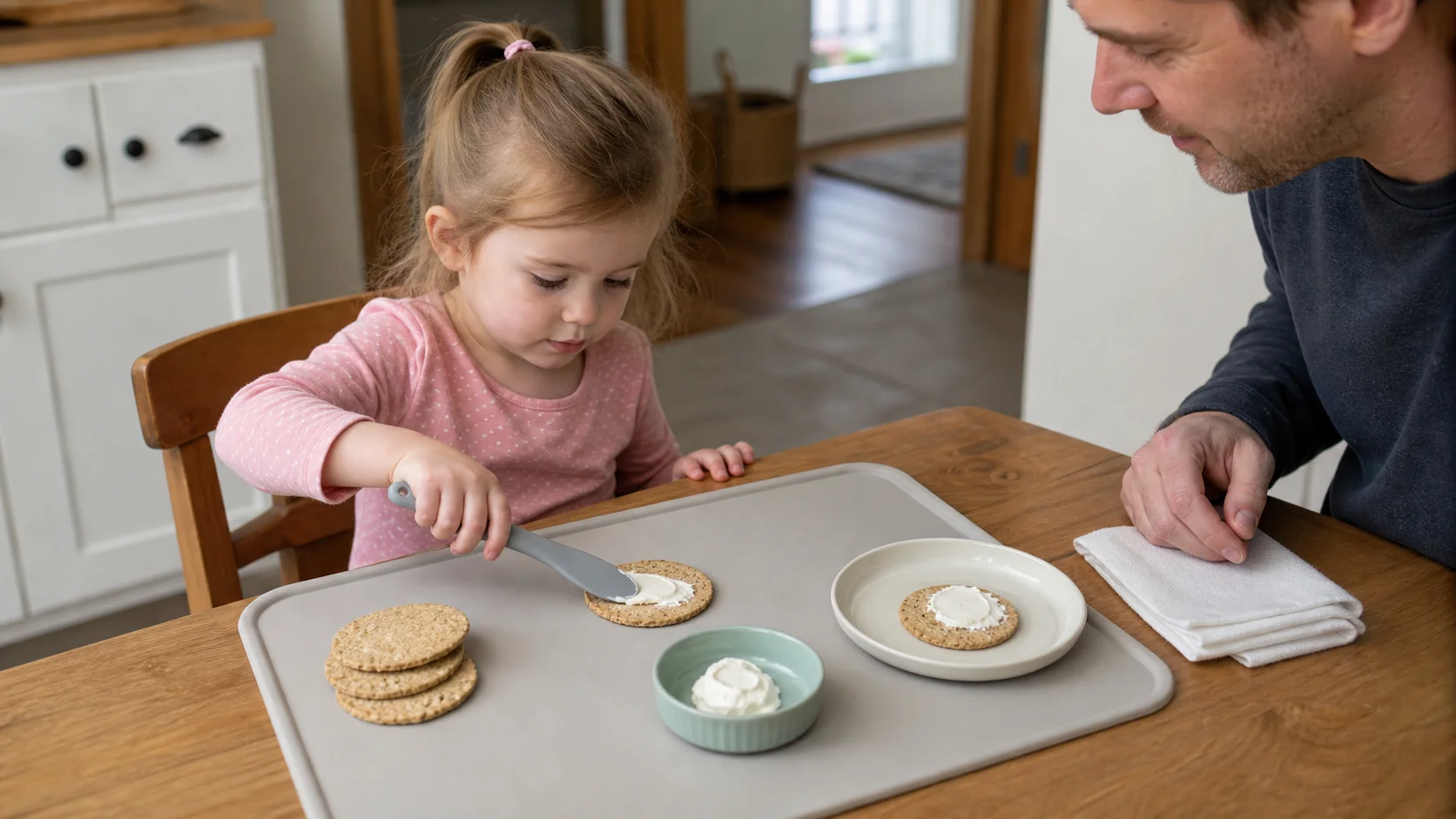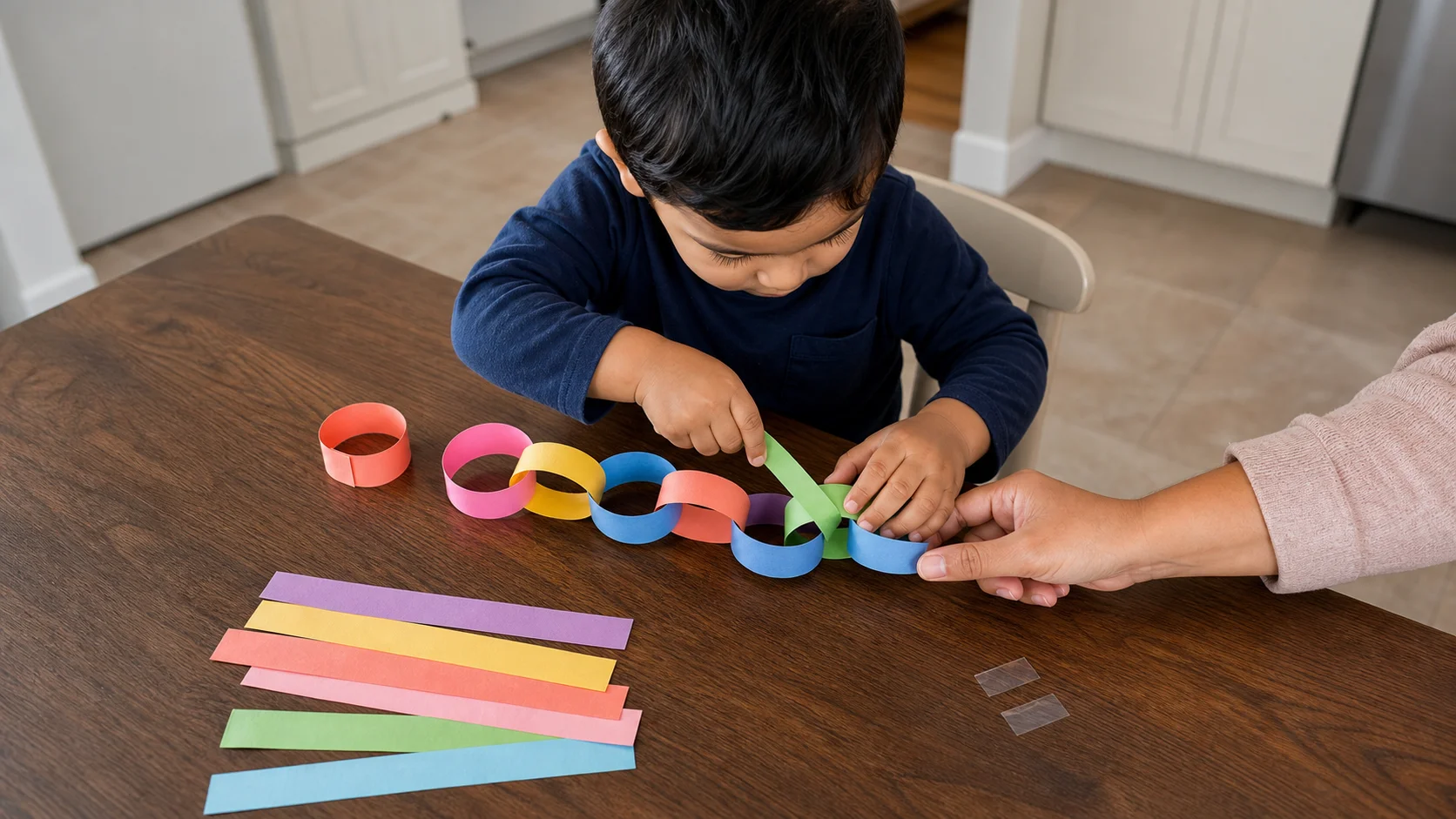
Toddler threading a colored paper strip through a starter paper chain while a grown-up steadies the link.
Fine motorOT-adjacent supportTwo Hand CoordinationIndoor

Paper Chain Links.

Thread one paper strip through a starter link, press it closed, and watch a short chain grow.

Play time
5-10+ min
Age
2-3 years
Energy
Low
Mess
Low
Effort
Medium
Where
Indoor
Start here

The recipe.

Medium parent effort
6 things

What you need

  • 6 to 10 paper strips cut ahead of time
  • 1 starter paper link already closed
  • tape or 1 glue stick
  • 1 table or floor workspace
  • 1 adult
  • 1 child
5 min minimum

Setup

Then start the loop
Step 01
On a table or clear floor spot, make enough space for the chain to lie flat.
Step 02
On that workspace, place the closed starter link closest to your child.
Step 03
Beside the starter link, put the loose paper strips in one small pile within reach.
Step 04
On the adult side of the workspace, choose tape or a glue stick, not both.
Step 05
If using tape, start a few short pieces where only the adult can reach them. If using glue, uncap it and keep it on the adult side.
Step 06
Before your child joins the play, make sure scissors are away from the workspace.
"Through the link."
The loop

How play unfolds.

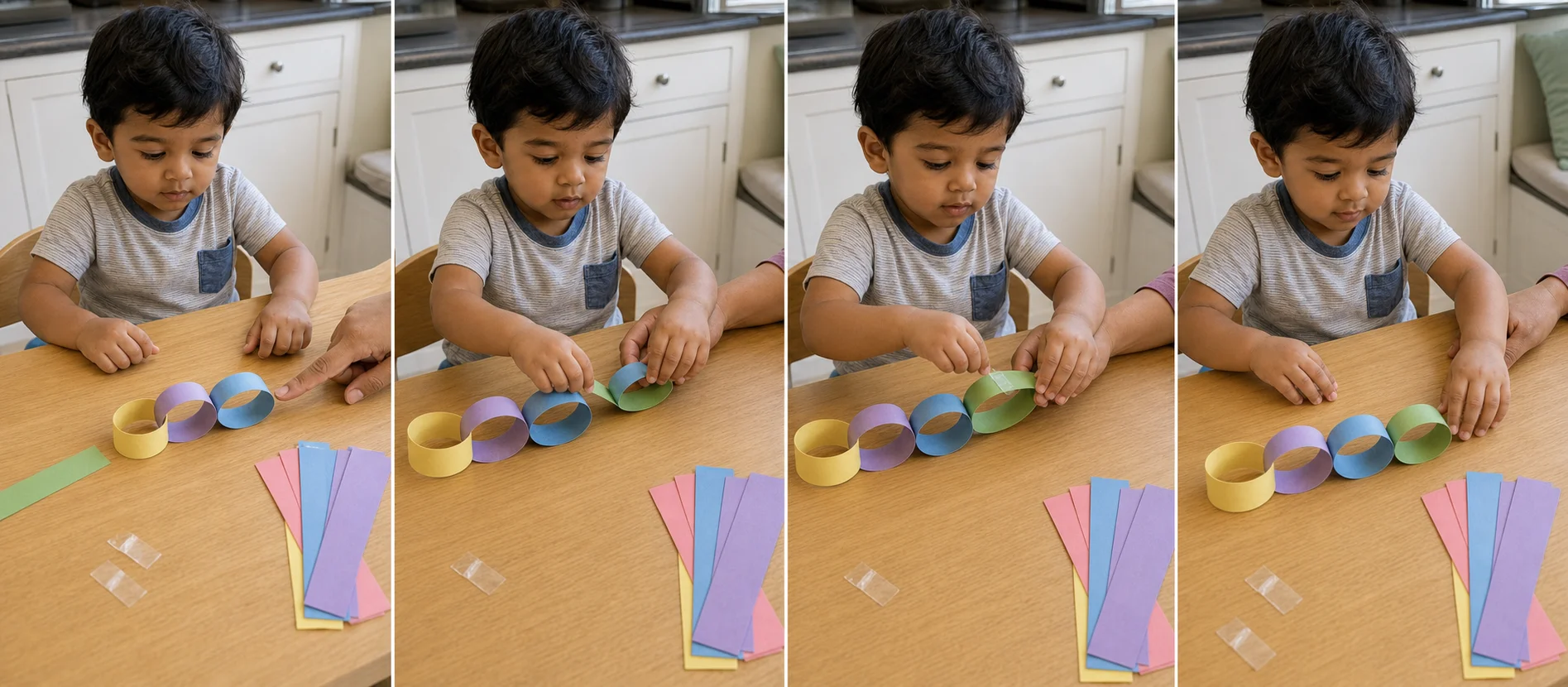
Panels showing a grown-up preparing paper strips, a toddler threading one strip, pressing the ends closed, and counting the new chain link.
  1. 01
    Thread one strip through the starter link and say, "Through, ends together, press."
  2. 02
    Hold the last link steady while your child pushes one loose strip through it.
  3. 03
    Help bring the ends together and close them with tape or glue only as needed.
  4. 04
    Lay the chain flat, count the new link, and offer one more strip.
  5. 05
    Stop after a few child-made links if attention fades.

Safety Check

  • Keep scissors adult-only and out of the play area.
  • Supervise paper strips, tape pieces, and glue for mouthing, tearing, or unsafe use.
  • Use one fastening option at a time. Loose tape pieces and an open glue stick need different cleanup and supervision.
  • Stop and reset if paper goes in the mouth, tape is pulled off, glue is rubbed around, or strips are thrown.
Supporting the play

What to say in the moment

Match what you say to what you see.

Prompt ladder
Level 1 (Start)
"Push one strip through."
Level 2 (Keep going)
"Bring the ends together."
Level 3 (Stretch)
"Press it closed."
Level 4 (Extend)
"Add one more link."
If your child seems...
What you'd see
Focused
What to do
Say
"Your helper hand is holding it."
Add
Ask one light noticing prompt while the strip is already moving.
Extend
Let your child hold the last link steady for the next strip.

Make it easier

Younger end
  • -Curve the loose strip into a soft loop before your child threads it.
  • -Keep only one loose strip in front of your child.
  • -Count a child-led final press as the full turn.

Make it harder

Older end
  • +Wait for your child to find the last link before you point.
  • +Ask your child to hold the chain with one hand while threading with the other.
  • +Let your child choose whether the next link faces sideways or up and down.

If it's not working

If you see
If child ignores it
Make one link yourself and invite your child to do the final press on the tape or glue.
If you see
If child misuses it
Pause the materials, say "Paper is for linking," and restart with one strip in front of your child.
If you see
If child gets frustrated
Hold the link wider, guide the strip halfway through, and let your child finish the pull-through before you help close it.
Skill spotlight

Two-hand coordination

This helps a child give each hand a job, which matters for dressing, feeding, turning pages, opening containers, and simple crafts.

  • Threading one strip through the last link gives each hand a clear job: one hand steadies while the other moves.
  • Closing each link helps your child practice a short sequence with a visible finish.
  • Watching the chain grow makes it easier to stop after a small success instead of pushing for a big craft.
Real-world transfer
  • Holding clothing steady while pulling fabric through.
  • Opening and closing simple containers with two hands.
  • Turning book pages without tearing them.
  • Keeping one hand on a project while the other hand works.

Parent questions