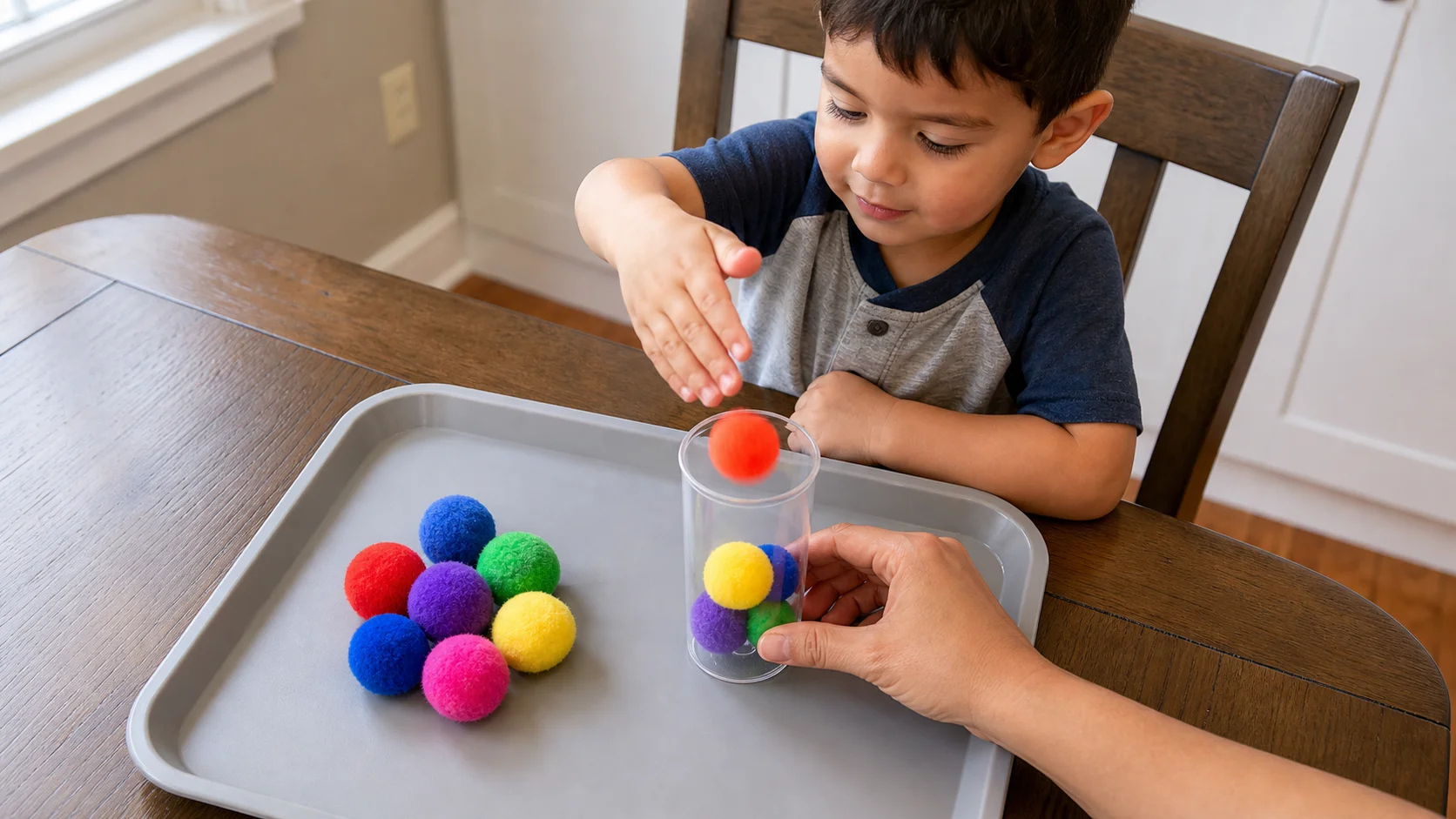
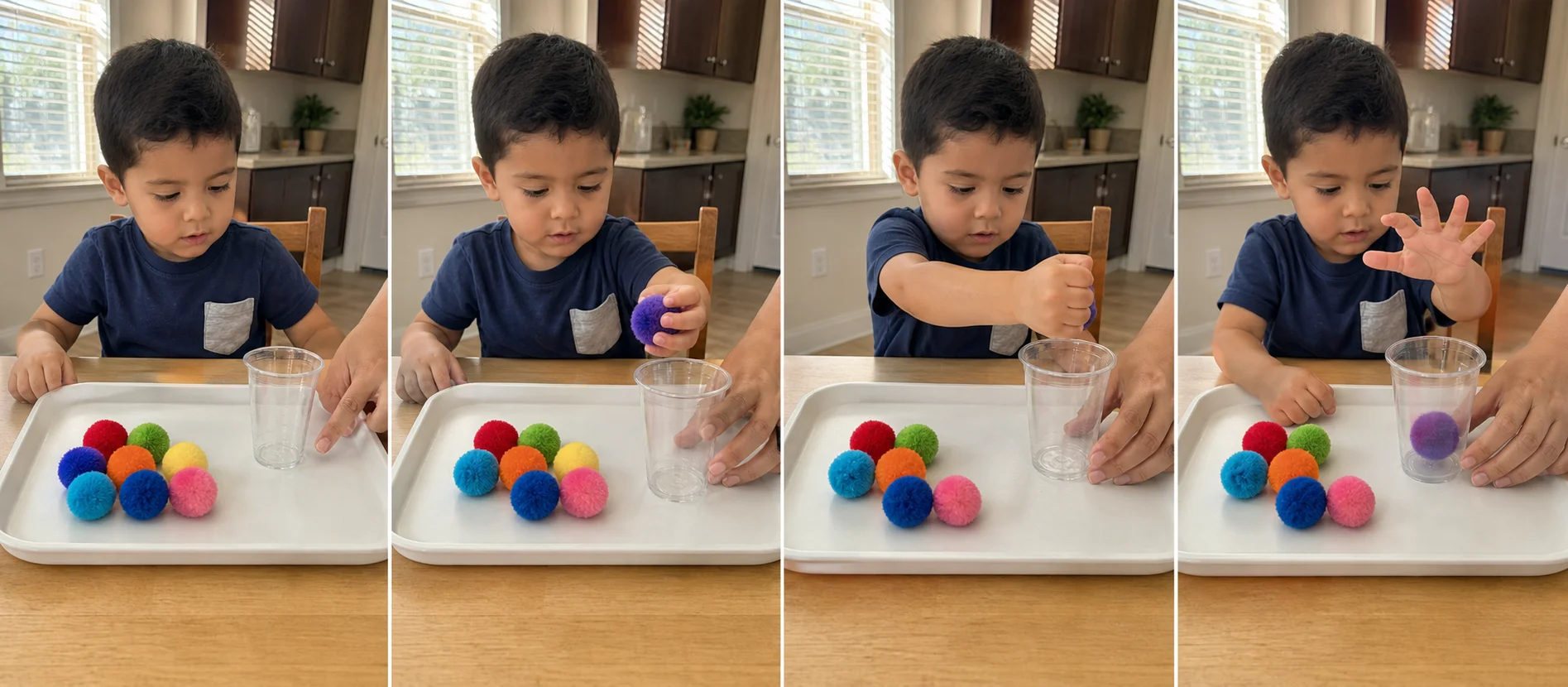
Toddler dropping a large soft pom-pom from a cupped palm into a plastic cup on a tray
Fine motorOT-adjacent supportRelease To TargetIndoor

Palm Pocket Drop.

Hide one soft piece in a palm pocket, carry it to a cup, drop it in, and reset.
Play time
3-5+ min
Age
3-4 years
Energy
Low
Mess
Low
Effort
Low
Where
Indoor
Start here

The recipe.

Low parent effort
5 things

What you need

  • 6 to 10 large pom-poms or crumpled paper balls
  • 1 narrow non-breakable plastic cup or jar
  • 1 small tray or clear table spot
  • 1 adult
  • 1 child
3 min minimum

Setup

Then start the loop
Step 01
On a small tray or clear table spot at your child's seated or standing hand height, leave room for the pile and cup.
Step 02
On the tray or table, place the large pom-poms or paper balls in one small pile in front of your child.
Step 03
Beside the pile, place the narrow non-breakable cup or jar with the opening facing your child.
Step 04
Check that the cup opening lets only one soft piece drop in at a time.
Step 05
Beside your child, sit close enough to steady the cup or cover the pile if needed.
"Pocket hand."
The loop

How play unfolds.

Panels showing a child picking up a soft piece, hiding it in a palm pocket, carrying it over a cup, dropping it in, and emptying the cup to repeat
  1. 01
    Pick up one soft piece, curl your fingers around it, and say, "Watch my hand pocket."
  2. 02
    Move your closed hand over the cup, open your fingers, and let the piece drop in.
  3. 03
    Let your child pick up one piece, tuck it into a cupped palm, and carry that hand over the cup.
  4. 04
    If the piece falls early, put it back on the tray and bring the cup closer for the next try.
  5. 05
    Add a second piece only after one-piece drops work. If two pieces ride in the pocket, drop them into the cup one at a time.
  6. 06
    Empty the cup back onto the tray after each round and repeat.

Safety Check

  • Use large pieces that cannot fit fully in your child's mouth. If a piece looks questionable, make a bigger paper ball instead.
  • Use a non-breakable cup or jar only.
  • Stay close. Stop and reset if pieces go in the mouth, get torn, get thrown, or scatter off the tray.
  • Skip fuzzy pom-poms if the texture is distracting, unpleasant, or likely to become a mouthing risk.
Supporting the play

What to say in the moment

Match what you say to what you see.

Prompt ladder
Level 1 (Start)
"Make your hand a pocket."
Level 2 (Keep going)
"Hide one piece, then drop it."
Level 3 (Stretch)
"Keep the pocket closed until it is over the cup."
Level 4 (Extend)
"Can your pocket carry two pieces?"
If your child seems...
What you'd see
Focused
What to do
Say
"Your pocket is working."
Add
Ask for one slow drop before the next reset.
Extend
Move the cup a little farther across the tray for the next round.

Make it easier

Younger end
  • -Hold the cup still so your child only has to control the hand.
  • -Place the cup directly under the cupped hand before asking for the drop.
  • -Use the hand your child already reaches with instead of asking for a switch.

Make it harder

Older end
  • +Ask for two hidden pieces before the drop.
  • +Pause with the closed palm over the cup before opening.
  • +Use the other hand for one full round after the favorite hand succeeds.

If it's not working

If you see
If child ignores it
Do one slow model turn, place one piece near their favorite hand, and pause with the cup open.
If you see
If child misuses it
If pieces go in the mouth, get torn, or get thrown, take the pieces back, say "Pieces stay on the tray," and restart with one large paper ball.
If you see
If child gets frustrated
Let them drop from fingertips first, then try the palm pocket again for just one piece.
Skill spotlight
Release Control

Controlled hand release

This helps a child control when the hand holds on and when it lets go, which matters for utensils, dressing, cleanup, and tabletop play.

  • Cupping one soft piece gives your child practice holding on while the hand moves.
  • Dropping over a narrow cup makes the release point clear: open over the target, then reset.
  • Emptying the cup after each round keeps mistakes low pressure because every dropped piece can try again.
Real-world transfer
  • Dropping small items into a container during cleanup
  • Letting go of food, clothing, or tools at the right spot
  • Holding something in one hand while moving it across a table
  • Using the same hand for a short sequence without rushing

Parent questions