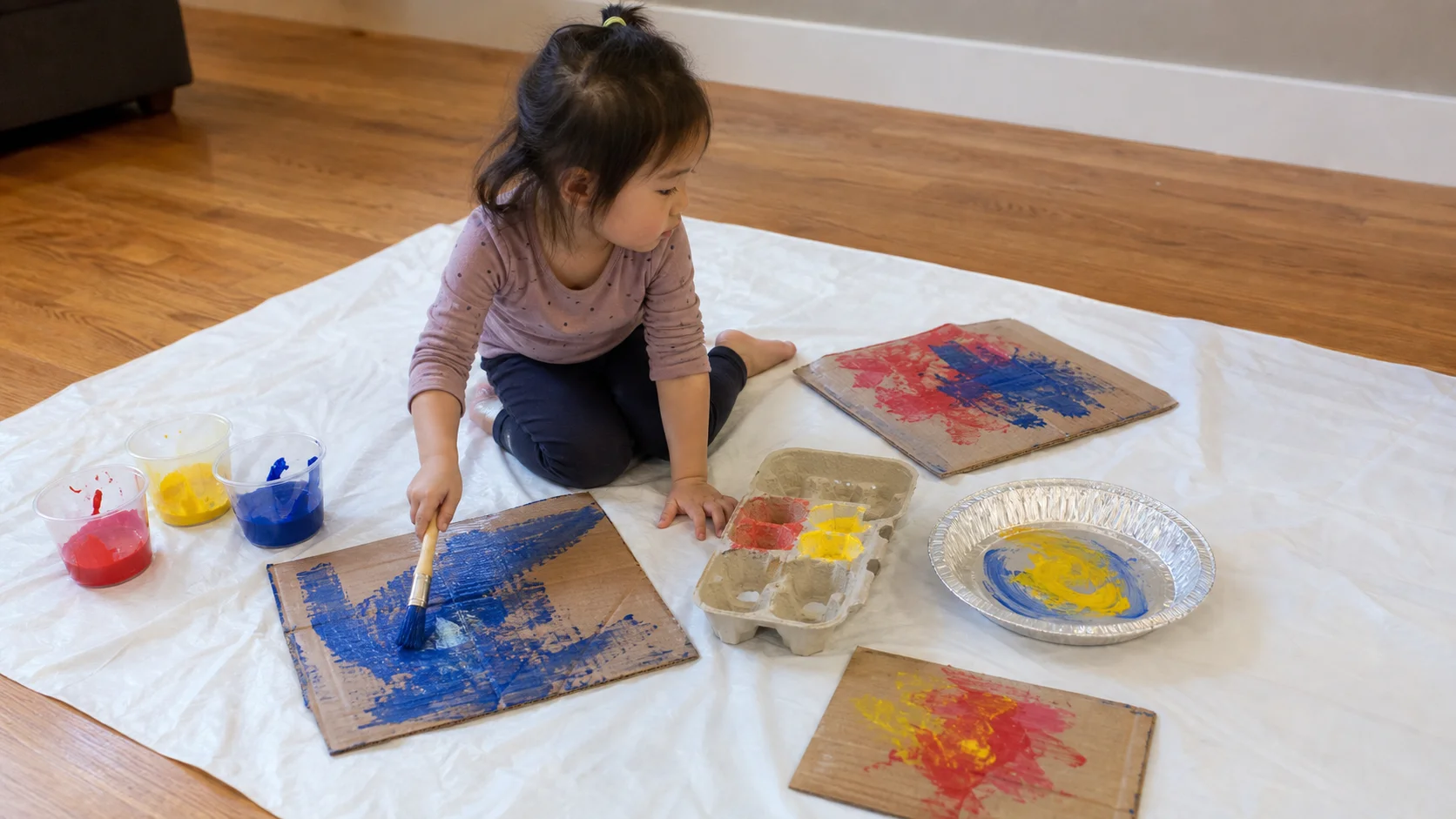
A child paints clean cardboard and egg cartons on a floor tarp with washable paint while a grown-up keeps extra recycled pieces nearby.
Fine motorPlace With ControlIndoor Tarp Covered Floor Or Washable Art Space

Paint the Trash.

Spread clean recycling across a tarp and let your child paint, turn, and swap pieces in one long open-ended art round.

Play time
30-45+ min
Age
2-5 years
Energy
Low
Mess
High
Effort
Medium
Where
Indoor Tarp Covered Floor Or Washable Art Space
Start here

The recipe.

Medium parent effort
8 things

What you need

  • 1 shower curtain liner or washable toddler tarp
  • Washable tempera paint
  • No-spill paint containers or small paint cups
  • 1 or more paintbrushes
  • Several clean recycled pieces, such as cardboard packaging, empty egg cartons, or disposable pie tins
  • Nearby cleanup plan for painty hands and surfaces
  • 1 adult for setup and supervision
  • 1 child
30 min minimum

Setup

Then start the loop
Step 01
On the floor, spread the shower curtain liner or washable tarp flat to define the paint zone.
Step 02
Across the tarp, scatter the clean recycled pieces in 1 loose layer so your child can reach more than one dry surface.
Step 03
On 1 edge of the tarp, set the washable paint containers and paintbrush where your child can reach them without leaning over wet pieces.
Step 04
Beside the play space, keep your cleanup plan ready for painty hands, wet recycling, and the tarp.
Step 05
At the edge or middle of the tarp, seat or stand your child close enough to reach both the paint and several recycled pieces.
"Brush on."
The loop

How play unfolds.

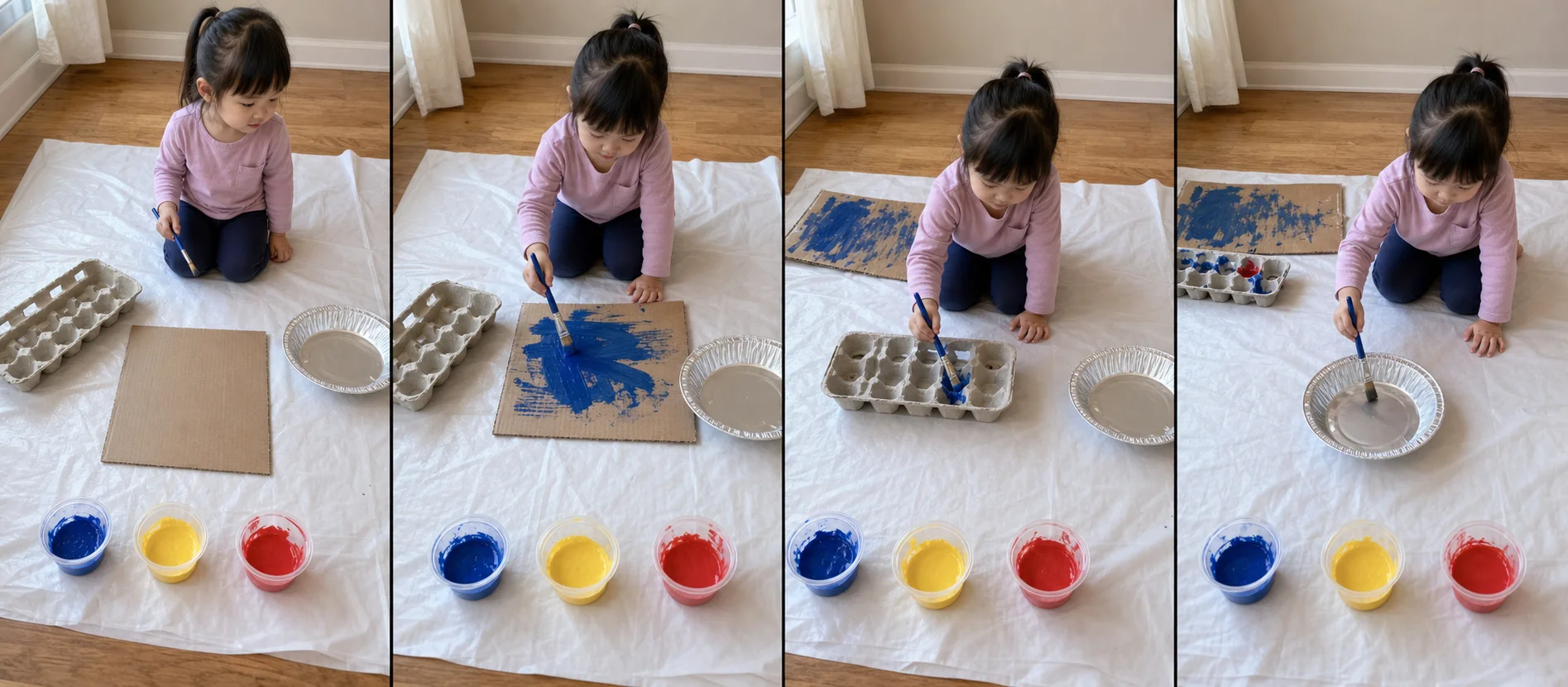
A step-by-step play sequence showing clean recycled pieces spread on a tarp, a child painting one piece, turning it to a new side, and sliding wet pieces to the edge.
  1. 01
    Hand your child the paintbrush, slide over a dry recycled piece, and say, "You can paint this trash any way you want."
  2. 02
    Let your child paint that piece, then turn it or swap in a new one when a fresh side is needed.
  3. 03
    Slide wet pieces to the tarp edge and pull a dry piece forward so the painting space stays open.
  4. 04
    Keep the paint-turn-switch loop going until most easy-to-reach pieces are painted, the paint is nearly gone, or your child is ready to stop.

Safety Check

  • Check every recycled piece before play so your child does not handle anything dirty, sharp, or too flimsy to paint safely.
  • Stay close and supervise the whole time because the activity uses paint, loose recycled objects, and a messy cleanup transition.
Supporting the play

What to say in the moment

Match what you say to what you see.

Prompt ladder
Level 1 (Start)
Paint this piece anywhere you want.
Level 2 (Keep going)
Turn it and find a dry side.
Level 3 (Stretch)
Pick a bumpy one or a flat one next.
Level 4 (Extend)
Make a row of finished pieces along the tarp edge.
If your child seems...
What you'd see
Focused
What to do
Say
"You found a new spot."
Add
Slide 1 different texture closer without interrupting the brush movement.
Extend
Invite 1 quick choice between 2 nearby pieces.

Make it easier

Younger end
  • -Start with the largest, flattest piece so the brush has an easy target.
  • -Hold lightweight cardboard still while your child paints across it.
  • -Place the next dry piece directly beside the brush hand so switching takes no search.

Make it harder

Older end
  • +Ask your child to paint the inside, outside, or edge of the same piece.
  • +Offer 2 recycled textures and let your child choose which one gets paint next.
  • +Make a simple finished pile by moving painted pieces to 1 side of the tarp.

If it's not working

If you see
If child ignores it
Make 2 quick brush strokes on 1 piece, say, "Your turn to add some paint," and hand the brush right back.
If you see
If child misuses it
If your child starts dumping paint or banging wet pieces together, pull the setup back to 2 or 3 sturdy pieces and 1 paint cup, then restart with a simple paint-one-piece, turn-it, paint-again round.
If you see
If child gets frustrated
If the paint tips, runs low, or every nearby piece is already wet, pause, reset the cup, slide a fresh dry piece forward, and say, "This one is ready."
Skill spotlight
Brush Control

Brush control with a real surface.

This helps your child steady a small tool, aim hand movement at a visible surface, and stay with a simple work loop. Those same hand skills show up in coloring, self-feeding, helping, and cleanup jobs.

  • Turning or swapping each piece gives the brush a fresh target and keeps the hand-control practice going.
  • The open-ended loop lets your child stay with one simple art job without needing constant new directions.
  • Flat, bumpy, and curved recycled surfaces ask your child to adjust the brush in small visible ways.
Real-world transfer
  • Using crayons, markers, brushes, and utensils with steadier hands
  • Noticing where a hand tool touches a surface
  • Keeping a simple art or cleanup job going for several turns