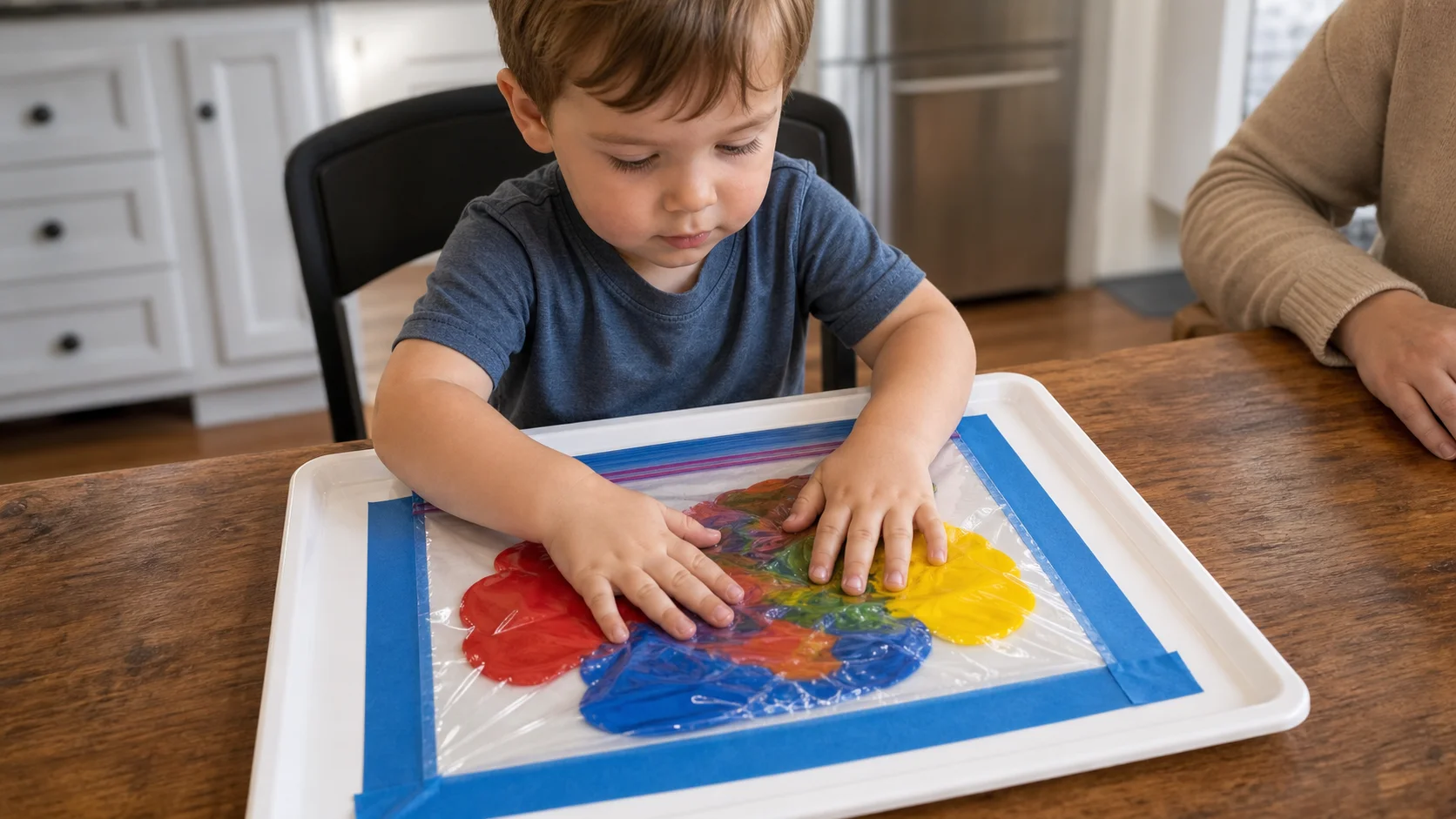
A toddler presses both hands on a sealed paint bag filled with bright colors while a grown-up stays close at the table.
ThinkingSensory-friendly supportAction ResultIndoor

Paint Bag Color Mix.

Let your toddler make colors change with their own hands while the paint stays contained. They press and swirl two or three colors through a sealed freezer bag, watching the colors meet and blend while practicing hand coordination and cause and effect.

Play time
5-10+ min
Age
1-5 years
Energy
Low
Mess
Low
Effort
Low
Where
Indoor
Start here

The recipe.

Low parent effort
4 things

What you need

  • 1 zip-lock plastic freezer bag
  • 2 to 3 paint colors
  • Tape
  • 1 flat washable table, tray, or high-chair surface
5 min minimum

Setup

Then start the loop
Step 01
Squeeze 2 or 3 paint colors into separate spots inside 1 zip-lock freezer bag.
Step 02
Zip the bag shut, then press the paint outward so it spreads while the colors remain separate.
Step 03
Tape the outside edges of the bag, then lay it flat on a washable surface.
"Push here."
The loop

How play unfolds.

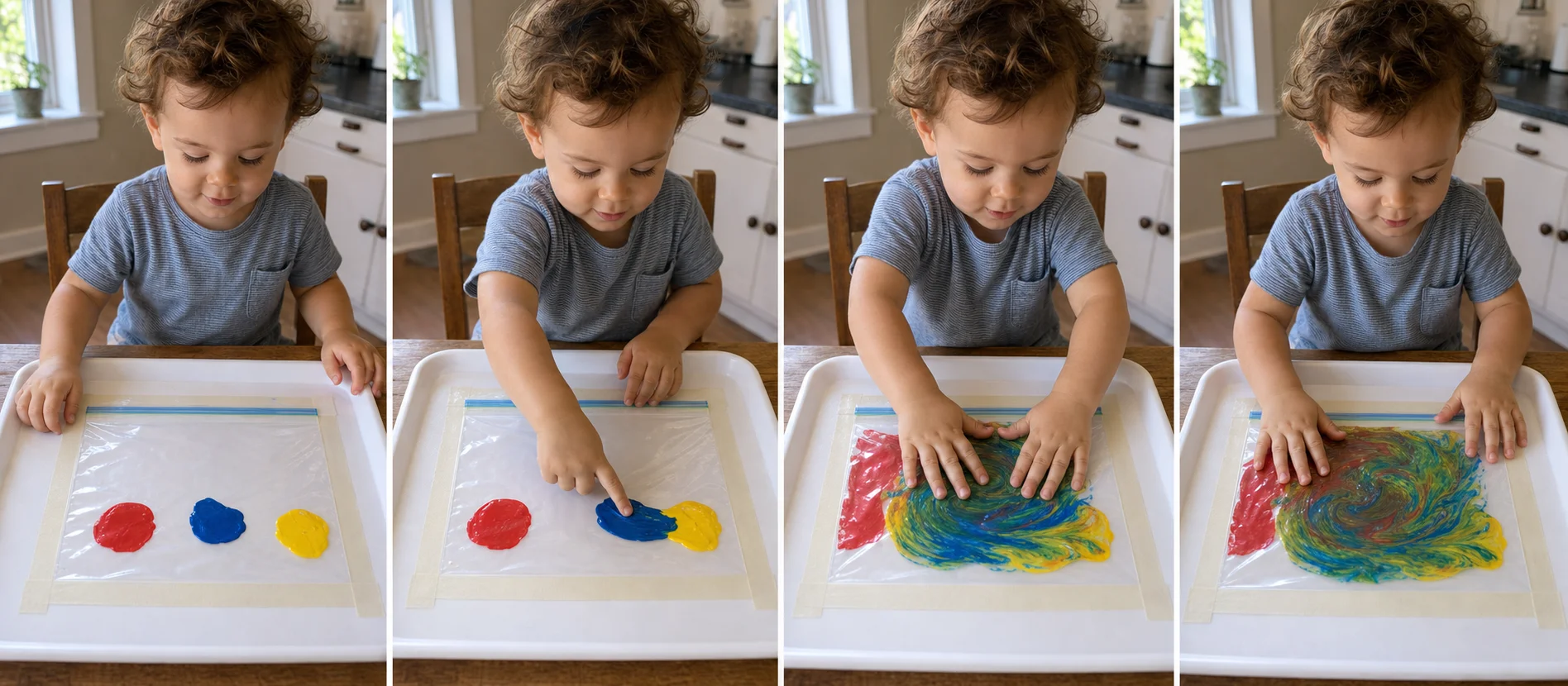
A multi-panel sequence showing a grown-up putting paint into a freezer bag, taping the sealed bag flat, a toddler pressing the colors together, and the mixed paint spread across the bag.
  1. 01
    Have your child press one paint color toward another through the sealed bag.
  2. 02
    Let them pat or swirl the bag until the colors meet and begin to blend.
  3. 03
    Pause to watch the color change, then move to another separate spot and repeat until the paint is mostly mixed.

Safety Check

  • Stay with your child the whole time.
  • Hand over the bag only after the zipper is shut and the outside edges feel secure.
  • Stop right away if the bag leaks, tears, opens, or becomes a chewing target.
  • Keep the bag lightly filled so the seams and zipper are not under strong pressure.
Skill spotlight
Action Result

Noticing that one hand action changes what the child sees right away

This helps a child connect hand movement to a clear result, which supports early problem solving, visual attention, and more controlled hand use during table play.

  • The sealed bag gives your child a clear hand action and a fast visible result.
  • The color shift makes it easy for your child to want another turn.
  • The contained setup lowers the sensory load for children who are curious about paint but not ready for it on bare hands.
Real-world transfer
  • Learning that hand actions can change what happens on purpose
  • Staying with a short table task long enough to notice the result
Supporting the play

What to say in the moment

Match what you say to what you see.

Prompt ladder
Level 1 (Start)
"Push the blue."
Level 2 (Keep going)
"Make them meet."
Level 3 (Stretch)
"Try a new spot."
Level 4 (Extend)
"Can you fill this corner?"
If your child seems...
What you'd see
Focused
What to do
Say
"You changed it."
Add
Name one color that just moved.
Extend
Invite your child to press from a new side of the bag.

Make it easier

Younger end
  • -Use only 2 paint colors instead of 3.
  • -Keep the bag on a tray or table instead of in the child's lap.
  • -Count one color change as a full turn.

Make it harder

Older end
  • +Ask your child to move one color into an empty corner before switching sides.
  • +Invite your child to use one finger for one short press instead of a whole palm.
  • +Pause after your model and let your child restart the next mix alone.

If it's not working

If you see
If child ignores it
Push one color slowly into another and pause so your child can watch the change.
If you see
If child misuses it
Hold the bag flat, say, "Hands on the bag," and restart with one slow press if your child bangs, chews, or peels at the tape.
If you see
If child gets frustrated
Guide one easy middle press, then stop after that small success if needed.