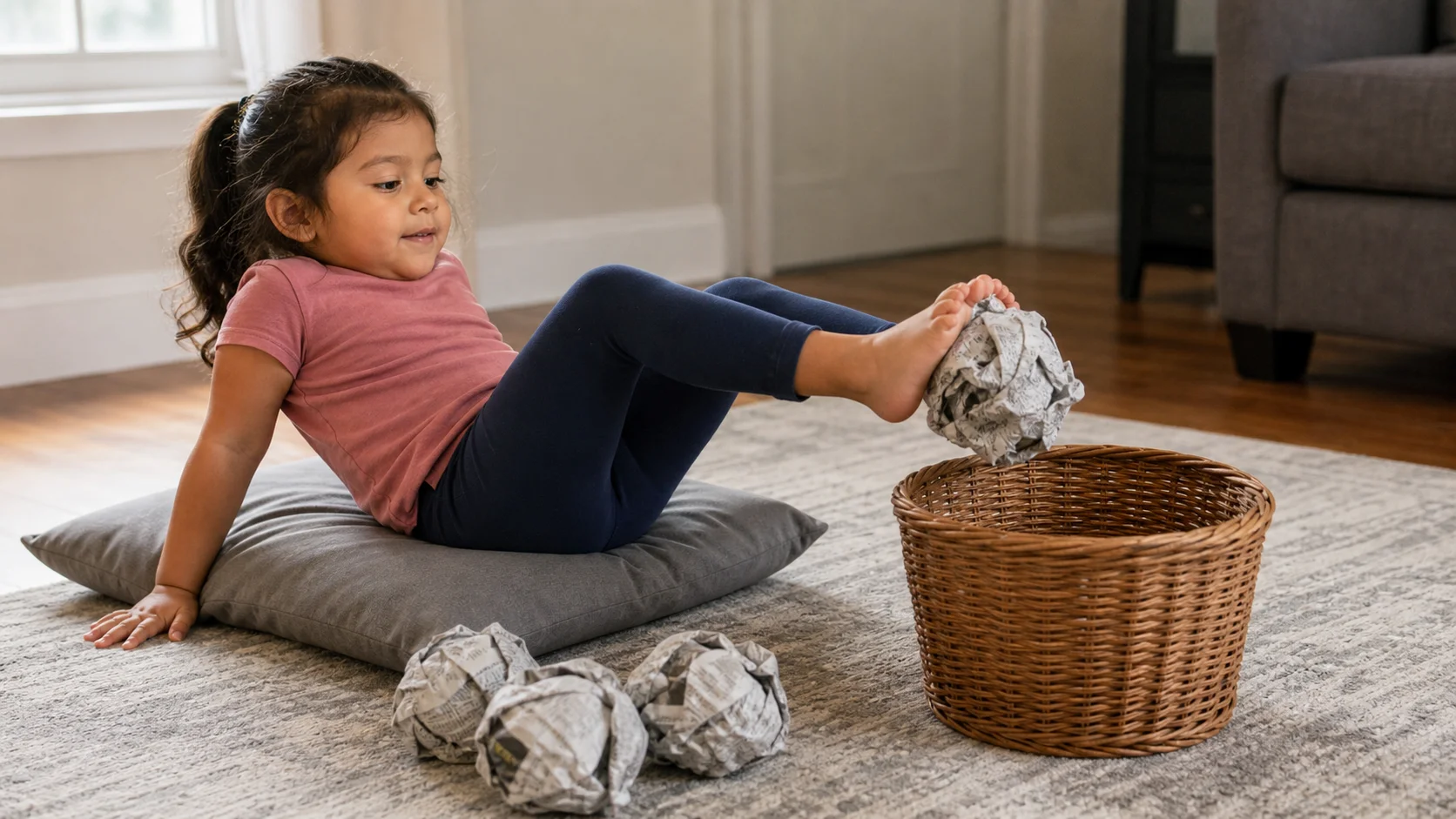
A toddler sits on a floor pillow and lifts a crumpled newspaper ball with both feet toward a basket on the rug.
Fine motorOT-adjacent supportShift WeightIndoor Floor

Newspaper Nest Foot Deliver.

Crumpled newspaper balls become nest eggs preschoolers lift, carry, and drop with their feet.

Play time
5-10+ min
Age
3-5 years
Energy
Medium
Mess
Low
Effort
Low
Where
Indoor Floor
Start here

The recipe.

Low parent effort
6 things

What you need

  • Several sheets of newspaper
  • 1 basket
  • 1 floor pillow
  • 1 rug or non-slippery floor space
  • 1 adult for setup and direct supervision
  • 1 child
5 min minimum

Setup

Then start the loop
Step 01
On the rug or non-slippery floor, clear a play space away from sharp furniture corners.
Step 02
In that space, crumple several sheets of newspaper into large, loose balls.
Step 03
At one end of the rug, place the basket where it will not slide.
Step 04
On the rug a few feet from the basket, place the pillow facing the basket.
Step 05
Between the pillow and basket, put the newspaper balls in one small pile close enough that your child can touch one with both feet.
Step 06
On the pillow, seat your child facing the basket and check that they can lean back with hands braced behind them.
"Feet pinch one nest."
The loop

How play unfolds.

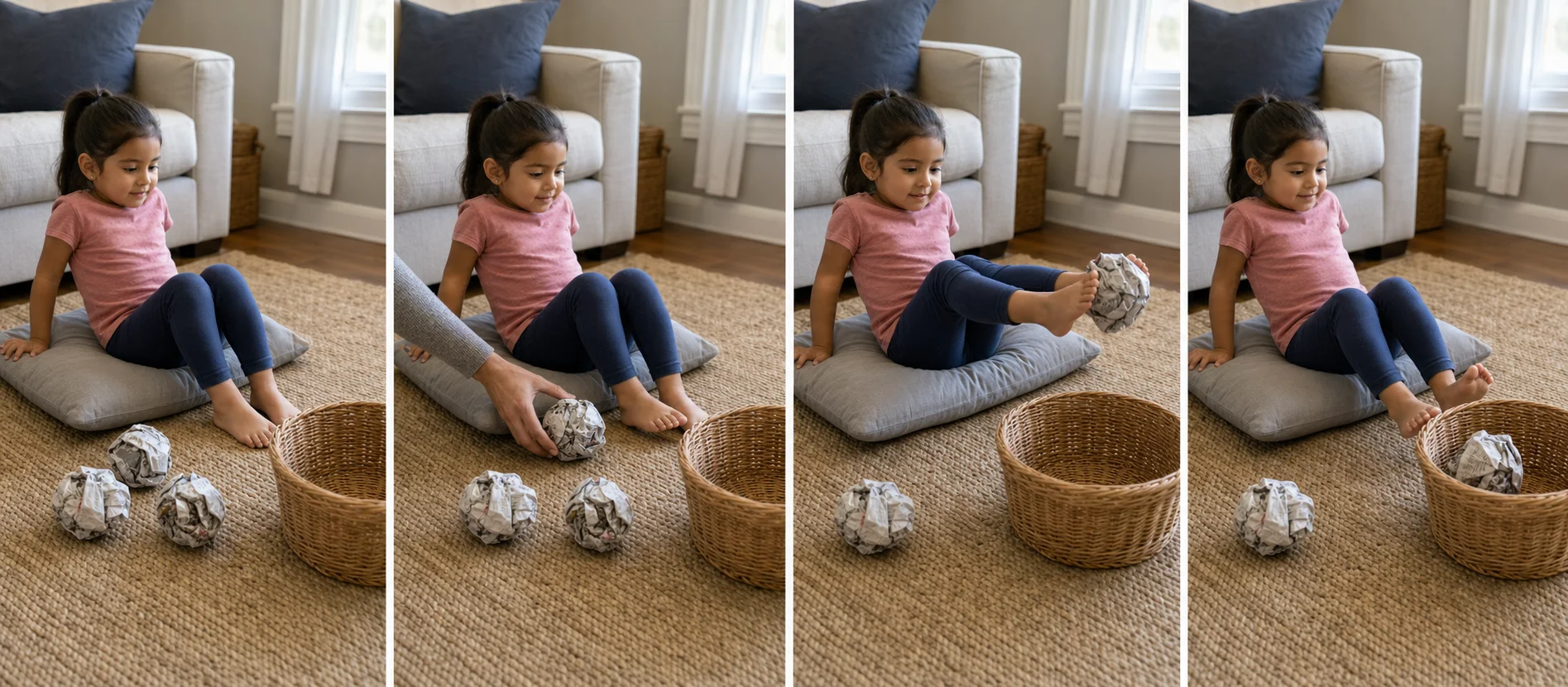
Four panels show a grown-up crumpling newspaper, a child seated on a pillow with hands braced, the child lifting a newspaper ball with both feet, and the ball dropping into a basket.
  1. 01
    Put 1 newspaper nest at your child's feet, show 1 slow lift, and say, "Hands stay back. Can your feet deliver the nest to the basket?"
  2. 02
    Let your child brace with hands behind them, pinch the nest with both feet, lift it, and drop it into the basket.
  3. 03
    If the nest misses, slide the same one back to the start spot. If it lands, slide the next nest into reach.
  4. 04
    Repeat until the pile is done or your child is finished.

Safety Check

  • Use a rug or other non-slippery floor.
  • Clear sharp furniture corners from your child's lifting path.
  • Stay close and supervise while your child leans back, braces, and lifts both feet.
  • Move the basket closer or stop if your child twists, slides, kicks fast, or cannot stay braced.
Supporting the play

What to say in the moment

Match what you say to what you see.

Prompt ladder
Level 1 (Start)
Put one nest at your child's toes and invite one slow foot delivery.
Level 2 (Keep going)
Slide the next nest close enough for another steady squeeze.
Level 3 (Stretch)
Ask for a quiet drop into the basket without a kick.
Level 4 (Extend)
Let your child choose whether the next nest starts near the left foot or right foot.
If your child seems...
What you'd see
Focused
What to do
Say
"Try one smooth lift."
Add
Count the nest only after it lands.
Extend
Move the next ball a hand-width farther from the basket.

Make it easier

Younger end
  • -Start with the ball touching both feet so your child only has to squeeze and lift.
  • -Use one successful drop as the whole round before adding more balls.
  • -Let your child rest both heels on the floor between turns.

Make it harder

Older end
  • +Place the basket slightly off center so your child has to aim before dropping.
  • +Ask for a silent landing instead of a fast toss.
  • +Have your child reset their feet to the pillow before each new ball.

If it's not working

If you see
If child ignores it
Put 1 ball at their toes, model 1 slow foot lift, and ask, "Can your bird feet deliver one nest?"
If you see
If child misuses it
If hands start grabbing or feet start kicking, reset your child with hands behind them, move the basket closer, and go back to 1 slow lift.
If you see
If child gets frustrated
Use just 2 or 3 balls, bring the basket closer, and celebrate 1 successful drop before deciding whether to keep going.
Skill spotlight
Shift Weight

Balancing while moving an object with feet.

This helps your child feel where their body is while they use both sides together, which matters for dressing, floor play, and careful movement around the house.

  • Pinching one loose nest with both feet helps your child use both sides together while staying seated and steady.
  • The squeeze, lift, drop, reset loop gives clear practice controlling force instead of kicking fast or flinging the nest.
  • One nest at a time makes misses easy to retry, which supports sticking with the game after a drop.
Real-world transfer
  • Sitting steady during shoes, socks, or pants
  • Noticing where feet are during floor play
  • Moving with more control instead of flinging or kicking
  • Helping with cleanup by carrying one item to one spot

Parent questions