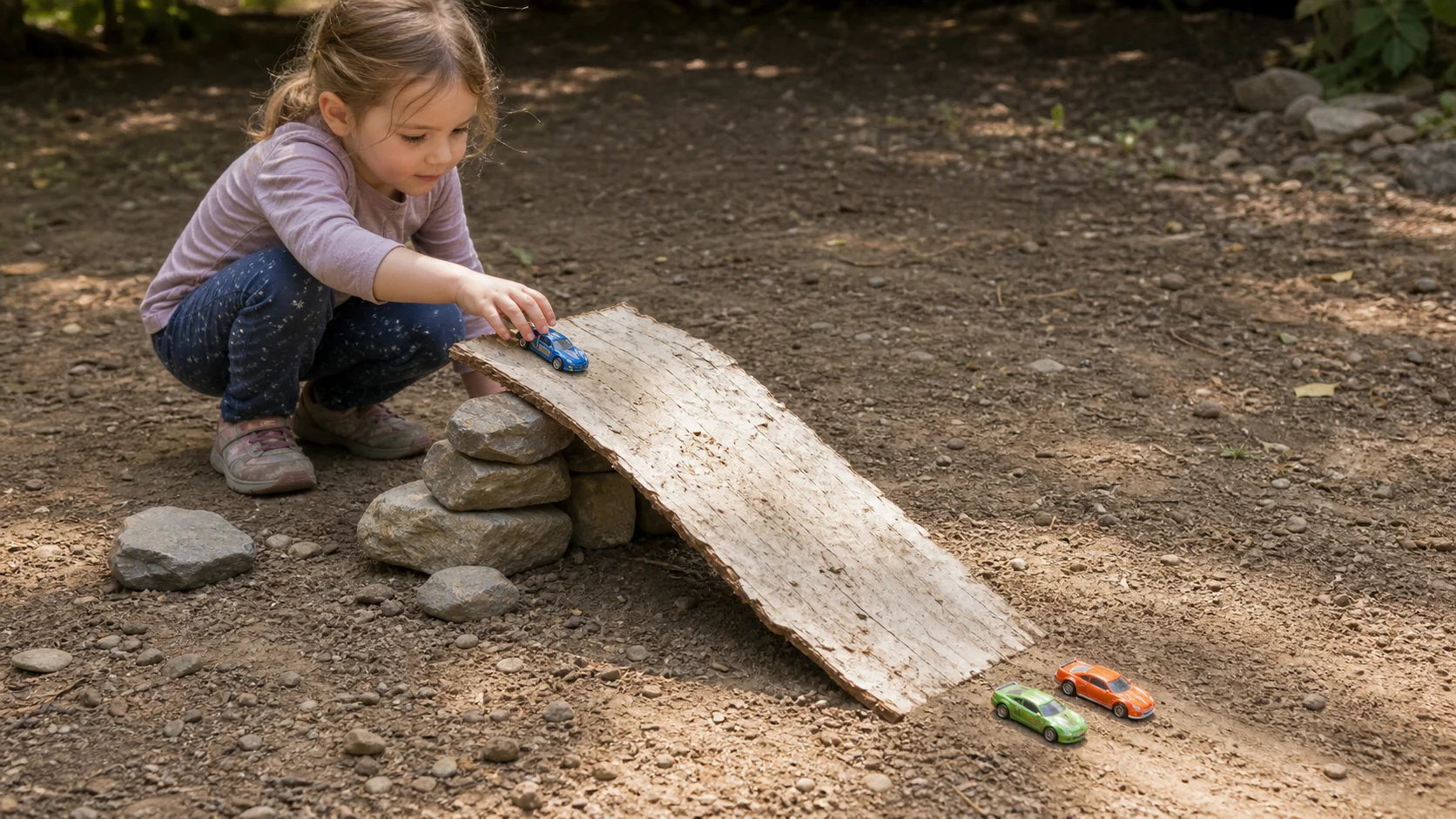
A toddler kneels outdoors beside a low bark ramp propped on a rock and sends a toy car down the path.
ThinkingTest And CompareOutdoor

Nature Ramps.

A toy car and found nature pieces become a simple outdoor ramp your child can build, test, and rebuild.

Play time
10-20+ min
Age
3-5 years
Energy
Medium
Mess
Low
Effort
Low
Where
Outdoor
Start here

The recipe.

Low parent effort
6 things

What you need

  • 1 or more toy cars or small trucks
  • 1 or more flat pieces of bark, wood, or sturdy sticks for ramp surfaces
  • 2 or more rocks, roots, or stumps for ramp supports
  • Optional leaves, twigs, or sticks for rails, finish lines, or obstacles
  • 1 clear outdoor ground spot or gentle slope
  • 1 adult for supervision
10 min minimum

Setup

Then start the loop
Step 01
On clear outdoor ground or a gentle slope, choose an open roll-out path away from feet, drop-offs, and people.
Step 02
Lean 1 flat bark or wood piece or 1 sturdy stick on 1 rock, root, or stump to make a low ramp.
Step 03
Press the ramp once and lower or reposition it if it slides, wobbles, or drops the car off the side.
Step 04
Put 1 toy car at the top and keep extra sticks, leaves, twigs, rocks, or flat pieces nearby for later changes.
"Ready, roll."
The loop

How play unfolds.

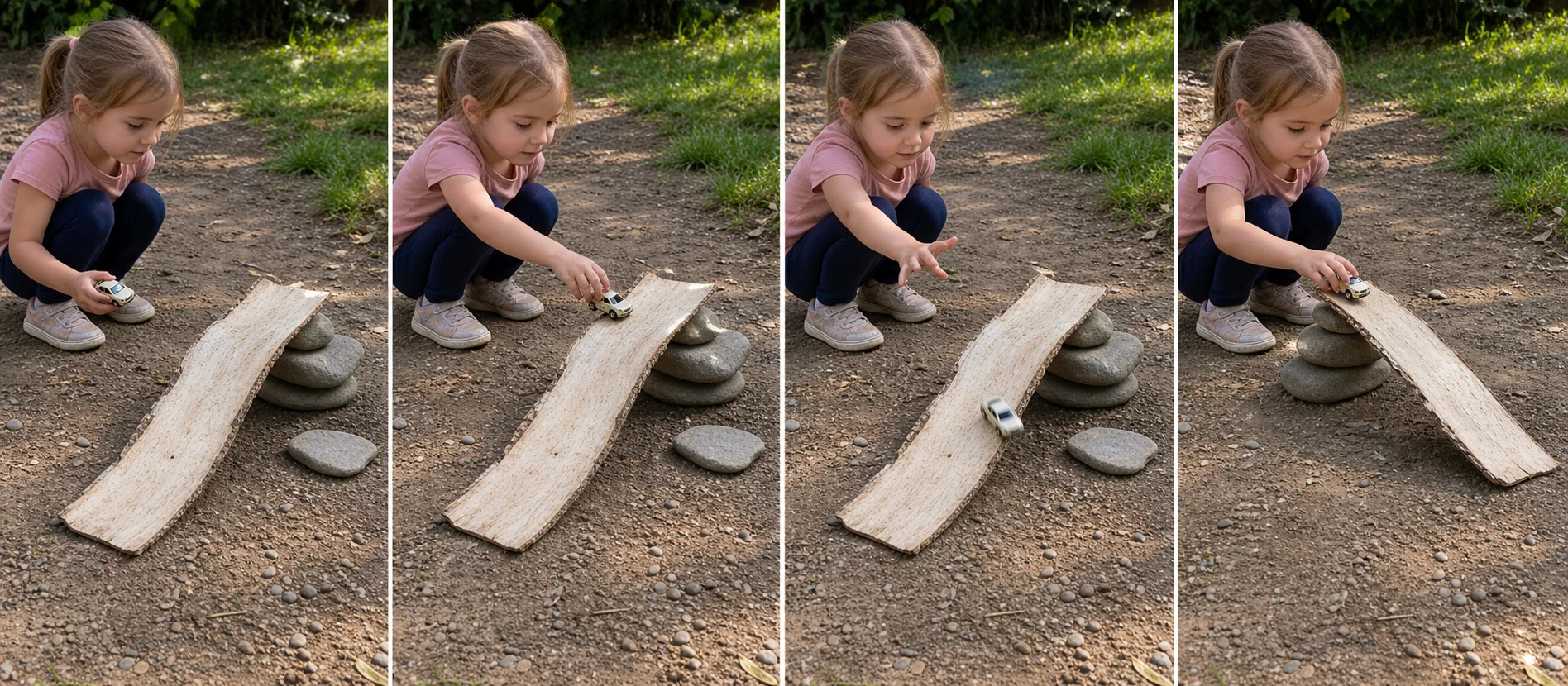
Four panels showing a grown-up propping bark on a rock, a child placing a toy car at the top, the car rolling down, and the ramp rebuilt for another test.
  1. 01
    Roll 1 car down the ramp yourself, leave it where it stops, and say, "Let's see what this ramp does. Can you send the car again?"
  2. 02
    Let your child put the car back at the top and send it down the ramp.
  3. 03
    Notice what happened, change 1 thing, such as the angle, support, surface, or a twig finish line, and test the same car again.
  4. 04
    Keep the build, roll, compare, and rebuild loop going until your child is done.

Safety Check

  • Supervise the whole activity.
  • Keep the ramp low and stable so bark, boards, rocks, or sticks do not slide onto your child.
  • Watch small toy cars and loose natural items closely around younger toddlers or nearby mouthing siblings.
  • Choose a clear roll-out path because outdoor roots, rocks, stumps, and uneven ground add trip risk.
Supporting the play

What to say in the moment

Match what you say to what you see.

Prompt ladder
Level 1 (Start)
Send 1 car down and watch where it stops.
Level 2 (Keep going)
Change 1 piece and try the same car again.
Level 3 (Stretch)
Make the car go a little farther this time.
Level 4 (Extend)
Build a second ramp and choose the smoother ride.
If your child seems...
What you'd see
Focused
What to do
Say
"What changed?"
Add
Invite 1 simple comparison after the car stops.
Extend
Ask your child to choose the next angle before rolling.

Make it easier

Younger end
  • -Start with 1 car and 1 ramp surface only.
  • -Let your child release the car while the adult handles the ramp support.
  • -Use a short roll distance so success happens right away.

Make it harder

Older end
  • +Ask your child to predict near or far before each roll.
  • +Test the same car on 2 ramp surfaces and pick the smoother one.
  • +Add 1 twig finish line after your child has several successful rolls.

If it's not working

If you see
If child ignores it
Make the first ramp tiny and obvious, do 1 quick roll yourself, and invite 1 more try right away.
If you see
If child misuses it
If rocks, sticks, or cars are being thrown, pause the activity and switch to rolling only on the ground until hands are calm.
If you see
If child gets frustrated
Lower the ramp, use the smoothest flat piece you can find, and make the goal 1 easy roll before rebuilding.
Skill spotlight
Test And Compare

Testing and adjusting a ramp

This builds cause-and-effect thinking your child can use when a block tower falls, a toy gets stuck, or a plan needs 1 small fix.

  • Changing one part of the ramp at a time helps your child see what made the car go farther, slower, or sideways.
  • Watching the same car on a rebuilt ramp gives clear compare-and-try-again practice.
  • Rebuilding after a crash turns a miss into a simple fix instead of a dead end.
Real-world transfer
  • Noticing how a choice changes what happens.
  • Comparing which setup worked better.
  • Making small fixes when something falls, sticks, or misses.
  • Trying again after a result was not what they wanted.

Parent questions