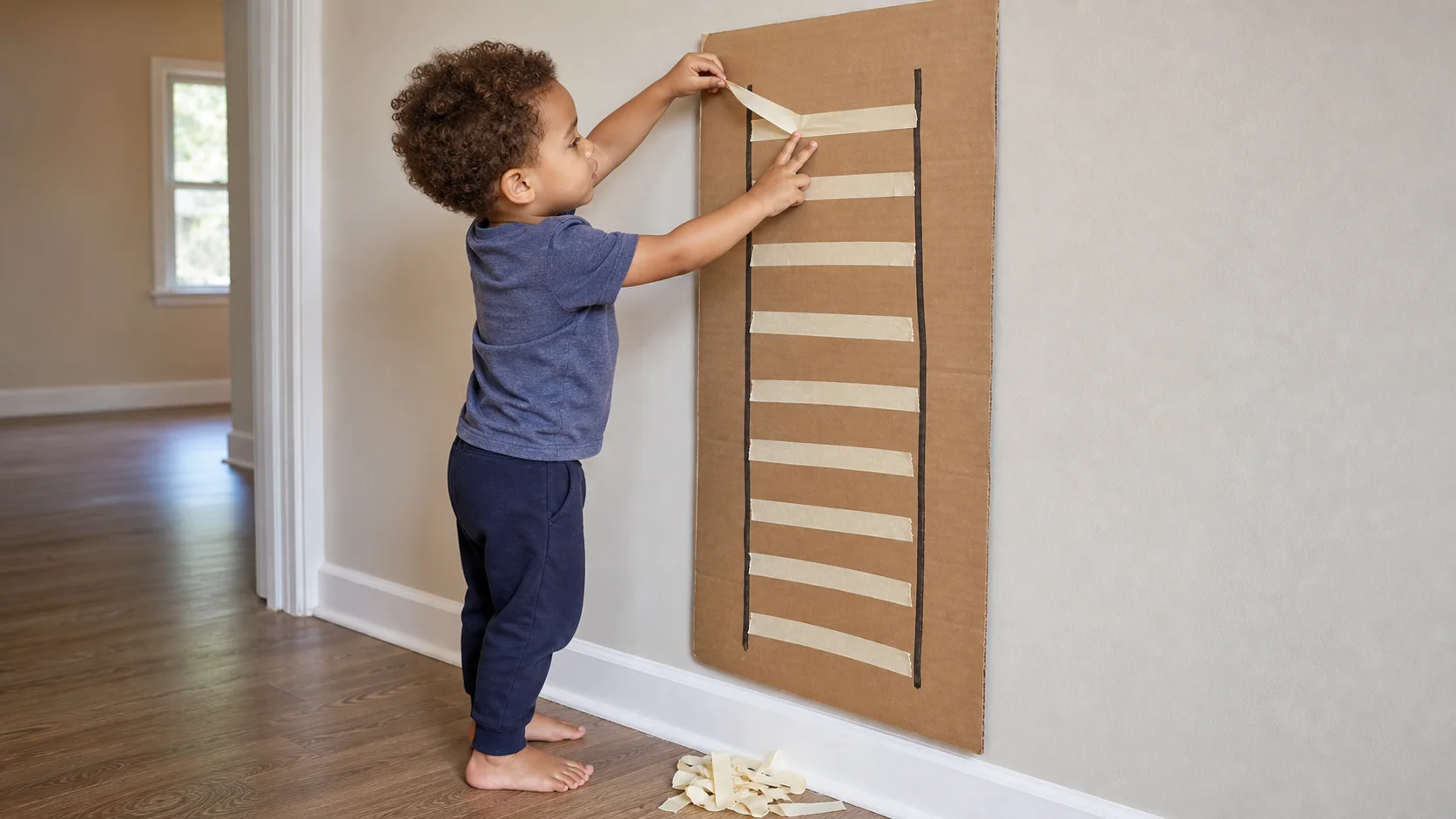
A preschool child peeling the top masking-tape rung from a cardboard ladder on the wall.
Fine motorOT-adjacent supportPeel And PressIndoor Wall Space

Masking Tape Finger Ladder.

Your child walks two fingers up a cardboard ladder, peels off the top tape rung, and repeats until the ladder is empty.

Play time
5-10+ min
Age
3-5 years
Energy
Low To Medium
Mess
Low
Effort
Medium
Where
Indoor Wall Space
Start here

The recipe.

Medium parent effort
7 things

What you need

  • 1 large piece of cardboard
  • 1 marker
  • 10 short strips of masking tape
  • 1 pair of scissors
  • 1 open wall space
  • 1 grown-up for setup and close supervision
  • 1 child
5 min minimum

Setup

Then start the loop
Step 01
On an open wall, tape the cardboard vertically at your child's eye level so it does not flap when tape is pulled.
Step 02
On the cardboard, draw 2 long marker lines like ladder sides.
Step 03
With the scissors, cut 10 short strips of masking tape.
Step 04
Between the 2 marker lines, press the tape strips across the cardboard as ladder rungs. Leave one tiny loose corner on each rung if your child needs help starting the peel.
Step 05
In front of the ladder, position your child close enough to reach the top rung with a straight or slightly bent arm.
Step 06
Away from the play area, put the scissors out of reach before your child begins.
"Two fingers climb."
The loop

How play unfolds.

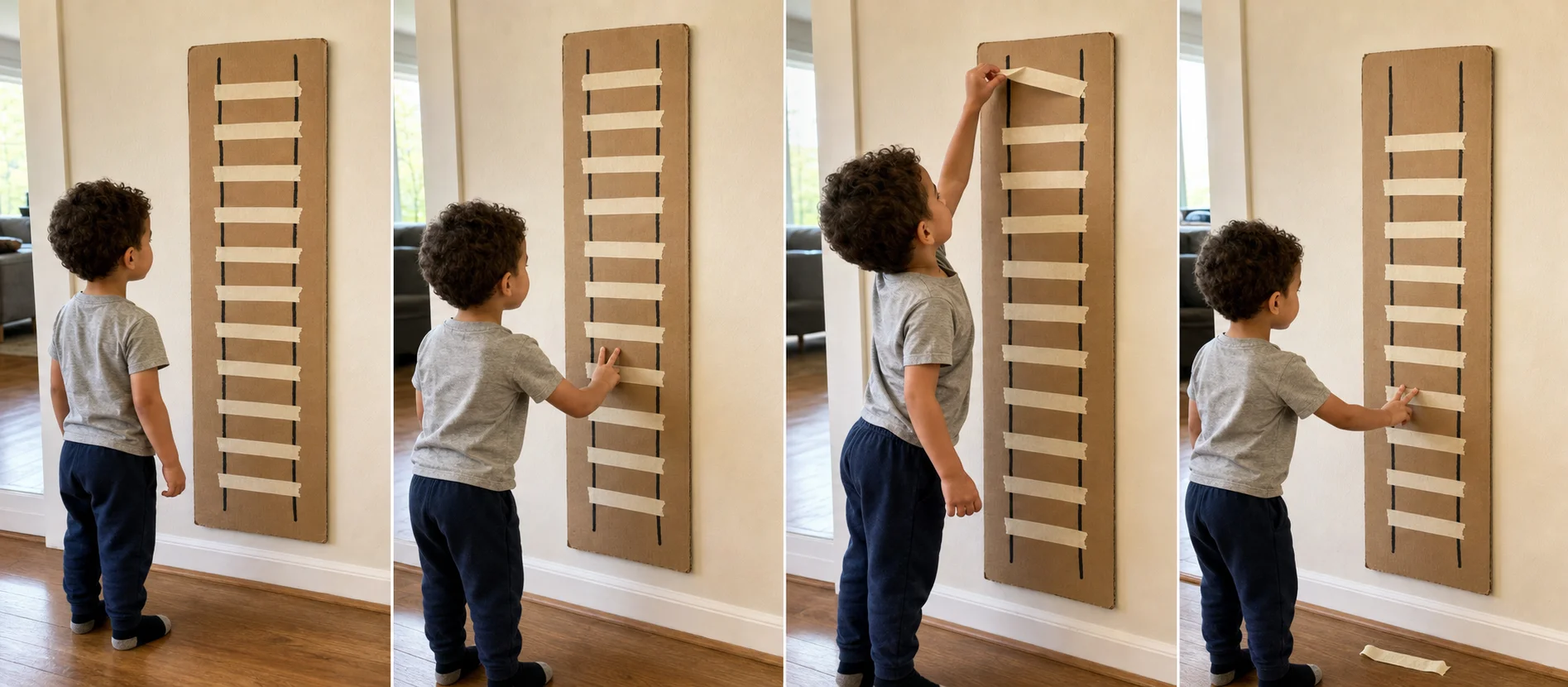
A sequence showing a grown-up modeling two-finger climbing, a child peeling a tape rung, and the tape dropped into a floor pile.
  1. 01
    Show two fingers walking up the ladder and say, "Walk, pinch, peel."
  2. 02
    Let your child walk two fingers toward the highest remaining tape rung.
  3. 03
    Have your child pinch that rung and peel it off, lifting one corner first if needed.
  4. 04
    Drop the peeled tape into the floor pile, start lower again, and repeat until the ladder is empty or your child is done.

Safety Check

  • Stay within arm's reach and supervise the whole time.
  • Keep masking tape away from your child's mouth.
  • Secure the cardboard firmly to the wall before play starts.
  • Lower the ladder if your child has to overreach.
  • Keep the scissors out of the play area after setup.
Supporting the play

What to say in the moment

Match what you say to what you see.

Prompt ladder
Level 1 (Start)
Can two fingers climb from the bottom?
Level 2 (Keep going)
Which tape is highest now?
Level 3 (Stretch)
Can the peel come off slowly?
Level 4 (Extend)
Send your fingers back down for another climb.
If your child seems...
What you'd see
Focused
What to do
Say
"Your fingers are climbing carefully."
Add
"Name the rung as top, middle, or bottom."
Extend
"Ask for one slow peel before the next climb."

Make it easier

Younger end
  • -Start with only the top 2 or 3 rungs so the goal is visible.
  • -Pre-lift one tiny tape corner on each remaining rung.
  • -Let your child climb with one finger while you guide the second finger nearby.

Make it harder

Older end
  • +Ask for quiet finger steps all the way from the bottom before each peel.
  • +Have your child peel without pulling the cardboard forward.
  • +Invite your child to keep the peeled rungs in one neat floor pile.

If it's not working

If you see
If child ignores it
Do one exaggerated finger walk yourself and peel the first rung, then invite your child to peel the next one.
If you see
If child misuses it
If tape goes near the mouth or the cardboard gets pulled hard, pause, move the tape pile away, and restart with one hand holding the cardboard steady.
If you see
If child gets frustrated
Start at the rung just below the top, lift one tape corner, and count down "pinch, pull, drop" for one success.
Skill spotlight
Peel And Press

Pinch-and-peel finger control

This helps your child use separate fingers, pinch and pull with control, and stay with a small hand task until it is finished.

  • The two-finger climb gives your child a visible path for using fingers separately.
  • Pinching and peeling the tape adds a small resistance challenge without much mess.
  • The fixed rungs make the next step and the finish line easy to see.
Real-world transfer
  • Pulling small tabs and stickers
  • Starting clothing fasteners with fingertips
  • Using fingers separately for early drawing and tracing
  • Finishing a short hand task one step at a time

Parent questions