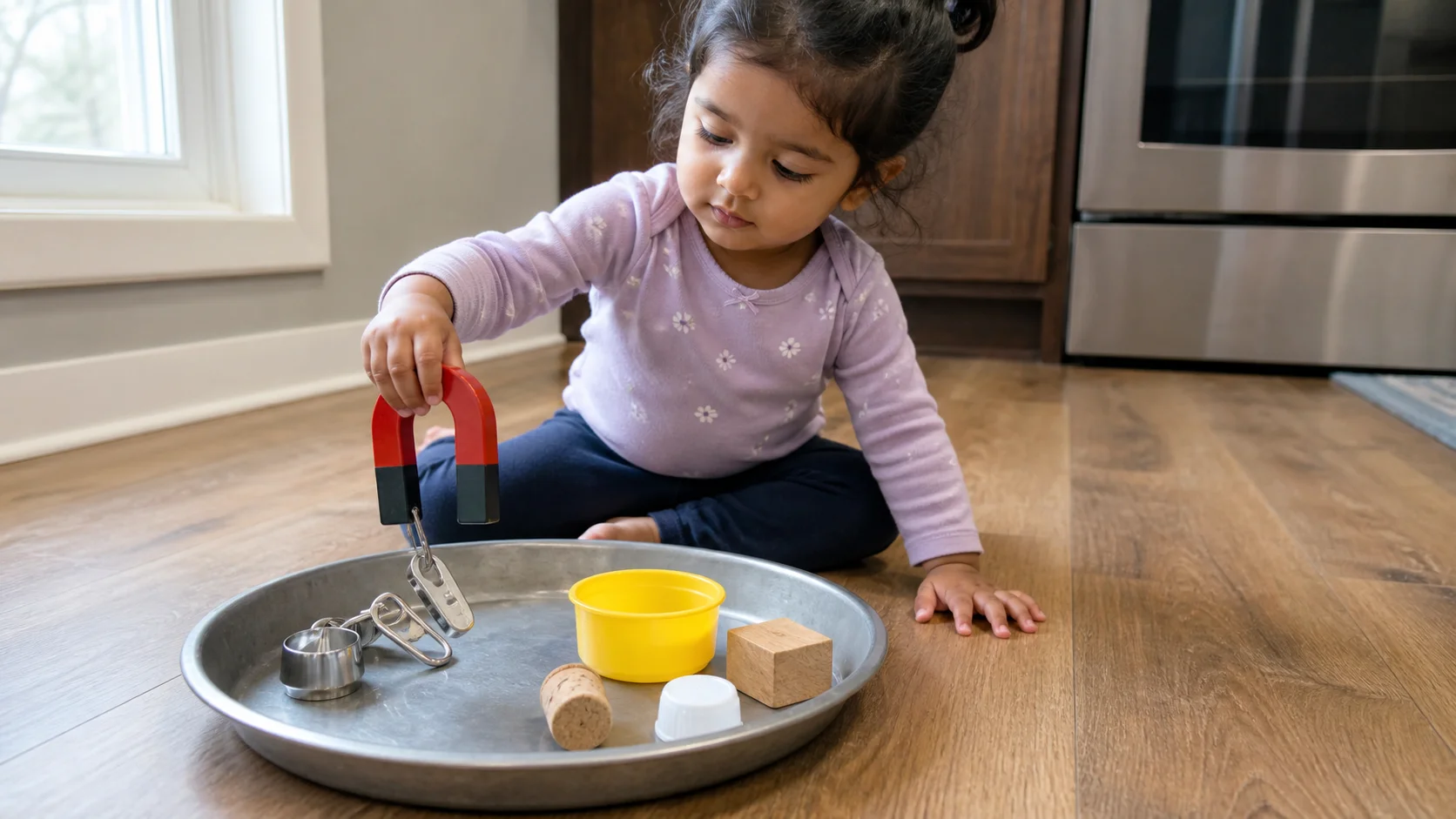
A toddler using a large magnet to lift a safe metal item from a pie pan.
ThinkingTest And Compare`Indoor Table Or Floor Spot

Magnet Grab.

Give your toddler a large magnet and a tray of safe objects to test, sort, and try again.

Play time
10-15+ min
Age
1-3 years
Energy
Low
Mess
Low
Effort
Low
Where
Indoor Table Or Floor Spot
Start here

The recipe.

Low parent effort
5 things

What you need

  • 1 large handheld magnet
  • 1 metal pie pan or other shallow magnetic tray
  • A small handful of toddler-safe household items that includes some magnetic pieces and some nonmagnetic pieces
  • 1 low table or floor spot
  • 1 adult for direct supervision
10 min minimum

Setup

Then start the loop
Step 01
On the low table or floor spot, set the metal pie pan flat in front of your child.
Step 02
Inside the pan, mix the household items together instead of sorting them first.
Step 03
Beside the pan, place the large magnet where your child can reach it.
Step 04
Before play starts, test the mix yourself. You need at least 1 item that clearly sticks and 1 item that clearly does not.
Step 05
Sit close enough to block mouthing, grabbing unsafe pieces, or dumping the whole pan.
"Try this one."
The loop

How play unfolds.

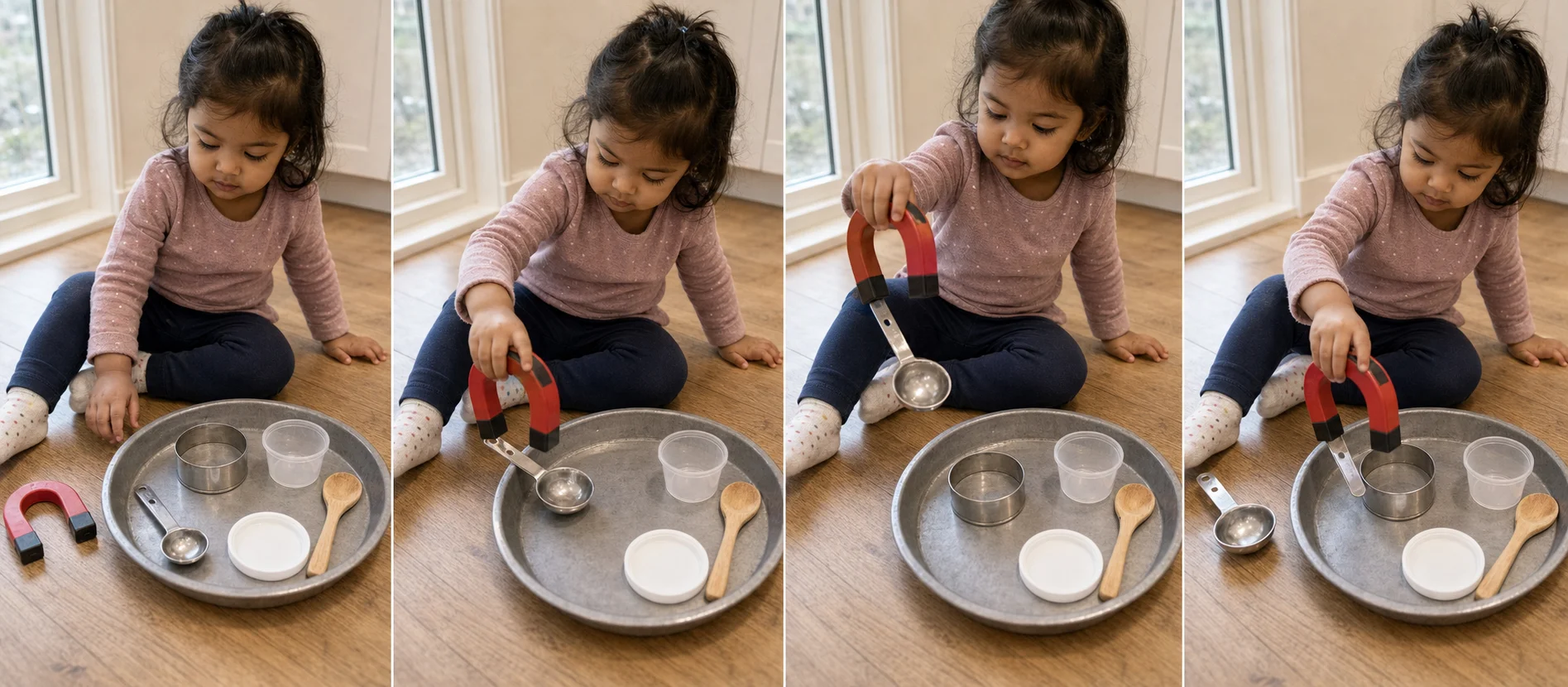
Three steps showing a toddler testing objects with a magnet, noticing what sticks, and sorting the pieces.
  1. 01
    Touch the magnet to one magnetic item, lift it, and say, "This one sticks."
  2. 02
    Hand the magnet to your child and say, "Can you find another one?"
  3. 03
    Let your child test one item at a time.
  4. 04
    Put sticky items on one side of the pan. Leave not-sticky items on the other side.
  5. 05
    Mix the pieces and play again if your child wants another round.

Safety Check

  • Use only items that are too large to mouth, not sharp, not rusty, not fragile, and not battery-like.
  • Stay close and supervise directly the whole time.
  • Remove any item that goes toward your child's mouth or starts getting thrown.
  • Store the magnet out of reach when play is over.
Supporting the play

What to say in the moment

Match what you say to what you see.

Prompt ladder
Level 1 (Start)
Touch the magnet to one item and say what happens.
Level 2 (Keep going)
Pick another item and test it.
Level 3 (Stretch)
Put the sticky ones together after each test.
Level 4 (Extend)
Mix the tray again and start a new round.
If your child seems...
What you'd see
Focused
What to do
Say
"That one sticks."
Add
Ask for 1 more item to test.
Extend
Invite your child to make a sticky pile after each lift.

Make it easier

Younger end
  • -Start with the magnet already touching a magnetic item so the first lift succeeds.
  • -Keep the tray close to your child's body so reaching does not become the hard part.
  • -Let your child retest the same favorite item several times before adding choices.

Make it harder

Older end
  • +Ask your child to guess with a point before testing 1 item.
  • +Have your child make a sticky side and a not-sticky side after each check.
  • +Turn the pan slightly between rounds so your child scans the mix again.

If it's not working

If you see
If child ignores it
Do 1 dramatic slow lift with a magnetic item, then hand the magnet over without asking for a full sorting task.
If you see
If child misuses it
Keep the pan on the surface, remove any mouthed or thrown item, and restart with 2 or 3 larger pieces.
If you see
If child gets frustrated
Switch to a yes/no rhythm: "This one sticks. This one does not." Let your child only lift the pieces that work.
Skill spotlight
Test And Compare`

Testing and comparing

This helps the child check an idea, notice same and different results, and keep trying when 1 item does not work.

  • The test-and-lift loop helps your child connect one action with a clear result.
  • Sticky and not-sticky pieces give your child a simple way to compare objects.
  • Repeating the tray helps your child practice checking again instead of stopping after one miss.
Real-world transfer
  • Checking how things work before giving up.
  • Sorting toys, dishes, or cleanup pieces by what they do.
  • Following a simple test-and-repeat routine.
  • Noticing when 2 objects are the same or different.

Parent questions