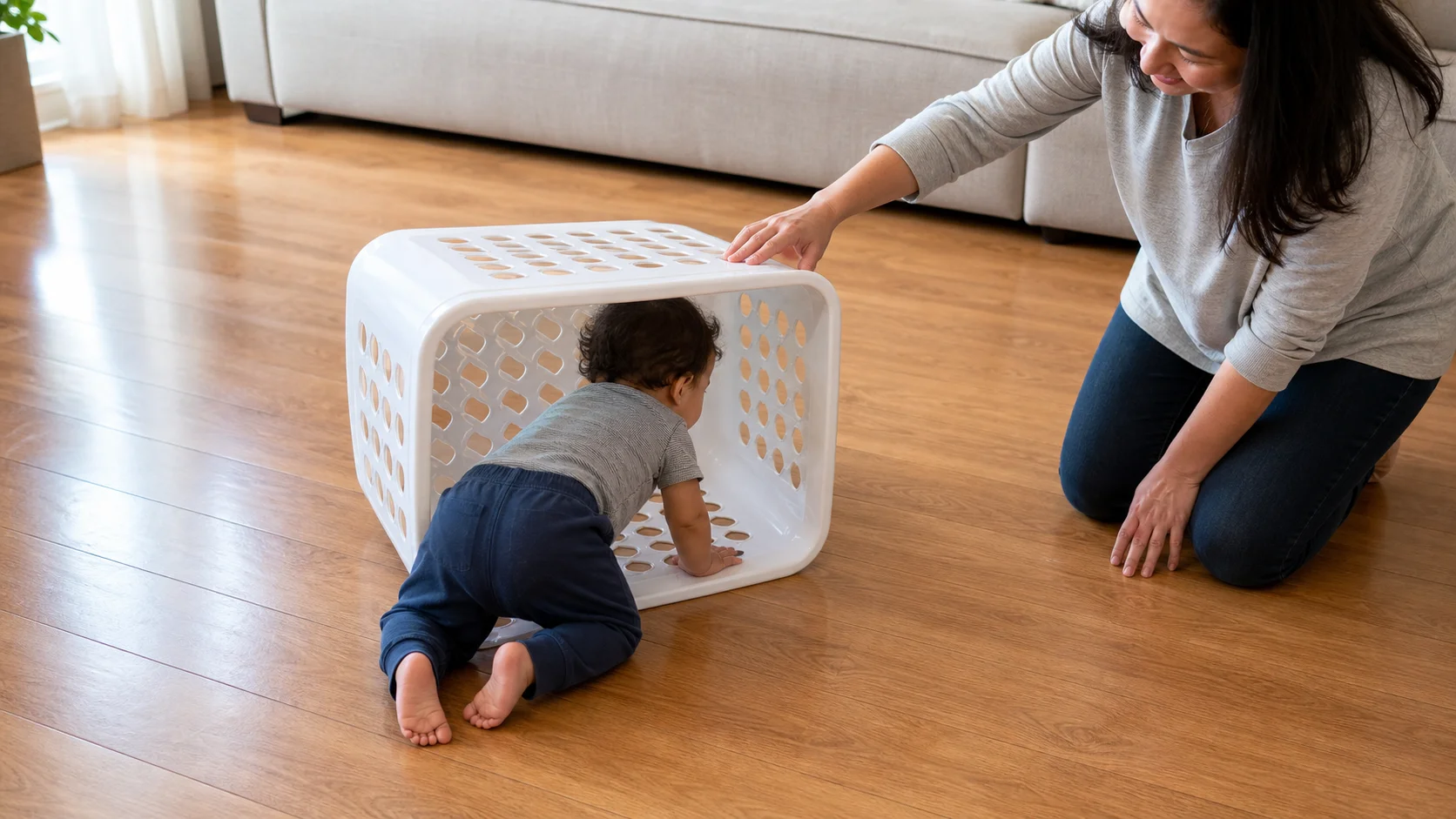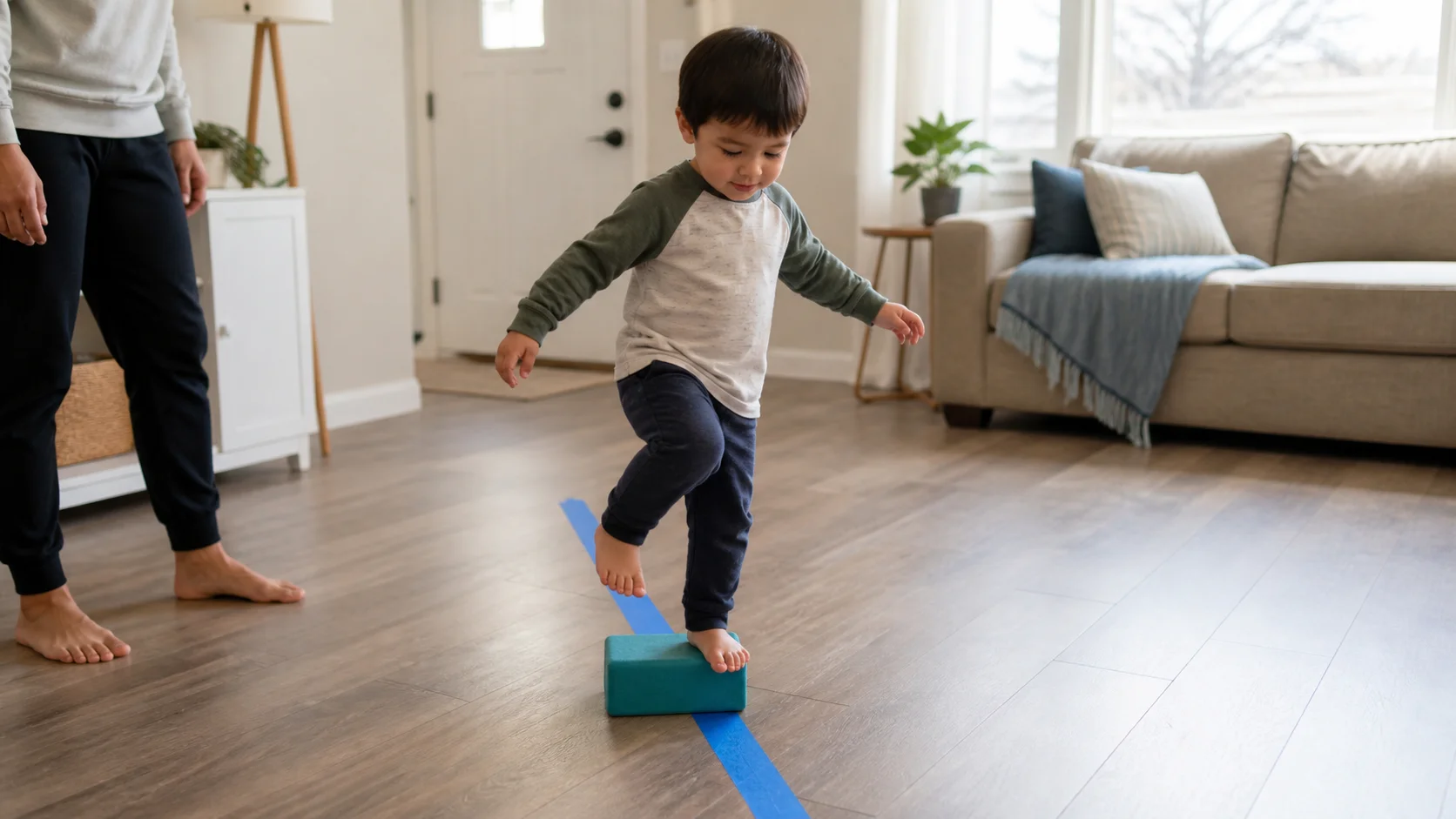
A young child walks along a taped floor line and steps over a low soft obstacle while a grown-up stays nearby.
Fine motorOT-adjacent supportBalance On PathIndoor

Line Balance Step-Over.

A short indoor path gives your child one clear job: walk the line, step over the obstacle, turn around, and try it again.

Play time
1-5+ min
Age
2-4 years
Energy
Medium
Mess
No
Effort
Low
Where
Indoor
Start here

The recipe.

Low parent effort
3 things

What you need

  • 1 taped line on the floor or 1 low balance beam
  • 1 or 2 low soft obstacles or blocks
  • 1 open floor space
1 min minimum

Setup

Then start the loop
Step 01
On a flat non-slip floor, make 1 short straight tape line or place 1 low balance beam where your child has open space at both ends to turn around.
Step 02
On that same path, place 1 low soft obstacle about halfway along the line.
Step 03
Add a second low soft obstacle only if your child still has clear room to take a few steps between the two obstacles.
"On the line."
The loop

How play unfolds.

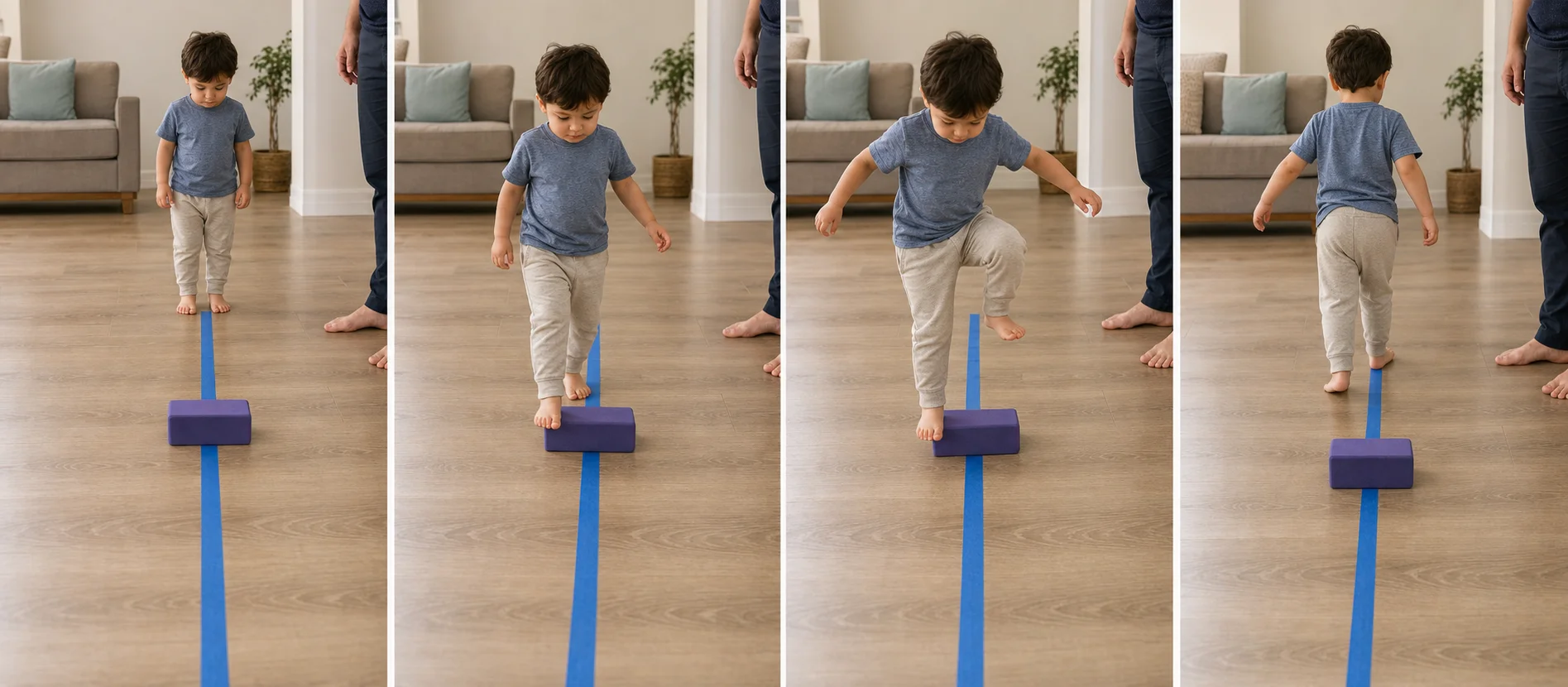
A multi-panel sequence showing a child walking a floor line, stepping over a low obstacle, turning around, and walking back.
  1. 01
    Show one slow walk on the path and step over the obstacle so your child can see the job.
  2. 02
    Say, "Walk the line. Step over," and let your child start at one end.
  3. 03
    Let your child follow the path, step over each obstacle, turn around, and walk back.
  4. 04
    If the step-over gets wobbly, shorten the line or go back to one obstacle.
  5. 05
    Repeat while the steps stay steady.

Safety Check

  • Stay with your child the whole time.
  • Keep the path away from slippery rugs, furniture edges, and hard obstacles.
  • Use low soft objects that can be stepped over safely.
  • Stop or simplify if your child starts rushing, stepping around the obstacle, or losing balance.
Supporting the play

What to say in the moment

Match what you say to what you see.

Prompt ladder
Level 1 (Start)
"Walk the line."
Level 2 (Keep going)
"Step over."
Level 3 (Stretch)
"Slow feet."
Level 4 (Extend)
"Turn and come back."
If your child seems...
What you'd see
Focused
What to do
Say
"You found the line."
Add
Pause for one slow step before the obstacle.
Extend
Let your child lead the walk back without your model.

Make it easier

Younger end
  • -Use only one obstacle.
  • -Let your child walk normally instead of heel-to-toe for the first round.
  • -Shorten the line so the turn comes sooner.

Make it harder

Older end
  • +Ask for slower heel-to-toe steps before the obstacle.
  • +Add a one-second freeze after stepping over.
  • +Let your child carry the return walk without your model.

If it's not working

If you see
If child ignores it
Walk the path yourself once, stop at the end, and pat the start spot for the child's turn.
If you see
If child misuses it
Say, "Feet on the line," remove one obstacle if needed, and restart with one slow walk.
If you see
If child gets frustrated
Use one obstacle and a shorter line for one easy success.
Skill spotlight
Balance On Path

Walking a narrow path and stepping over obstacles with balance control

This helps a child steady their body on a clear route, adjust movement for something in the way, and keep going through a short movement sequence without losing the plan.

  • The narrow path gives your child a clear route to watch and follow with their feet.
  • Stepping over the obstacle adds one body adjustment without changing the whole game.
  • The turn-and-repeat loop lets your child practice the same movement pattern enough to get steadier.
Real-world transfer
  • Walking through a room while noticing things in the way.
  • Stepping over curbs, toys, or floor changes with more control.
  • Staying with a short movement route from start to end.
Back to library
Keep playing

Related activities.