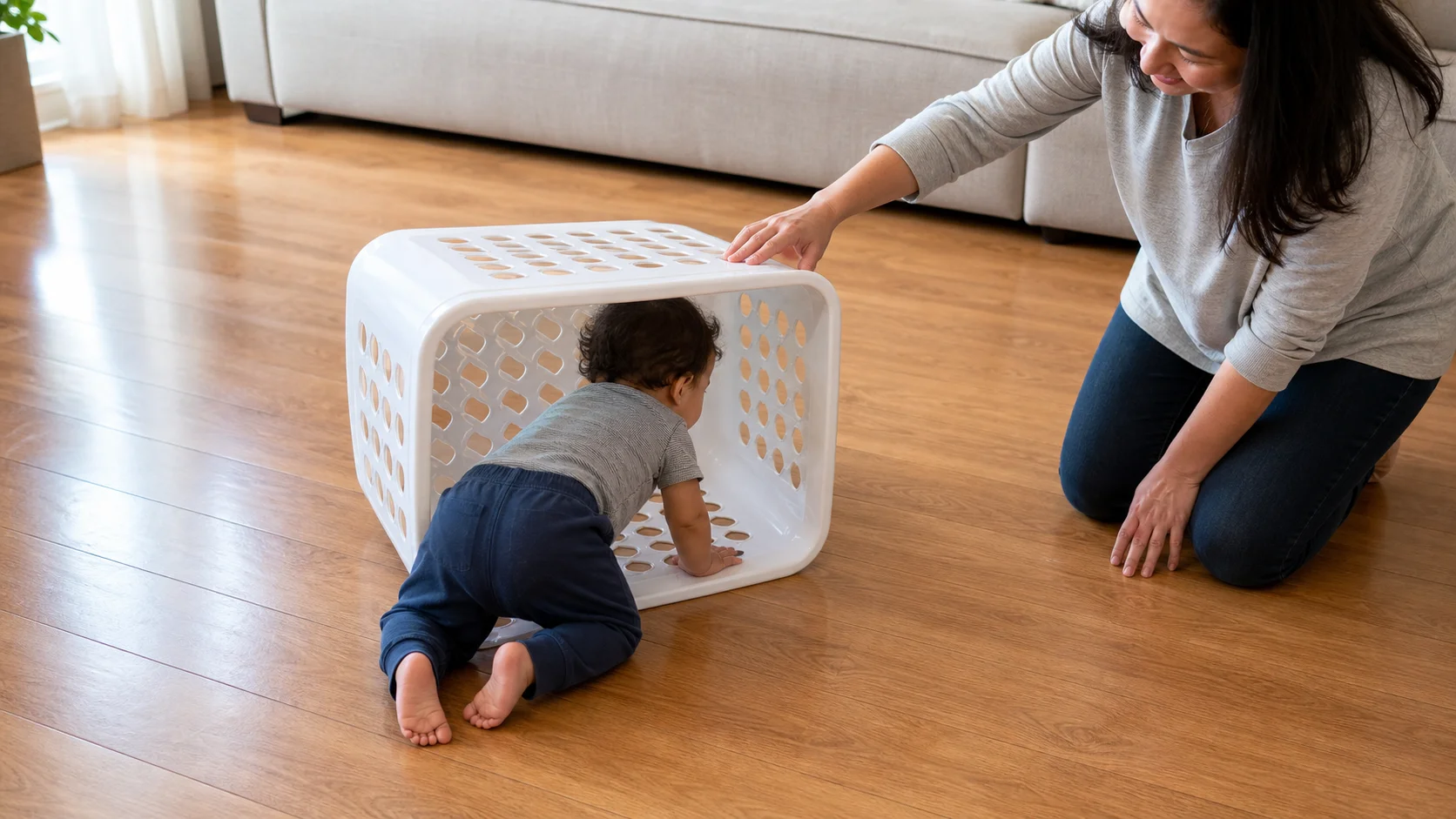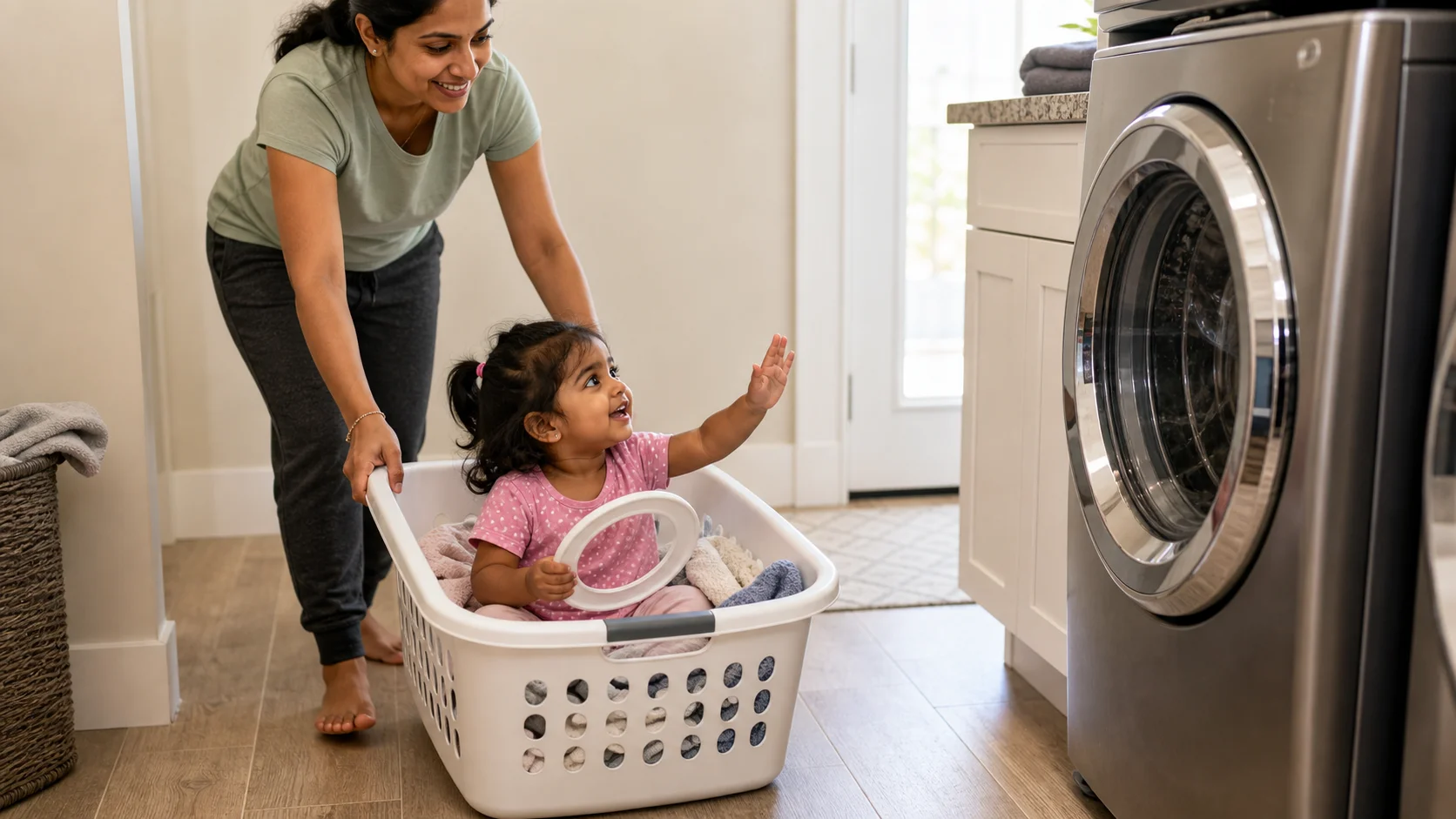
A toddler sits on clothes inside a laundry basket holding a pretend steering wheel while a grown-up pulls the basket toward a washing machine.
Fine motorAutism supportDevelopmental supportStop And StartIndoor Laundry Room Or Quiet Laundromat

Laundry Basket Train.

A short basket ride to the washer becomes a stop-and-go game with clear movement cues and easy communication pauses.

Play time
5-10+ min
Age
1-4 years
Energy
Medium
Mess
No
Effort
Medium
Where
Indoor Laundry Room Or Quiet Laundromat
Start here

The recipe.

Medium parent effort
3 things

What you need

  • 1 sturdy laundry basket
  • Enough clean or soft clothes to pad the bottom
  • 1 round toy such as a Frisbee, plastic ring, or plate
5 min minimum

Setup

Then start the loop
Step 01
Put enough clothes in the laundry basket to make a soft seat, then place the basket at the start of one short clear path toward the washing machine.
Step 02
Clear that path so the basket can slide without hitting toys, stools, cords, or furniture edges.
Step 03
Sit your child in the basket and hand over the round toy as the steering wheel.
"All aboard."
The loop

How play unfolds.

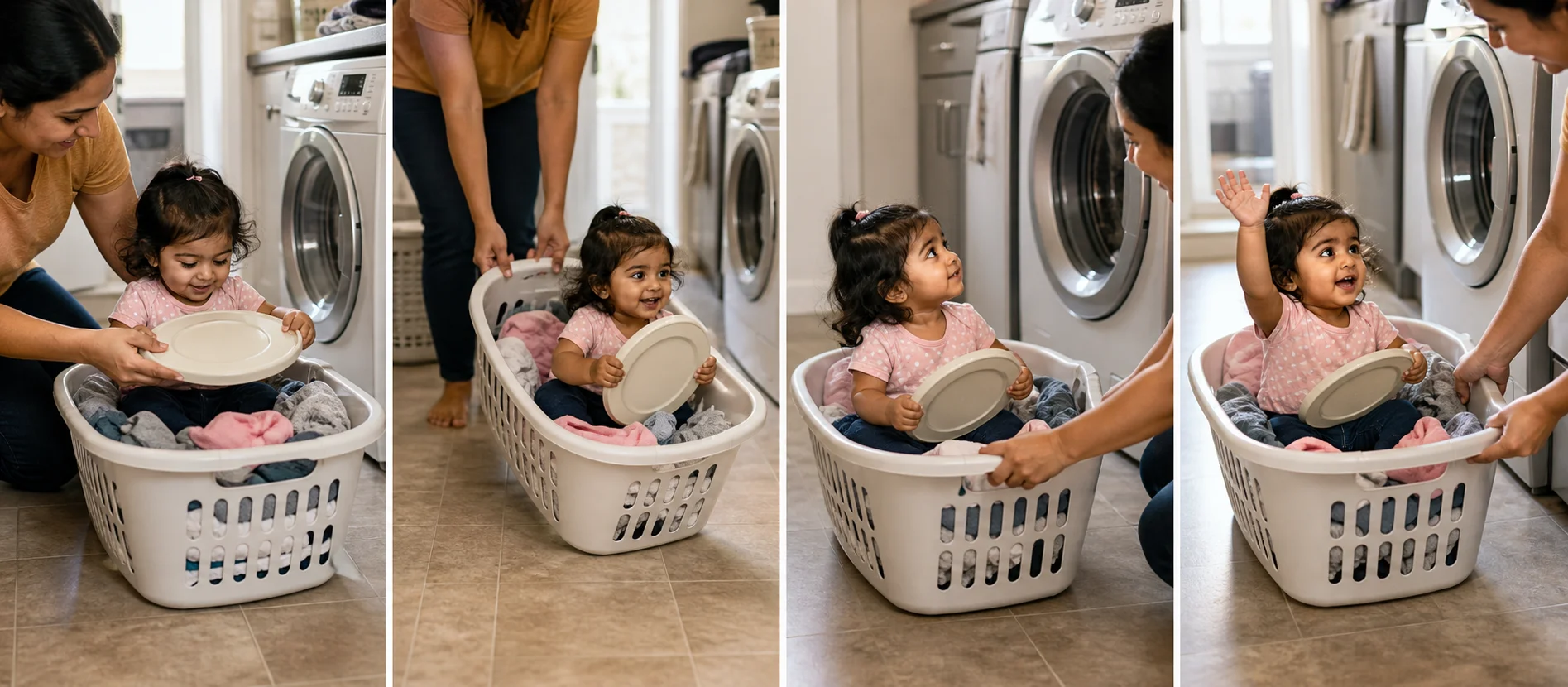
Four panels show clothes padding a laundry basket, a child seated with a plate steering wheel, a short basket ride toward the washer, and a pause while the child signals for another turn.
  1. 01
    Start one short ride and say one cue such as "go," "fast," or "slow."
  2. 02
    Stop the basket at the same spot each round and wait for your child's look, gesture, sound, nod, or word.
  3. 03
    When your child signals for more, start the next short ride.
  4. 04
    Repeat the same ride, stop, wait, and restart pattern until the laundry trip or play window is done.

Safety Check

  • Stay close enough to stop the basket right away.
  • Keep the route short, dry, and away from stairs or sharp furniture edges.
  • Stop if the basket tips, snags, moves too fast, or your child tries to stand up during the ride.
  • In a laundromat, use this only in a space that is not too busy or noisy.
Supporting the play

What to say in the moment

Match what you say to what you see.

Prompt ladder
Level 1 (Start)
"Train says go."
Level 2 (Keep going)
"Fast or slow?"
Level 3 (Stretch)
"Say stop when you want stop."
Level 4 (Extend)
"Now tell the train go again."
If your child seems...
What you'd see
Focused
What to do
Say
"You told the train go."
Add
Offer one simple choice between fast and slow.
Extend
Pause at the stop spot and wait for your child to restart the train.

Make it easier

Younger end
  • -Keep every ride the same short distance.
  • -Use only "go" and "stop" for one round.
  • -Accept looking at you as the whole request.

Make it harder

Older end
  • +Wait for your child to choose fast or slow before the next ride.
  • +Pause at each stop long enough for your child to give a clearer signal.
  • +Add one extra stop on the same short route.

If it's not working

If you see
If child ignores it
Do one very short ride, stop close to your face, and ask, "More train?"
If you see
If child misuses it
Hold the basket still and say, "Bottom stays in the basket," then restart only when your child sits back down.
If you see
If child gets frustrated
Accept the smallest signal right away and do one easy "go" round before stopping again.
Skill spotlight
Stop And Start

Stop-and-go body control during a repeated ride game

This helps a child feel movement changes in the body, handle a short pause before the next turn, and stay with a simple start-stop routine.

  • The same short route gives your child a clear pattern to expect.
  • The stop creates one natural place to practice waiting and restarting.
  • The ride gives movement feedback without needing extra gear beyond the laundry basket already in the room.
Real-world transfer
  • Pausing and restarting during other movement games.
  • Handling short stops in daily routines without losing the thread of the activity.
  • Using a simple signal to keep a fun routine going.

Parent questions

Back to library
Keep playing

Related activities.