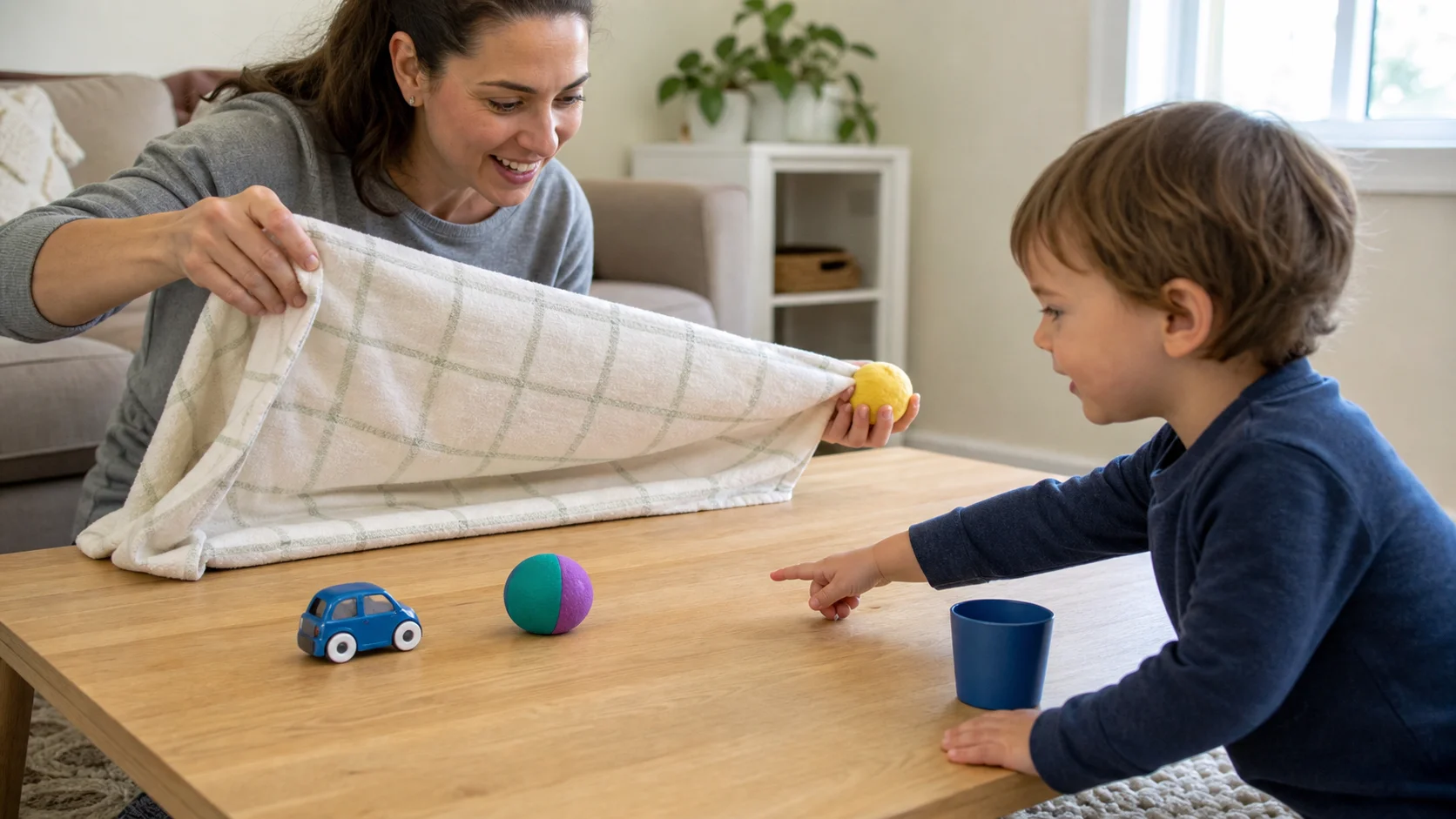
A young child looking at a small row of familiar objects while a grown-up lifts a cloth to reveal one missing item.
ThinkingSpeech delay supportRemember LocationIndoor

Kim's Missing Object.

A quick hide-and-reveal game that turns familiar objects into an easy memory challenge.

Play time
5-10+ min
Age
2-4 years
Energy
Low
Mess
Low
Effort
Low
Where
Indoor
Start here

The recipe.

Low parent effort
3 things

What you need

  • 2 to 4 familiar toddler-safe items such as a cup, toy car, ball, or spoon
  • 1 light cover such as a scarf, tea towel, or pillowcase
  • 1 floor spot or low table
5 min minimum

Setup

Then start the loop
Step 01
Put 2 to 4 familiar items in a short row on the floor or low table in front of your child.
Step 02
Leave a small gap between the items so each one stays easy to see.
Step 03
Keep the cover beside the row and sit close enough to hide and reveal the set in one smooth motion.
"Look. One is gone."
The loop

How play unfolds.

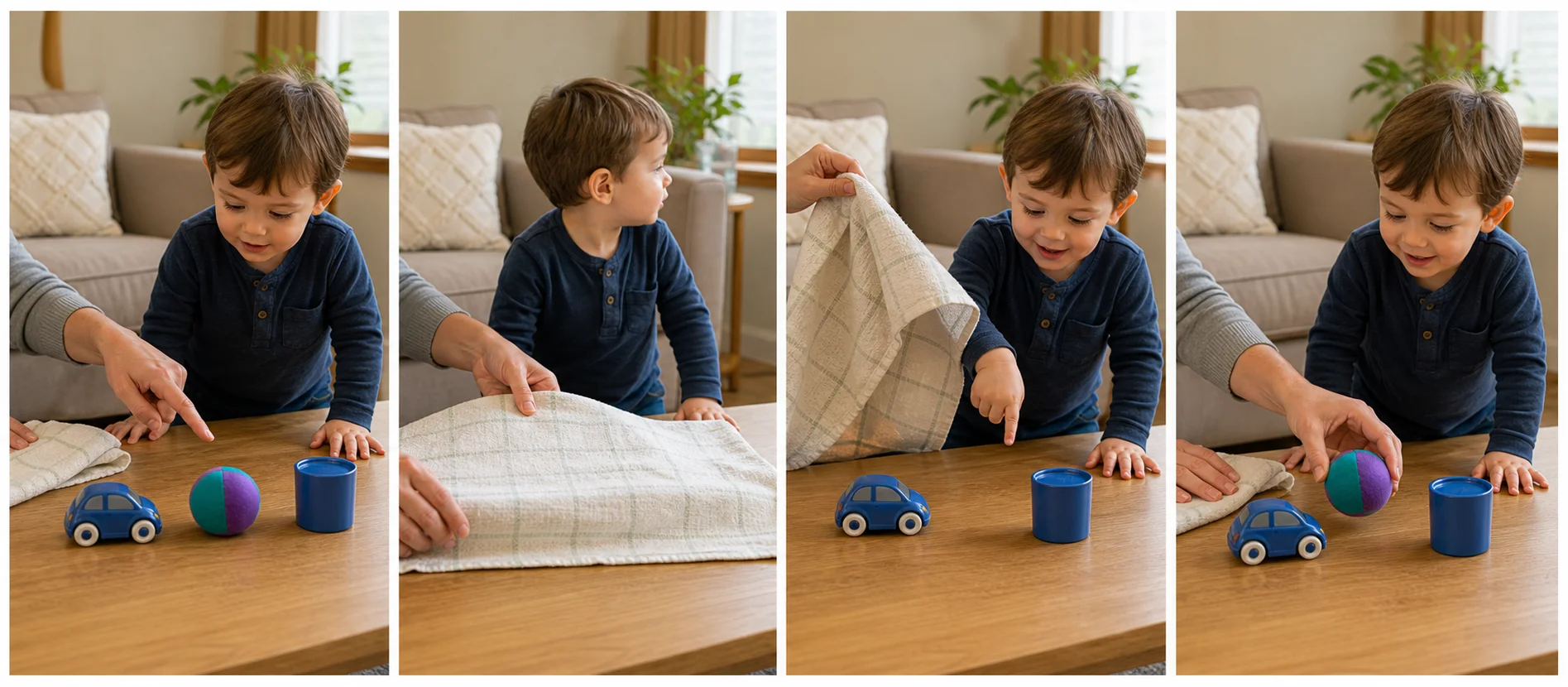
A multi-panel sequence showing a grown-up naming a few familiar objects, covering them, removing one, and a child spotting what is missing.
  1. 01
    Point to each item and say, "Look at these."
  2. 02
    Cover the row, slide one item away without your child seeing, then ask, "What's missing?"
  3. 03
    Let your child point to, gesture about, or name the missing item, then show it right away.
  4. 04
    Put the item back or swap in a new set and play another round if your child wants more.

Safety Check

  • Stay close if your child still mouths, throws, or bangs objects.
  • Use only items that are too large to swallow and not sharp or breakable.
  • Keep the cover loose and brief so it does not turn into face-covering play.
Supporting the play

What to say in the moment

Match what you say to what you see.

Prompt ladder
Level 1 (Start)
"What's missing?"
Level 2 (Keep going)
"Look again."
Level 3 (Stretch)
"Was it the car or the ball?"
Level 4 (Extend)
"Your turn to hide one."
If your child seems...
What you'd see
Focused
What to do
Say
"You knew which one was gone."
Add
Pause for a beat before you point or help.
Extend
Let your child put the missing item back before the next round.

Make it easier

Younger end
  • -Use 2 items instead of 3 or 4.
  • -Keep the same item order for several rounds.
  • -Choose items that look very different from each other.

Make it harder

Older end
  • +Add a third or fourth item after easy wins.
  • +Swap which spot the missing item comes from each round.
  • +Let your child answer before you repeat the item names.

If it's not working

If you see
If child ignores it
Use 2 favorite items only and do one very fast round.
If you see
If child misuses it
Keep the removed item in your lap and say, "Look first," before showing it again.
If you see
If child gets frustrated
Keep the same 2 items in the same spots and remove the most obvious one for the next turn.
Skill spotlight
Remember Location

Remembering which familiar item disappeared from a small set

This helps a child keep a small visual set in mind, notice what changed, and connect that remembered item to a word, point, or shared answer during play and everyday routines.

  • This gives your child practice noticing what changed in a small familiar set.
  • It supports early word use because a point, look, gesture, or item name all work as real answers.
  • The short repeatable routine keeps the demand low while still asking your child to hold one visual detail in mind.
Real-world transfer
  • Noticing when something is missing from a simple set
  • Holding onto a short visual memory while a routine changes
  • Naming or showing a remembered object in shared play
Back to library
Keep playing

Related activities.