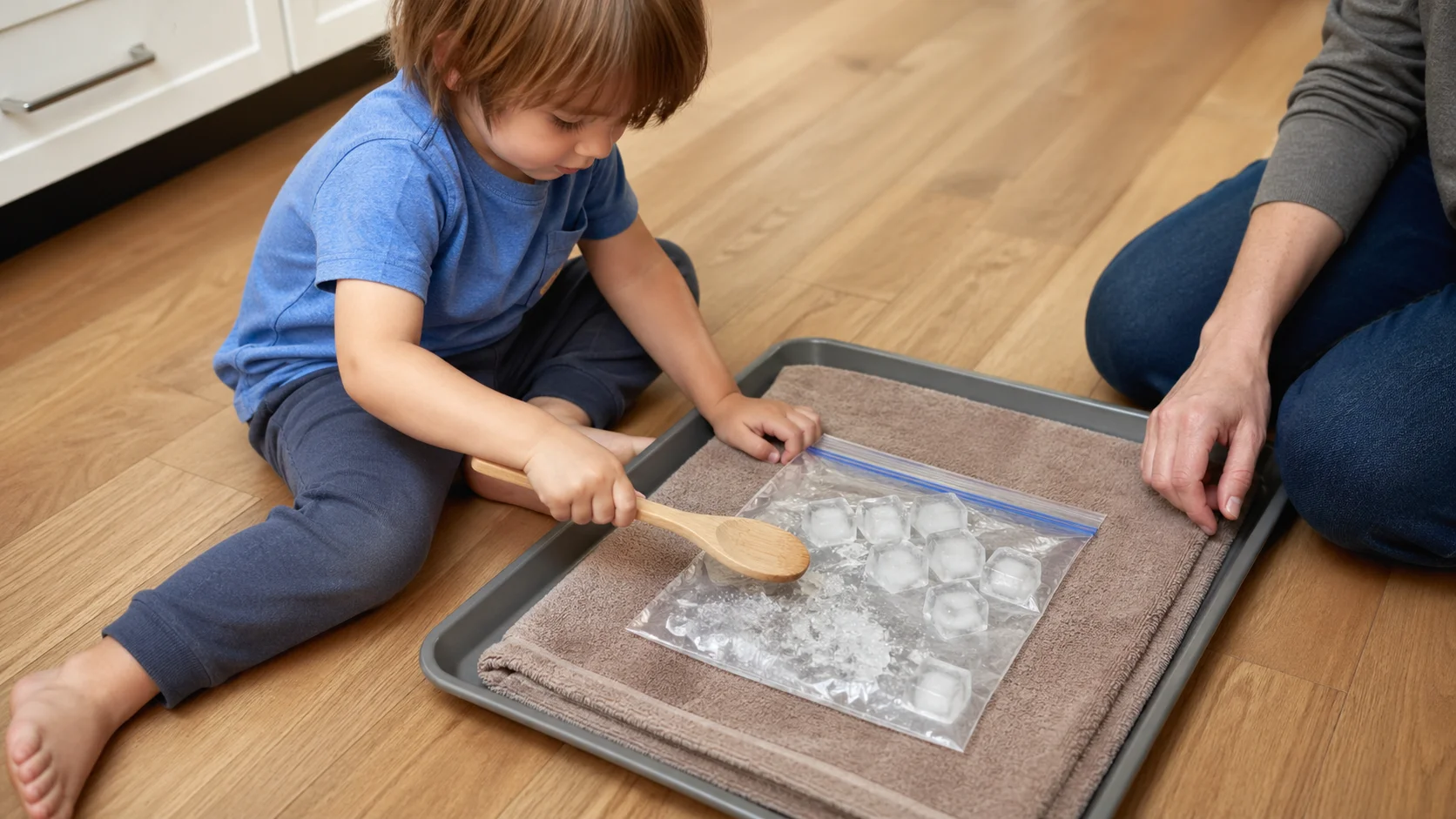
A young child taps a sealed bag of ice cubes with a wooden spoon on a towel while a grown-up sits nearby.
ThinkingOT-adjacent supportAction ResultIndoor Or Outdoor

Ice Bag Smash.

A sealed bag of ice turns tapping into a simple crack-and-repeat sensory game.

Play time
5-10+ min
Age
3-5 years
Energy
Low To Medium
Mess
Low To Medium
Effort
Low
Where
Indoor Or Outdoor
Start here

The recipe.

Low parent effort
4 things

What you need

  • 1 sealable plastic bag
  • A small handful of ice cubes
  • 1 towel, tray, or shallow bin
  • 1 lightweight tapping tool, such as a wooden spoon, silicone spatula, or toy hammer
5 min minimum

Setup

Then start the loop
Step 01
Put a folded towel, tray, or shallow bin on the floor or a sturdy low table.
Step 02
Seal a small handful of ice cubes inside one plastic bag with most of the extra air pressed out.
Step 03
Lay the bag flat in the middle of the play area.
Step 04
Put one lightweight tapping tool beside the bag.
"Tap, tap, crack."
The loop

How play unfolds.

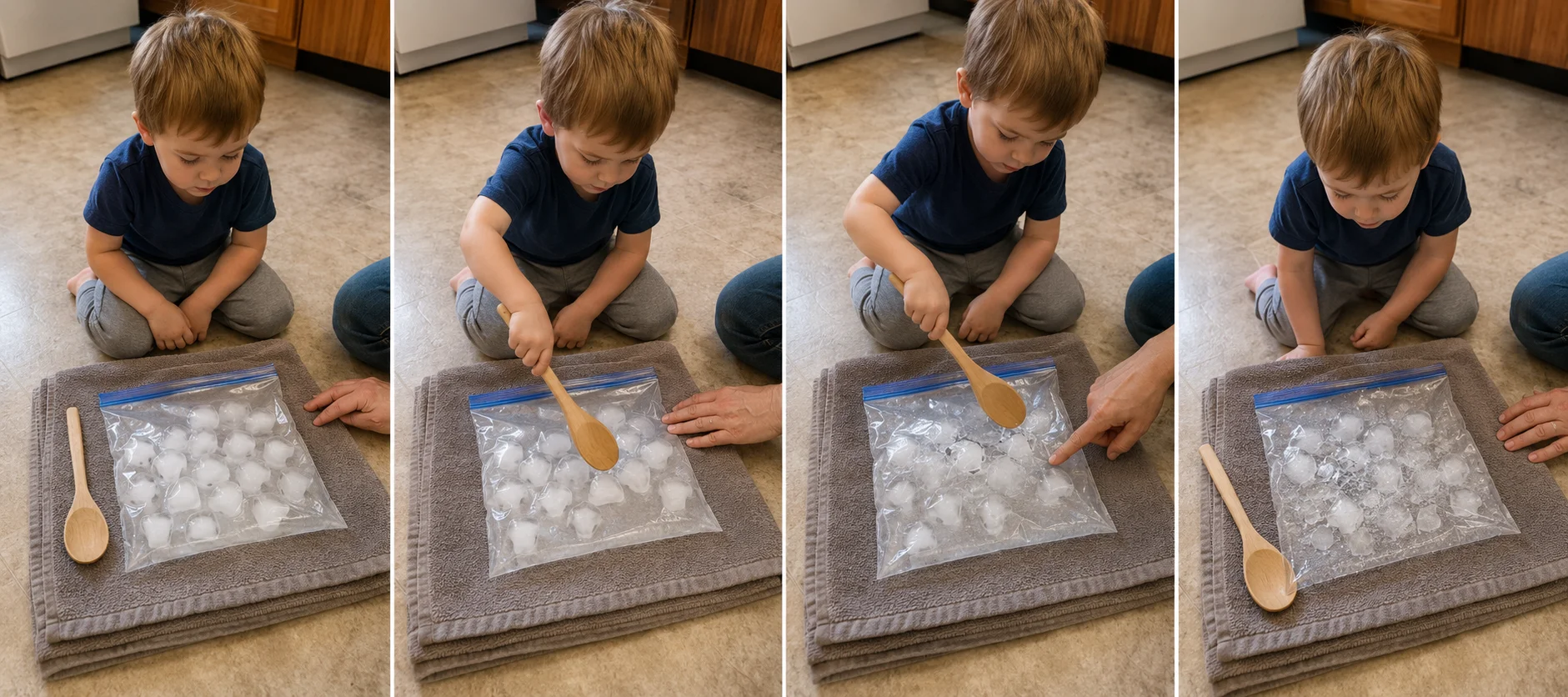
Four panels showing ice cubes sealed in a plastic bag, the bag placed on a towel, a child tapping it with a wooden spoon, and the crushed ice inside after the round.
  1. 01
    Tap one corner of the bag and say, "Tap the ice bag."
  2. 02
    Let your child tap, then pause to hear or see the crack.
  3. 03
    Keep going on new spots until the cubes sound and feel broken up.

Safety Check

  • Stay with your child the whole time.
  • Use a lightweight child-safe tapping tool instead of a heavy hammer.
  • Stop if the bag leaks, the floor gets slippery, or your child starts swinging away from the bag.
  • Stop if your child mouths the bag, the ice, or any broken plastic.
Supporting the play

What to say in the moment

Match what you say to what you see.

Prompt ladder
Level 1 (Start)
"Smash the ice."
Level 2 (Keep going)
"Hear that crack?"
Level 3 (Stretch)
"Try a new spot."
Level 4 (Extend)
"Big crack or little crack?"
If your child seems...
What you'd see
Focused
What to do
Say
"That spot cracked."
Add
Point to one cube that still looks whole.
Extend
Let your child choose the next corner to hit.

Make it easier

Younger end
  • -Use only two or three ice cubes in the bag.
  • -Keep the bag on the floor instead of a table.
  • -Use a wooden spoon before offering a toy hammer.

Make it harder

Older end
  • +Let your child aim for one cube that is still whole.
  • +Ask your child to switch corners after each crack.
  • +Use a slightly thicker bag of ice once the flat bag feels easy.

If it's not working

If you see
If child ignores it
Make one louder crack yourself, then hand over the tool right away.
If you see
If child misuses it
Keep the bag under your hand, say, "Tool hits the bag," and restart with one gentle tap.
If you see
If child gets frustrated
Hold the bag steady, switch to a wooden spoon or hand-over-hand tap, and count one visible crack as success.
Skill spotlight
Action Result

Noticing that one action changes what happens next

This helps a child connect one action to one visible result and stay with a short retry loop when the first hit does not change enough.

  • The crack gives your child a fast cause-and-effect payoff after each hit.
  • The short repeat loop makes retrying easier when one tap is not enough.
  • The contained heavy-work feel can be a good match for children who seek impact and sound.
Real-world transfer
  • Learning that one action can change what happens next.
  • Trying again after a small first result.

Parent questions

Back to library
Keep playing

Related activities.