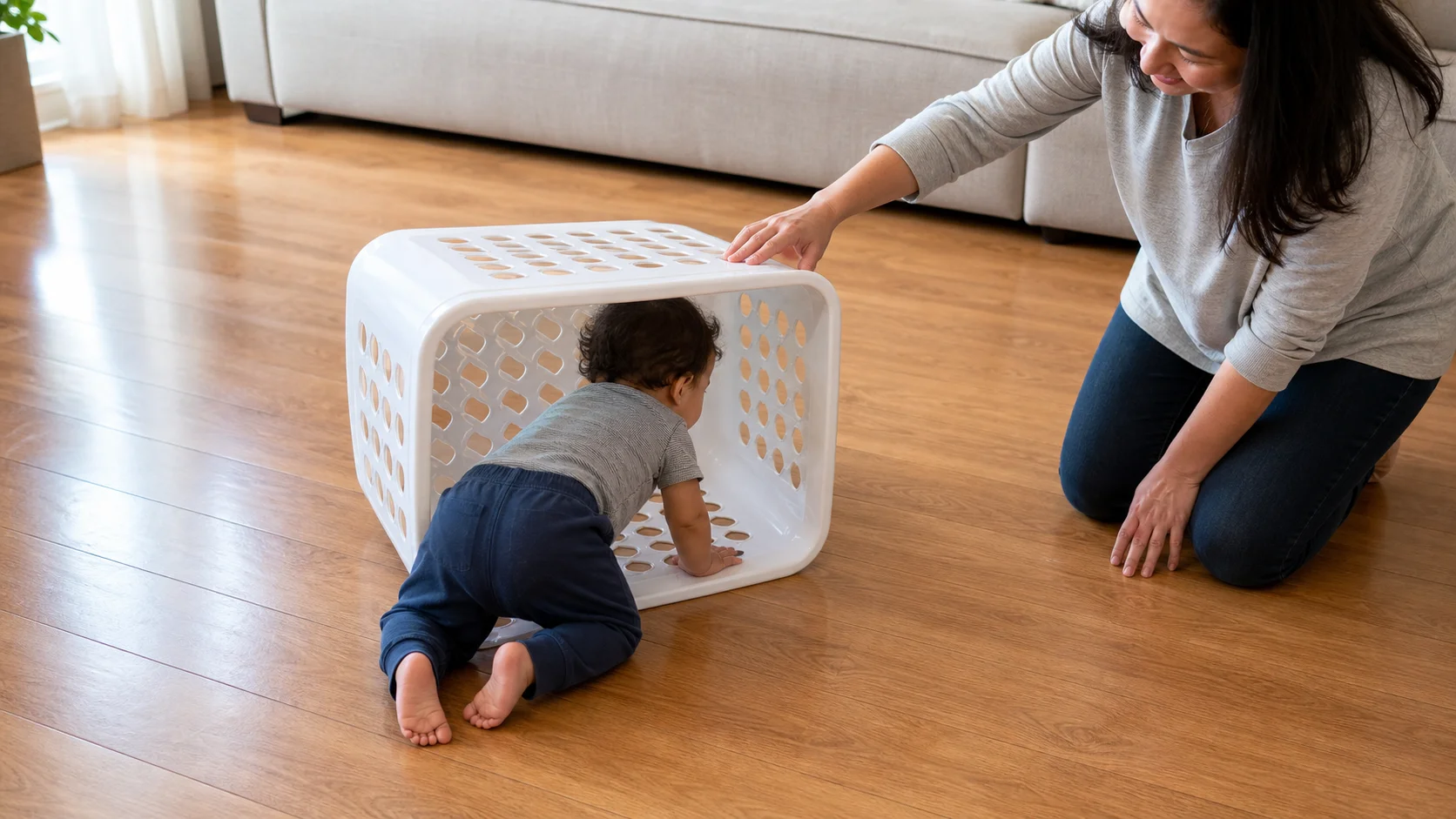
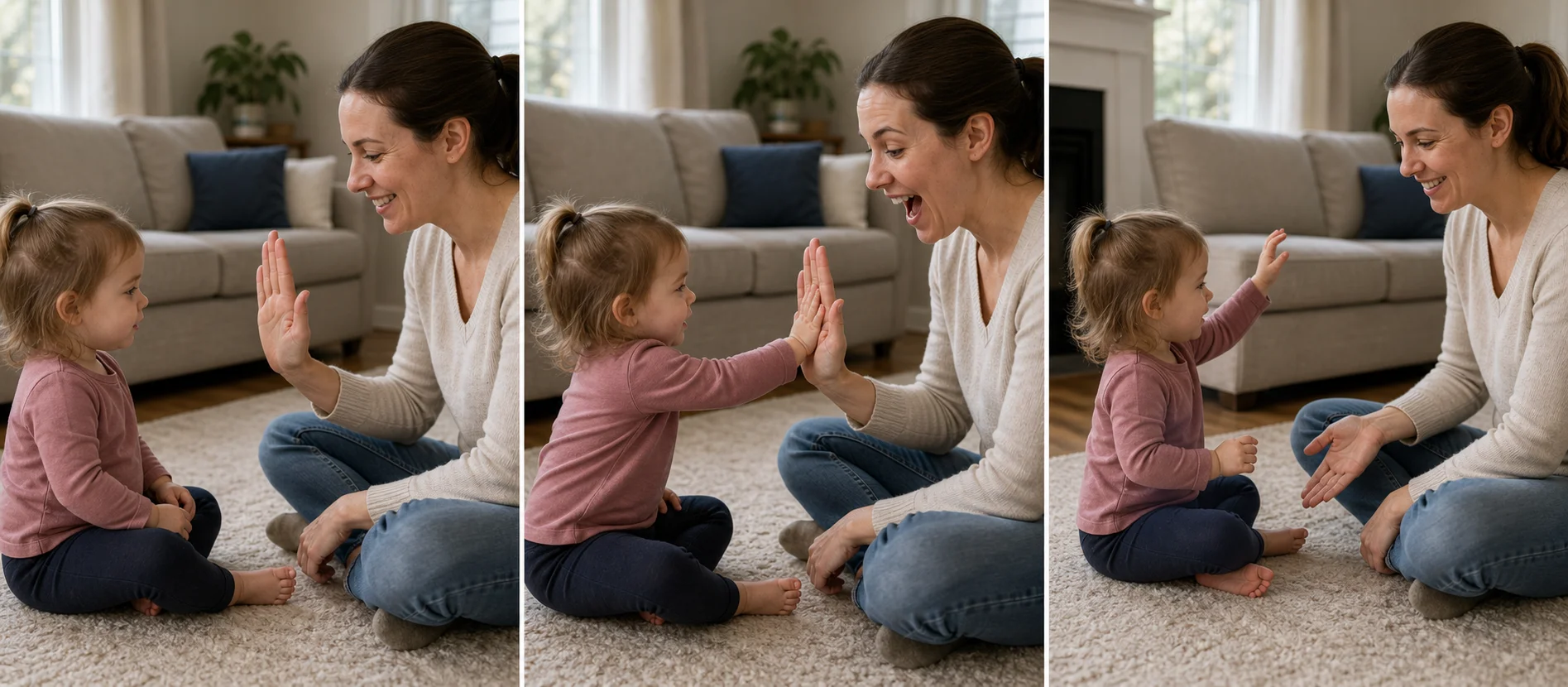
A toddler giving a gentle high five to an adult's open palm during a seated play moment.
Skill builderDevelopmental supportCopy Then TryIndoor

High-Five Ouch.

Offer one open palm, answer one gentle tap with a silly word, and pause to see if your child wants another turn.

Play time
5+ min
Age
1-2 years
Energy
Low
Mess
Low
Effort
Low
Where
Indoor
Start here

The recipe.

Low parent effort
3 things

What you need

  • 1 child
  • 1 adult
  • 1 quiet floor or seated space
5 min minimum

Setup

Then start the loop
Step 01
In a calm spot, sit or stand facing your child close enough that one easy arm lift can reach your hand.
Step 02
Hold one open palm still at your child's chest or shoulder height, and keep it a little away from faces so the target is easy to see and safe to tap.
Step 03
Pick one short reply such as `ouch`, `owie`, or `whoa` before you start so every turn sounds the same.
`High five.`
The loop

How play unfolds.

Three panels showing an adult offering a palm, a toddler tapping once, and both pausing before another turn.
  1. 01
    Hold your open palm still and say `High five`.
  2. 02
    When your child taps once, answer with the same playful reply right away.
  3. 03
    Pause so your child can look, smile, move again, or try the sound if they want to.
  4. 04
    Offer another turn only if your child stays interested or lifts a hand again.
  5. 05
    Stop after a few calm high fives, or sooner if your child turns away, drops their hand, or walks off.

Safety Check

  • Keep your palm away from faces and model gentle taps so the game does not turn into hard slapping.
  • Leave enough clear space around you that an excited swing will not hit a face, chair, or nearby furniture.
  • End early if direct hand contact, the silly reply, or the pace of the game starts to feel too intense.
Supporting the play

What to say in the moment

Match what you say to what you see.

Prompt ladder
Level 1 (Start)
Give my hand one high five.
Level 2 (Keep going)
High five, then listen for `ouch`.
Level 3 (Stretch)
Give one more high five after the silly word.
Level 4 (Extend)
Pick whether the next turn says `ouch` or `whoa`.
If your child seems...
What you'd see
Focused
What to do
Say
`High five. Ouch.`
Add
Name one part or sound only, like `hand` or `ouch`.
Extend
Pause after the reply and wait to see if your child looks at you, smiles, or tries the sound before you offer the next turn.

Make it easier

Younger end
  • -Stay seated close together so your child only has to lift an arm instead of stepping or leaning.
  • -Keep the same hand at the same height for every turn so the target never shifts.
  • -Let a soft touch with fingers or palm count instead of waiting for a louder slap.

Make it harder

Older end
  • +Pause one extra beat after `ouch` before raising your palm again so your child waits for the next turn cue.
  • +Let your child choose between `ouch` and `whoa` before the next high five.
  • +Try three calm high fives in a row with the same gentle touch and stop there.

If it's not working

If you see
If child ignores it
Tap your own palm once, say the silly word with a big smile, and offer just one more chance before ending the routine.
If you see
If child misuses it
If the taps get too hard, miss the hand, or drift toward faces, lower your palm to lap height or do one gentle hand-over-hand tap and then stop.
If you see
If child gets frustrated
Switch to one last easy tap with a calmer voice, say `all done high five`, and end before the routine feels like pressure.
Skill spotlight
Back-And-Forth Play

Taking one high-five turn and waiting for the playful reply

This helps a child stay inside one tiny social back-and-forth, notice another person's response, and get more comfortable with simple gesture-and-sound exchanges.

  • The open palm gives your child one clear visual target.
  • The same reply after each tap makes the turn pattern predictable.
  • The pause gives your child room to look, smile, reach, or try the sound before another turn.
  • Keeping it to one gentle tap helps the game stay social instead of wild.
Real-world transfer
  • Joining simple back-and-forth social games like waving, clapping, or greeting
  • Waiting for another person's response before acting again
  • Trying short playful sounds without pressure to say full words

Parent questions