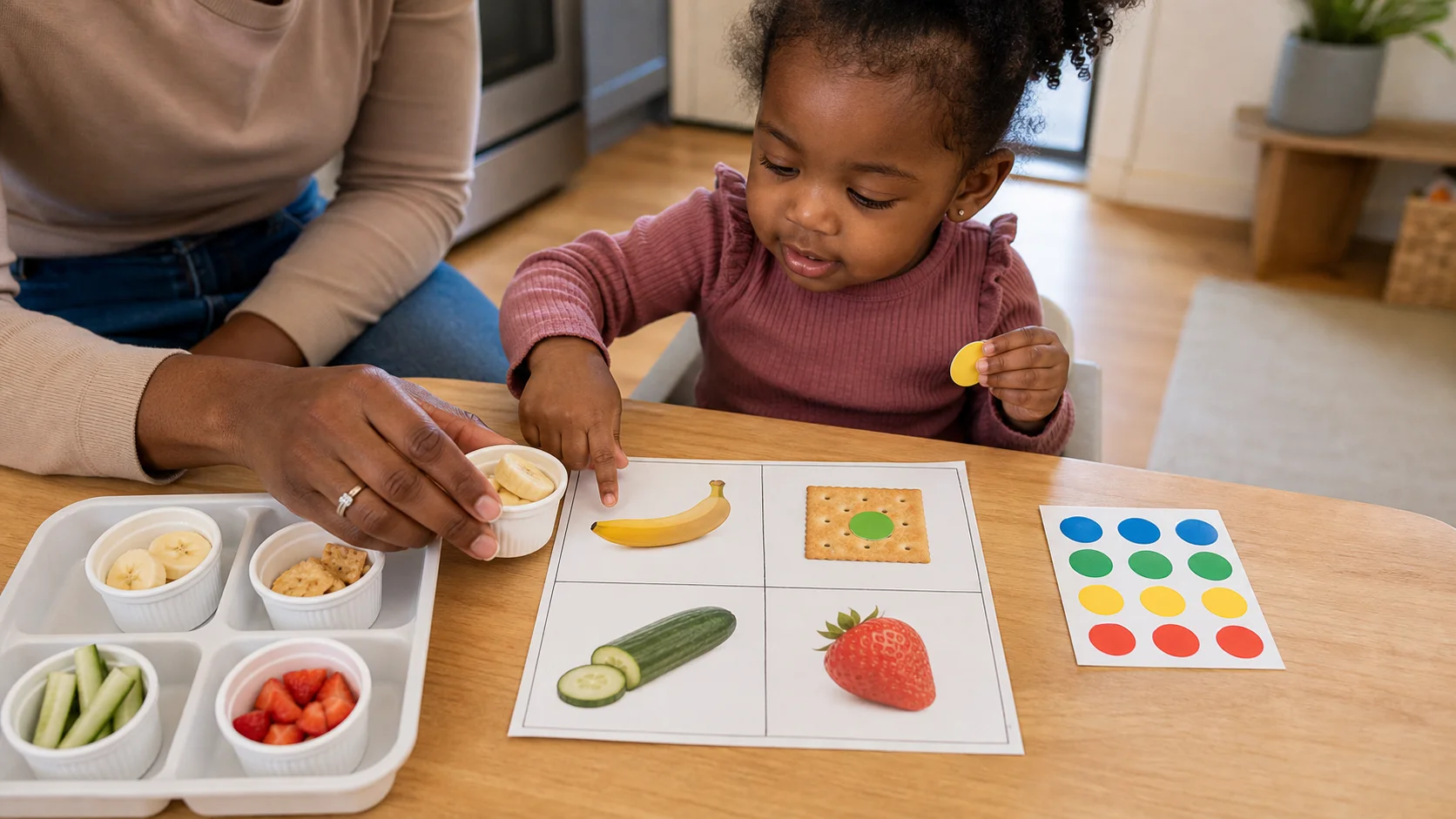
A toddler matching a food picture to a small sample on a bingo card with stickers nearby.
ThinkingAutism supportObject To TargetIndoor

Food Bingo Sticker.

Match food pictures to real samples, explore one calm turn, and close each effort with a sticker.

Play time
5-10+ min
Age
2-3 years
Energy
Low
Mess
Low To Medium
Effort
Medium
Where
Indoor
Start here

The recipe.

Medium parent effort
6 things

What you need

  • 1 simple bingo card with 4 food pictures
  • 4 small food samples that match the pictured foods, with 2 familiar foods and 2 less-familiar foods when possible
  • 1 sheet of stickers or 4 loose stickers
  • 4 small cups or 1 divided tray for the food samples
  • 1 adult
  • 1 child
5 min minimum

Setup

Then start the loop
Step 01
At a low table or on a floor mat, place the bingo card flat in front of your child.
Step 02
Beside the card, line up the 4 matching food samples in small cups or a divided tray so each picture has one visible match. Use foods that fit your child's allergy needs and usual eating safety, and keep the mix familiar and less familiar when possible.
Step 03
Keep the stickers beside the card, sit next to your child, and start with one simple rule
your child can look, smell, touch, take a bite of a familiar food if they want, or say `no thanks` without pressure.
Pick one.
The loop

How play unfolds.

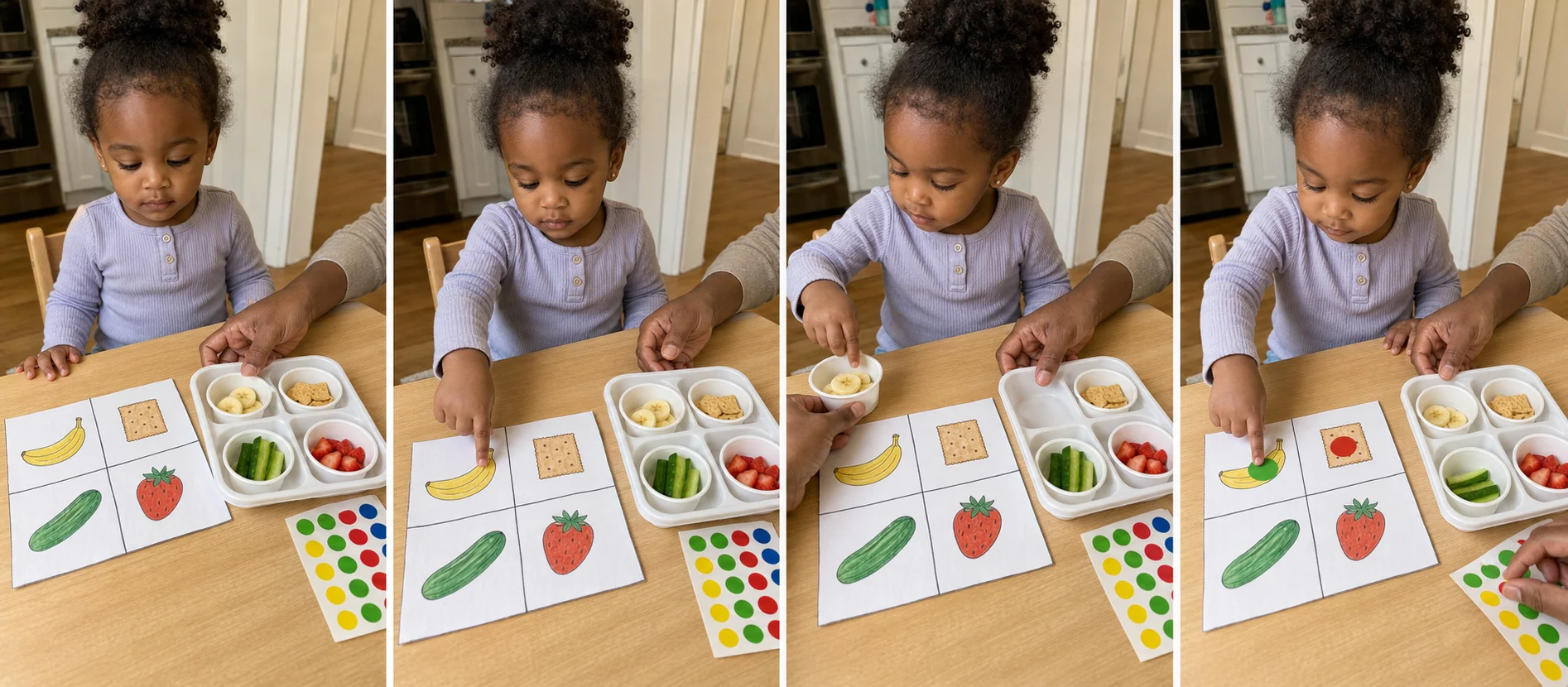
Three panels showing a child choosing a food picture, exploring the matching sample, and placing a sticker on the square.
  1. 01
    Ask your child to pick one picture square.
  2. 02
    Move the matching food beside the picture and say, "Look, smell, touch, or no thanks." For familiar foods, an optional bite can count too.
  3. 03
    When the food turn is finished, hand over one sticker and mark the square.
  4. 04
    If your child skips a square, leave it open and choose a different picture.
  5. 05
    Repeat until a few squares are marked or attention drops.

Safety Check

  • Use only food sizes, textures, and ingredients that already fit your child's usual eating safety and allergy needs.
  • Stay close for the whole round, and stop if your child starts gagging, throwing food, hiding from the setup, or getting more upset with each turn.
  • Keep handled food and the play surface clean, and end the round before smells, sticky textures, or too many choices push your child past their comfort level.
Supporting the play

What to say in the moment

Match what you say to what you see.

Prompt ladder
Level 1 (Start)
Pick one square.
Level 2 (Keep going)
Find the match.
Level 3 (Stretch)
Try a familiar one or a new one.
Level 4 (Extend)
One more square, then done.
If your child seems...
What you'd see
Focused
What to do
Say
Pick your next square.
Add
Ask `What is this?` only after the sticker lands if your child is still engaged.
Extend
Offer one open square that is slightly less familiar after a calm familiar-food turn.

Make it easier

Younger end
  • -Start with familiar-food squares first and save the less-familiar foods for later in the round.
  • -Hold the sticker sheet yourself and pass over only one sticker after each completed match.
  • -Angle the card so only the next open side is closest to your child, which cuts down the scanning load without changing the game.

Make it harder

Older end
  • +Pause after your child points and let them look back to the picture before you move the matching food forward.
  • +After one familiar-food square, invite your child to pick a less-familiar square next.
  • +Finish the last open square with no adult pointing, using only your short verbal cue.

If it's not working

If you see
If child ignores it
Start with only 2 familiar picture squares, do 1 model turn first, and let your child choose between those 2.
If you see
If child misuses it
Keep only 1 food sample and 1 sticker in front of your child at a time, and reset the next turn if food starts getting thrown or stickers go down too early.
If you see
If child gets frustrated
Switch to 1 familiar food for 1 easy success, praise it right away, and stop there. Tasting still stays optional for the full activity.
Skill spotlight
Object To Target

Matching one pictured food to the real food

This helps a child connect a simple picture cue to the real item in front of them, make one food choice at a time, and use visual supports more calmly during snack or meal routines.

  • One picture and one food at a time keep the choice load small.
  • Matching the picture to the real food practices object-to-target matching.
  • Looking, smelling, touching, or saying `no thanks` gives your child a way to participate without forcing a bite.
  • The sticker marks a clear finish so your child can see the round moving forward.
Real-world transfer
  • Choosing between a few snack or meal options without extra pressure
  • Using a picture cue to understand what food is being offered
  • Moving through one small food-exploration step before the next choice

Parent questions