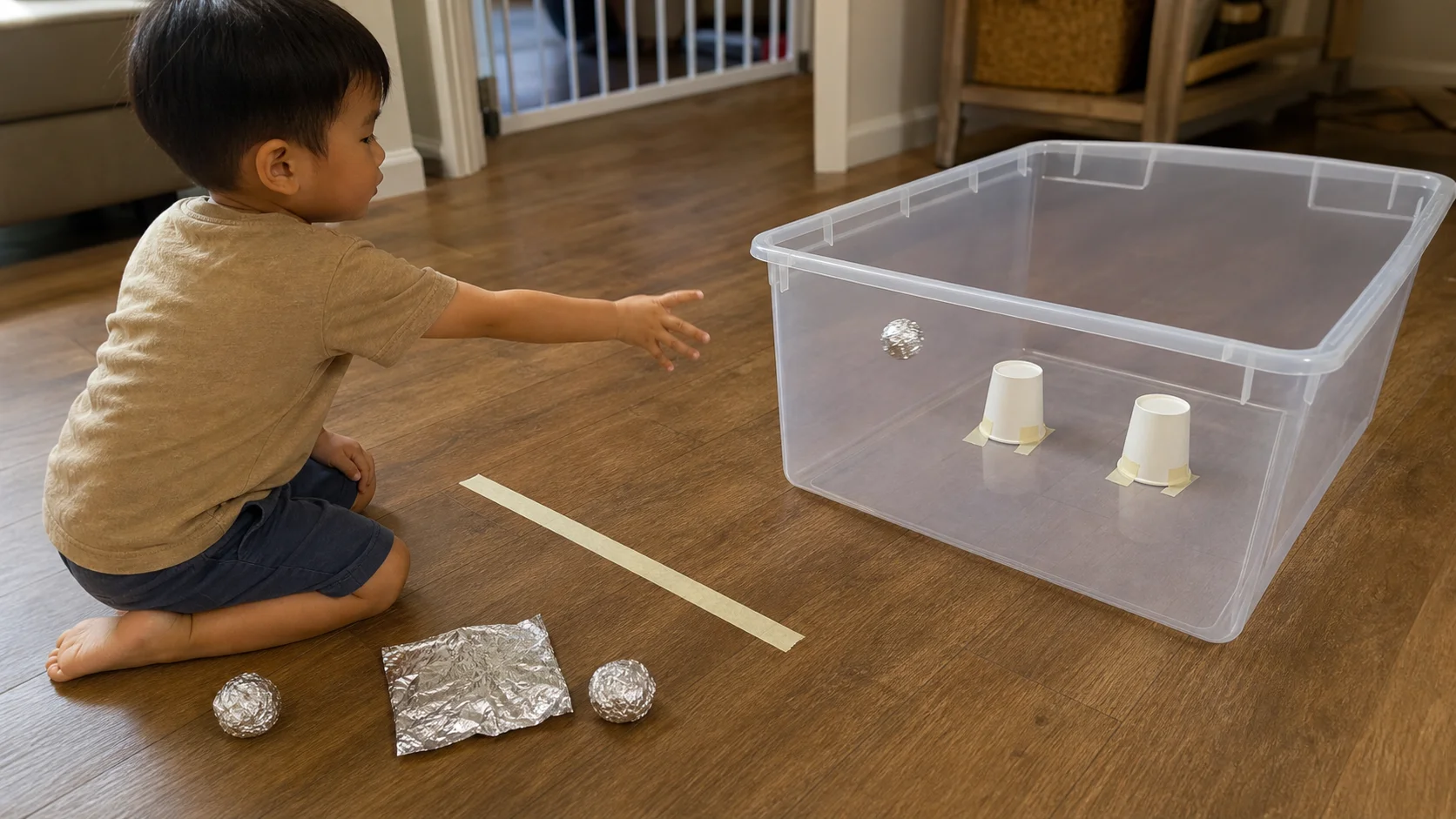
Child squeezing aluminum foil into a ball before tossing it toward paper cup targets in a plastic container.
Fine motorOT-adjacent supportTwo Hand Coordination`Indoor Floor Space

Foil River Rock Toss.

Foil balls and paper-cup targets make a quick crumple, aim, toss, and reset game.

Play time
5-10+ min
Age
2-4 years
Energy
Low To Medium
Mess
Low
Effort
Low
Where
Indoor Floor Space
Start here

The recipe.

Low parent effort
6 things

What you need

  • Aluminum foil
  • 2 small paper cups
  • Masking tape
  • 1 large plastic container
  • Markers, optional for marking a toss line
  • 1 adult for close supervision
5 min minimum

Setup

Then start the loop
Step 01
Inside the plastic container, tape 2 small paper cups firmly upright with a little space between them.
Step 02
On the floor, place the container with open space in front of it for tossing.
Step 03
Beside the toss spot, place 4 to 8 loose foil squares, about 12 inches per side.
Step 04
On the floor a little way back from the container, point out or mark 1 simple toss line.
Step 05
Behind the toss line, stand or sit your child facing the cup targets.
Step 06
Before play starts, squeeze 1 foil square into a tight ball and check that no sharp foil edges are sticking out.
"Squeeze, squeeze, toss."
The loop

How play unfolds.

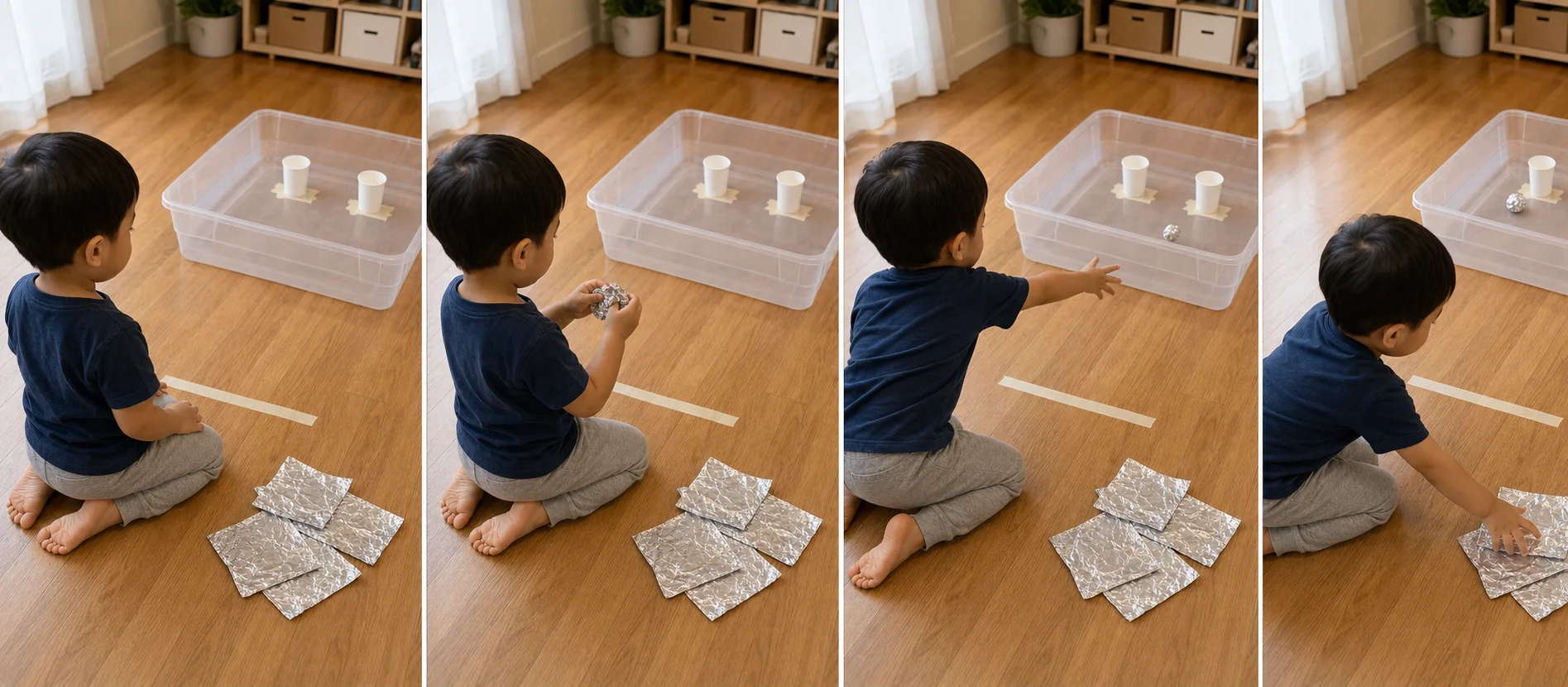
Three-step sequence showing foil crumpling, standing behind the toss line, and tossing toward taped cup targets.
  1. 01
    Crumple one foil square into a tight ball where your child can watch.
  2. 02
    Say, "Make a tight foil rock, then toss it from behind this line."
  3. 03
    Let your child squeeze one foil square with two hands until it becomes a dense ball.
  4. 04
    Have your child stand behind the line and toss the foil rock toward a cup.
  5. 05
    Count one throw as a complete turn, even if it misses.
  6. 06
    Hand over the next foil square, or retrieve the tossed ball, and repeat the crumple-and-toss turn.

Safety Check

  • Supervise closely during the full activity.
  • Make sure foil pieces are crumpled tightly into balls before handling so sharp edges are not left exposed.
  • Remind your child to stay behind the toss line during play.
  • Remove torn scraps right away before they become mouthing hazards.
Supporting the play

What to say in the moment

Match what you say to what you see.

Prompt ladder
Level 1 (Start)
Make 1 tight foil rock and toss it toward a cup.
Level 2 (Keep going)
Pick the next square and squeeze it even smaller.
Level 3 (Stretch)
Aim for the other cup this time.
Level 4 (Extend)
Try 1 throw from a new angle while your feet stay behind the line.
If your child seems...
What you'd see
Focused
What to do
Say
"You are squeezing it smaller."
Add
Ask for 1 cup choice before the toss.
Extend
Alternate cup targets for the next 2 rocks.

Make it easier

Younger end
  • -Pre-start the first squeeze so your child only has to finish tightening the foil.
  • -Use the larger container as the target for 1 round before returning to cup aiming.
  • -Let your child toss from a seated or kneeling position if standing still is hard.

Make it harder

Older end
  • +Ask your child to choose left cup or right cup before squeezing the foil.
  • +Try a gentle underhand toss, then a gentle overhand toss.
  • +Keep score for 3 rocks only, then reset back to free play.

If it's not working

If you see
If child ignores it
Make 1 loud crinkly foil rock yourself and toss it into the container so your child can hear and see the goal.
If you see
If child misuses it
Give only 1 foil square at a time and repeat, "Crumple first, then toss."
If you see
If child gets frustrated
Move the toss line closer or count a container hit as the goal before aiming for the cups again.
Skill spotlight
Two-Hand Coordination`

Using 2 hands to make 1 tight object.

This helps both hands work together for everyday jobs like coloring, pulling, fastening, and handling small objects with control.

  • Squeezing the foil with two hands gives your child repeated practice making one tight object.
  • Tossing from the line adds a simple aim-and-release target without turning the game into a long lesson.
  • The cup targets and container make misses easy to see, reset, and try again.
Real-world transfer
  • Using both hands for zippers, snaps, and lids.
  • Pressing firmly with crayons, markers, or play dough.
  • Throwing soft objects toward a basket or bin.
  • Staying with a short turn sequence.

Parent questions