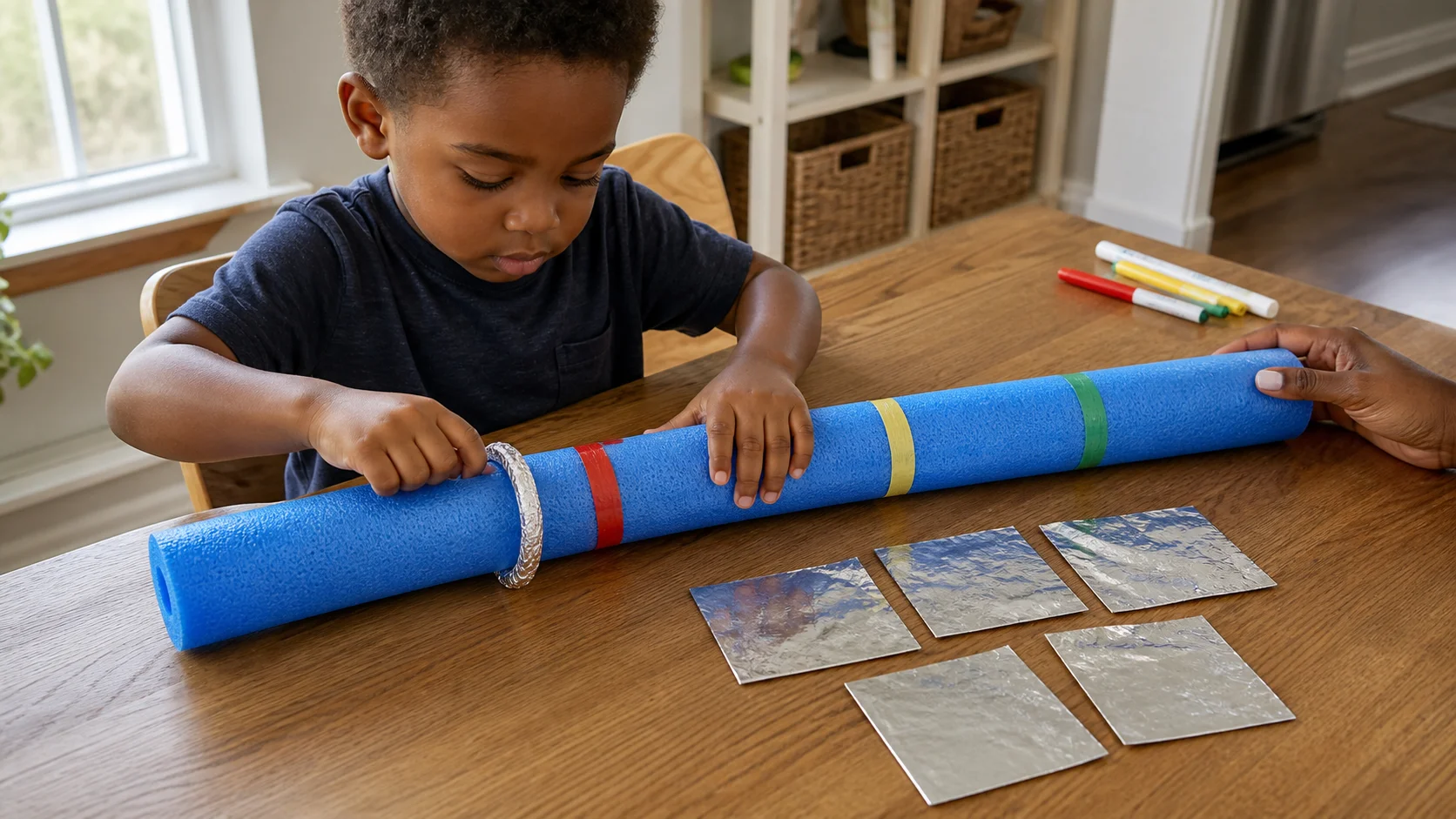
A preschool child sliding a loose foil ring along a striped pool noodle toward a matching color band.
Fine motorOT-adjacent supportTwo Hand CoordinationIndoor Table Or Floor Workspace

Foil Ring Noodle Slide.

Children make loose foil rings, slide them along a striped pool noodle, and stop each ring at a matching color band.

Play time
5-10+ min
Age
3-5 years
Energy
Low
Mess
Low
Effort
Low
Where
Indoor Table Or Floor Workspace
Start here

The recipe.

Low parent effort
4 things

What you need

  • Aluminum foil
  • Markers
  • 1 pool noodle
  • 1 adult for direct supervision
5 min minimum

Setup

Then start the loop
Step 01
On a low table or floor workspace, lay the pool noodle sideways in front of where your child will sit or stand.
Step 02
Around the pool noodle, draw a few bright color bands with visible space between them.
Step 03
At one open end of the noodle, leave clear space before the first color band so each ring can start sliding easily.
Step 04
Beside your child's helper-hand side, place 5 foil squares about the size of a piece of bread.
Step 05
On the play surface, keep the markers and any extra foil out of reach before the first turn starts.
Step 06
Before the first turn, ask your child to hold the noodle with one hand. If it rolls away, steady it lightly while they learn the motion.
"Steady noodle."
The loop

How play unfolds.

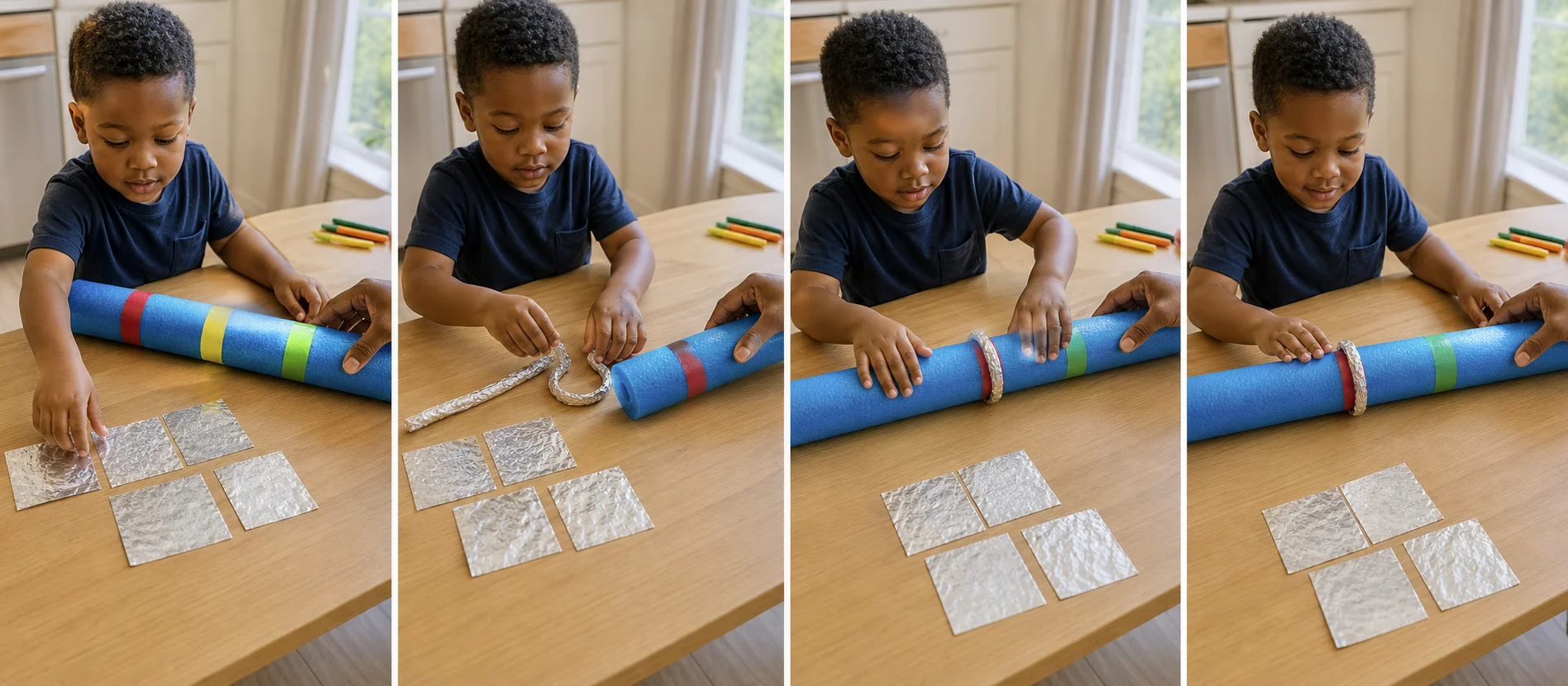
A child rolls foil into a ring, steadies a striped pool noodle, slides the ring, and stops it at the matching color.
  1. 01
    Roll a foil square into a long skinny snake, then bend it into a loose ring and twist the ends closed.
  2. 02
    Slide the ring onto the open end of the noodle and say, "Steady noodle. Same color."
  3. 03
    Let your child hold the noodle with one hand and push the ring toward the matching stripe with the other hand.
  4. 04
    If the ring sticks or passes the stripe, widen it, back it up, or aim for the nearest color.
  5. 05
    Make the next ring and repeat until the prepared rings reach stripes or the foil stops being used safely.

Safety Check

  • Supervise the whole activity.
  • Aluminum foil can have thin edges, and small pieces can become choking hazards.
  • Remove torn foil scraps right away.
  • If foil goes near your child's mouth, pause, collect the foil, and restart only when hands are back on the noodle.
  • Keep each ring loose enough to slide; a tight ring can scrape, stick, tear, and raise frustration quickly.
Supporting the play

What to say in the moment

Match what you say to what you see.

Prompt ladder
Level 1 (Start)
"Hold the noodle still while I start the ring."
Level 2 (Keep going)
"Push it to the same color."
Level 3 (Stretch)
"Can you stop right on the stripe?"
Level 4 (Extend)
"Pick the next color before we make the ring."
If your child seems...
What you'd see
Focused
What to do
Say
"You found the match."
Add
Ask for one color name while the ring is already moving.
Extend
Invite your child to choose whether the next ring starts fast or slow.

Make it easier

Younger end
  • -Start the ring halfway onto the noodle so your child only has to push.
  • -Use the widest ring first so it glides with less resistance.
  • -Aim for a stripe close to the open end before trying farther colors.

Make it harder

Older end
  • +Ask your child to stop the ring before it passes the stripe.
  • +Have your child hold the noodle steady without adult support for one turn.
  • +Let your child choose the color target before the ring goes on.

If it's not working

If you see
If child ignores it
Make 1 ring yourself, slide it to a stripe, and invite your child to pick the next color.
If you see
If child misuses it
If the foil goes near the mouth or gets torn into small scraps, pause, collect the foil, and restart with only 1 ring in play.
If you see
If child gets frustrated
Make the next ring wider, hold the noodle steady for them, and aim for the nearest matching stripe.
Skill spotlight
Two-Hand Coordination

Two-hand coordination, Fine motor control

Using two hands for different jobs helps children manage everyday tasks that need a helper hand and a working hand, like eating with utensils, dressing, and simple craft play.

  • The noodle gives one hand a steadying job while the other hand pushes the ring.
  • Rolling and twisting foil asks for controlled finger pressure before the sliding starts.
  • The color bands give your child a visible target, so matching and stopping are part of the same small game.
Real-world transfer
  • Holding paper still while drawing
  • Using a spoon or fork with steadier hands
  • Pulling clothing through openings
  • Stringing large items
  • Slowing down before a hand task overshoots

Parent questions