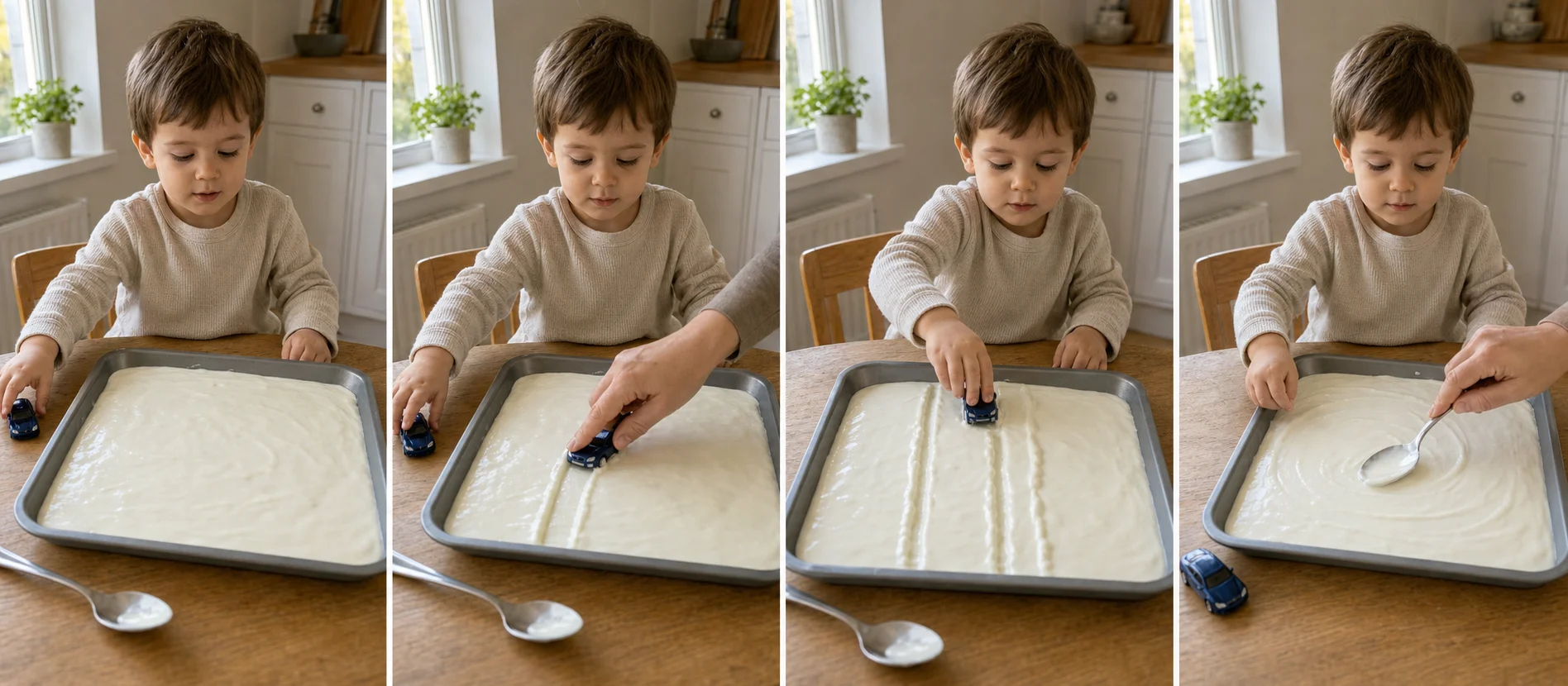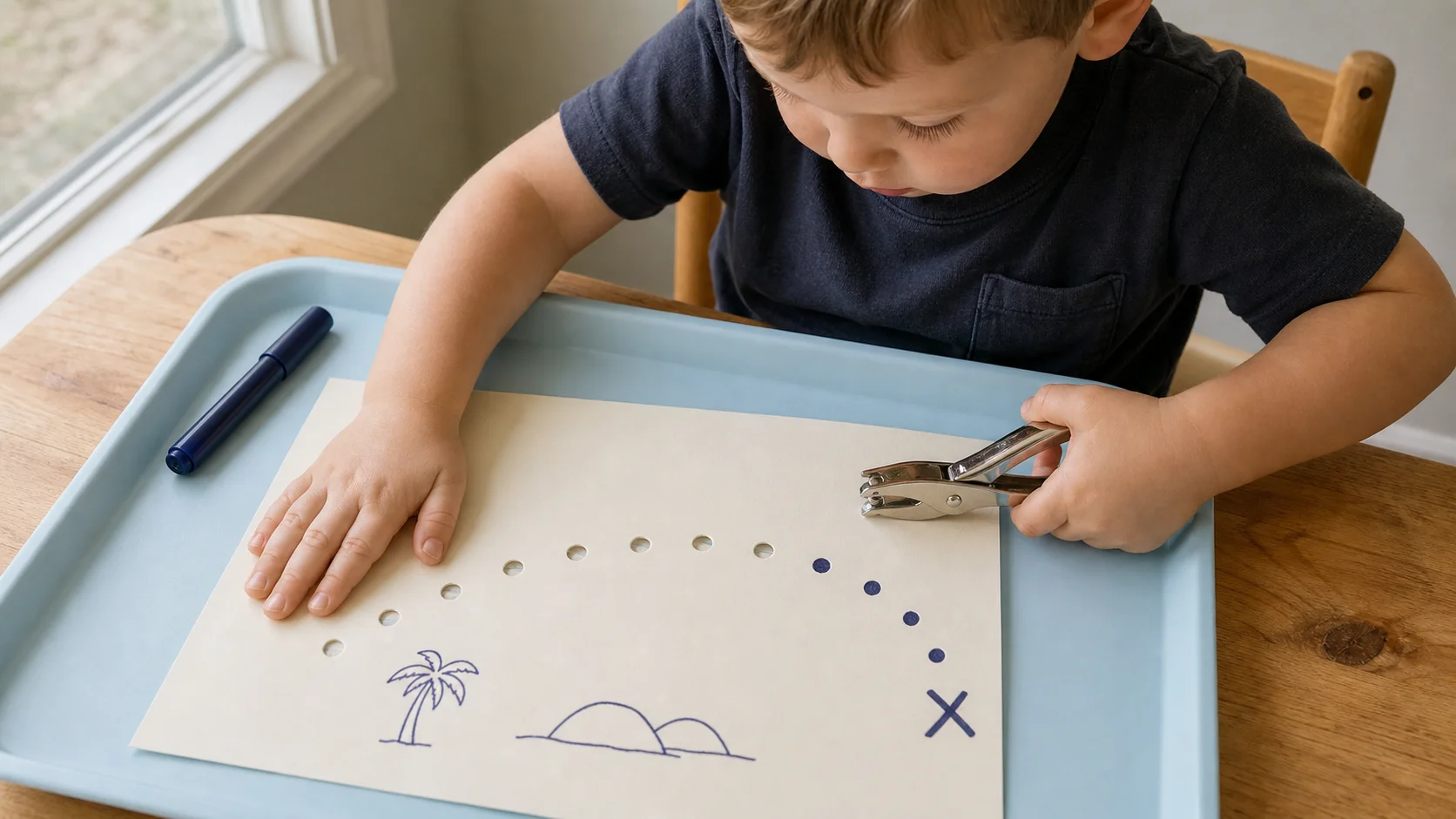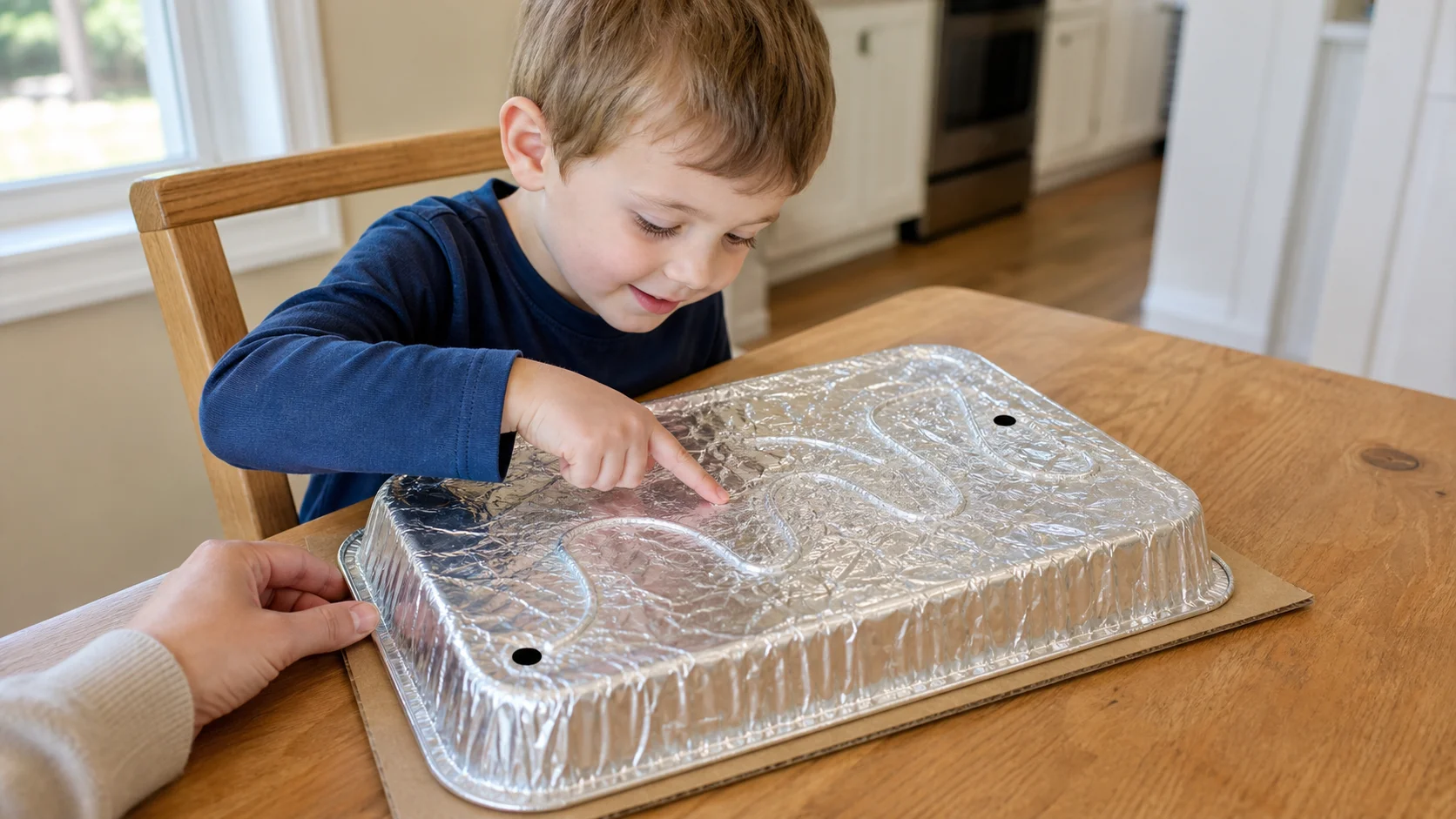
A child tracing a raised yarn path hidden under a foil pan with one pointer finger.
ThinkingOT-adjacent supportMove Through Path`Indoor Table Or Floor Workspace

Foil Bump Maze.

Hide a yarn path under foil and let your child trace the raised road with one careful pointer finger.

Play time
5-10+ min
Age
3-5 years
Energy
Low
Mess
Low
Effort
Medium
Where
Indoor Table Or Floor Workspace
Start here

The recipe.

Medium parent effort
6 things

What you need

  • 1 piece of sturdy cardboard
  • Markers
  • Glue
  • Yarn
  • 1 aluminium foil pan
  • 1 adult for setup and direct supervision
5 min minimum

Setup

Then start the loop
Step 01
On a table or floor workspace, place the sturdy cardboard flat.
Step 02
On the cardboard, draw one winding maze with a clear start and finish.
Step 03
Along the full maze path, trace glue over the marker line.
Step 04
Onto the glue line, press yarn so it follows the maze path from start to finish.
Step 05
On the same flat surface, let the glued yarn dry until it stays attached when you tap it.
Step 06
Inside the foil pan, place the dried cardboard maze.
Step 07
Over the cardboard, turn the foil pan so the cardboard is hidden underneath and the foil is on top.
Step 08
Near the outside edge of the pan, make tiny marker dots for the start and finish if you need a reminder.
Step 09
In front of the foil-covered maze, seat your child with one hand free to trace.
"Find the bump."
The loop

How play unfolds.

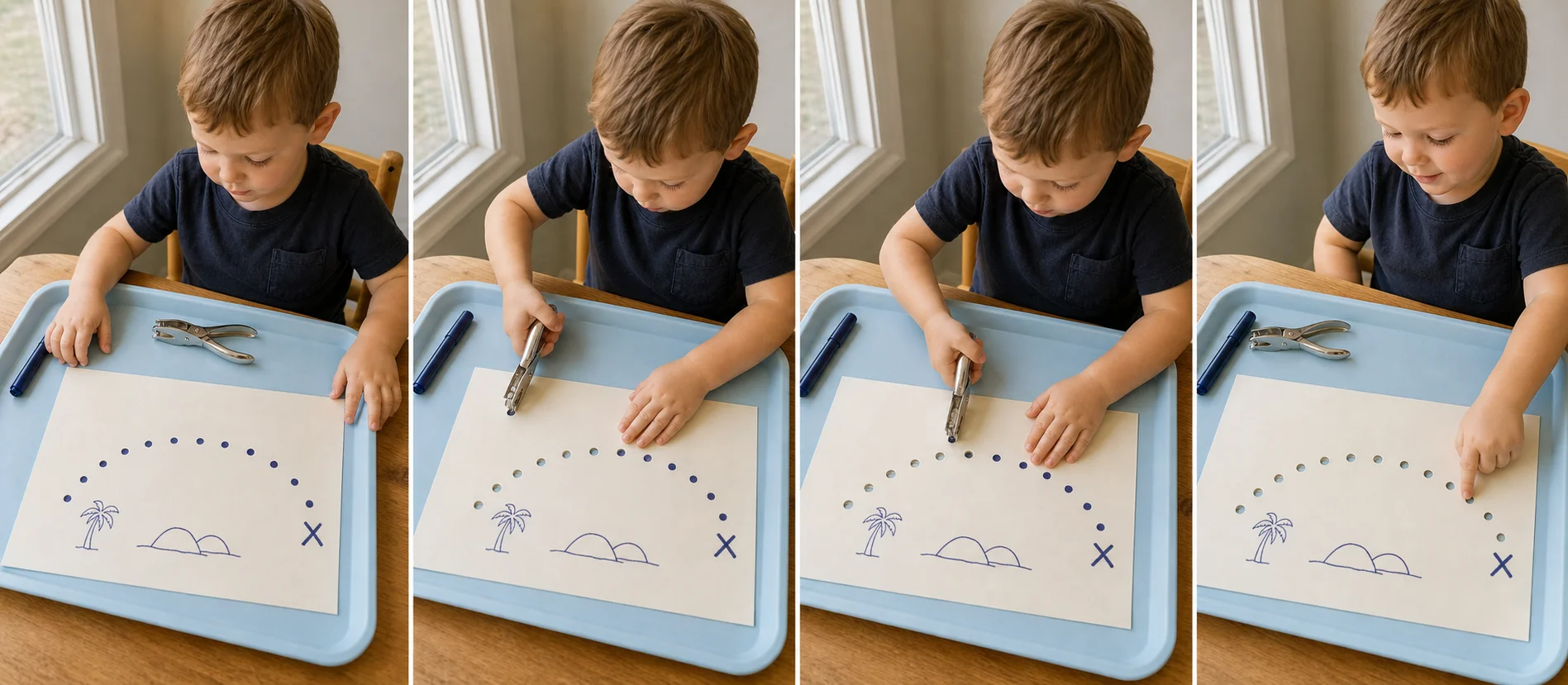
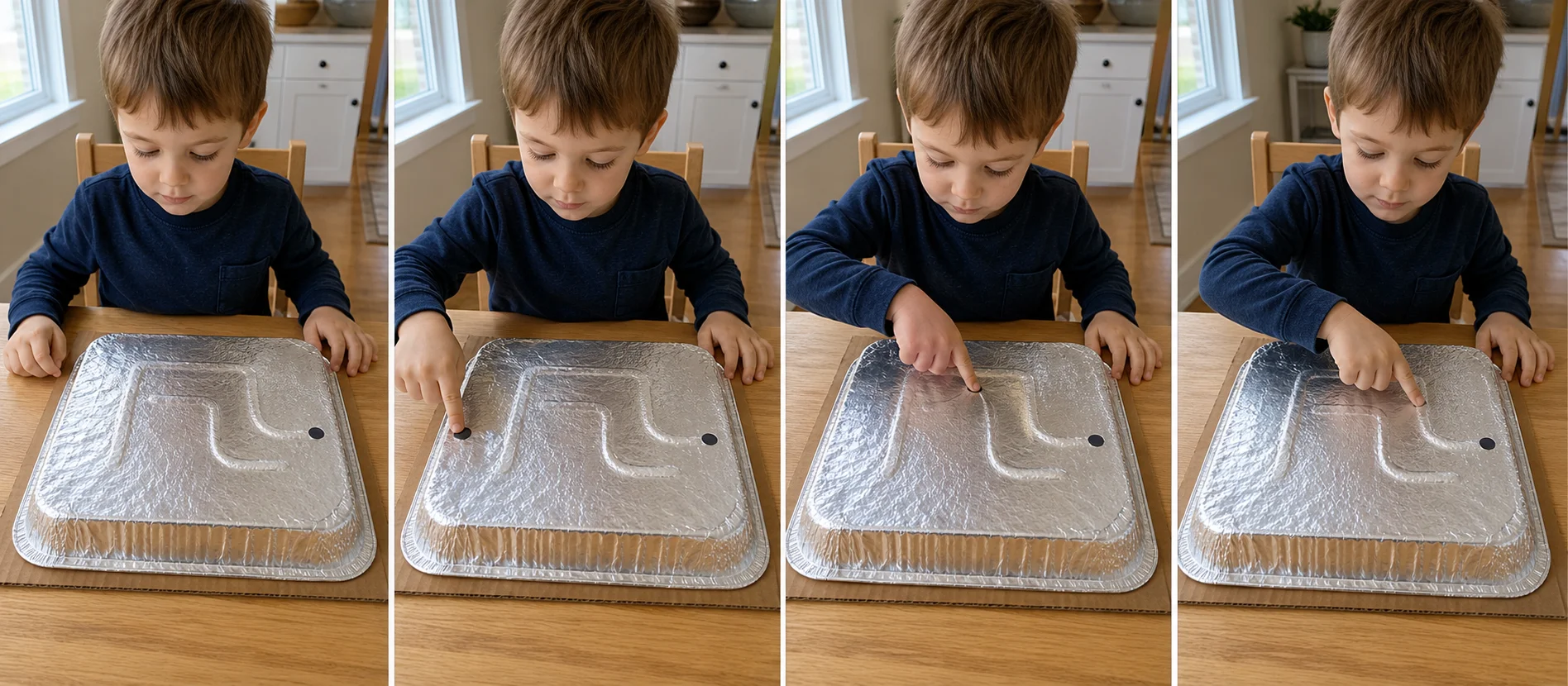
A three-step sequence showing a grown-up setting up the hidden yarn path, a child finding the bump, and the child tracing to the finish.
  1. 01
    Press your pointer finger on the foil at the start and say, "There is a secret bumpy road under here."
  2. 02
    Let your child press one pointer finger into the foil and slide along the raised path.
  3. 03
    When your child reaches the finish, say, "You found the end."
  4. 04
    Move back to the start and repeat the press, feel, slide, and finish loop.
  5. 05
    If your child loses the bump, help them find the nearest raised spot instead of starting over unless they want a fresh try.

Safety Check

  • Supervise closely while your child uses yarn, glue, markers, and the foil pan.
  • Move glue, markers, and extra yarn away before tracing starts.
  • Start only after the glue is dry so the yarn does not slide loose under the foil.
  • Stop or simplify if the foil crumples, tears, sounds unpleasant, or feels uncomfortable to your child.
Supporting the play

What to say in the moment

Match what you say to what you see.

Prompt ladder
Level 1 (Start)
"Press one pointer finger and feel for the bumpy road."
Level 2 (Keep going)
"Slide slowly and keep your finger on the bump."
Level 3 (Stretch)
"Can you find the next turn?"
Level 4 (Extend)
"Try another trip back to the start."
If your child seems...
What you'd see
Focused
What to do
Say
"Your finger is following the hidden road."
Add
Name the direction once, like "turn" or "straight."
Extend
Invite one more run from finish to start.

Make it easier

Younger end
  • -Begin halfway along the maze on a straight section instead of at the start.
  • -Let your child peek under the pan before each run, then cover it again.
  • -Keep your finger next to theirs as a guide without taking over.

Make it harder

Older end
  • +Ask your child to trace back from the finish to the start.
  • +Invite a no-peek run after one practice run with the path visible.
  • +Add one slow count while the finger is already moving.

If it's not working

If you see
If child ignores it
Press your own finger into the foil, trace one slow section, and invite them to feel the same bump with one finger.
If you see
If child misuses it
If they pound, tear, or crumple the foil, pause and reset with "gentle pointer finger only," then model one slow slide.
If you see
If child gets frustrated
Start on the easiest straight section, guide their finger to the next bump, or lift the pan for a quick peek before covering it again.
Skill spotlight
Move Through Path`

Pointer-finger path following., Feeling and following a hidden bump.

This helps the child use one finger on purpose, follow a path, and adjust when the road changes direction.

  • Pressing one pointer finger into the foil gives your child a clear, small movement to practice.
  • The raised yarn path gives touch feedback, so your child can feel where to go next.
  • Finding the bump again after a miss makes the reset simple and low-pressure.
Real-world transfer
  • Pointing to small details in a book
  • Pressing a button with one finger
  • Tracing simple lines before writing
  • Staying with a careful hand task

Parent questions