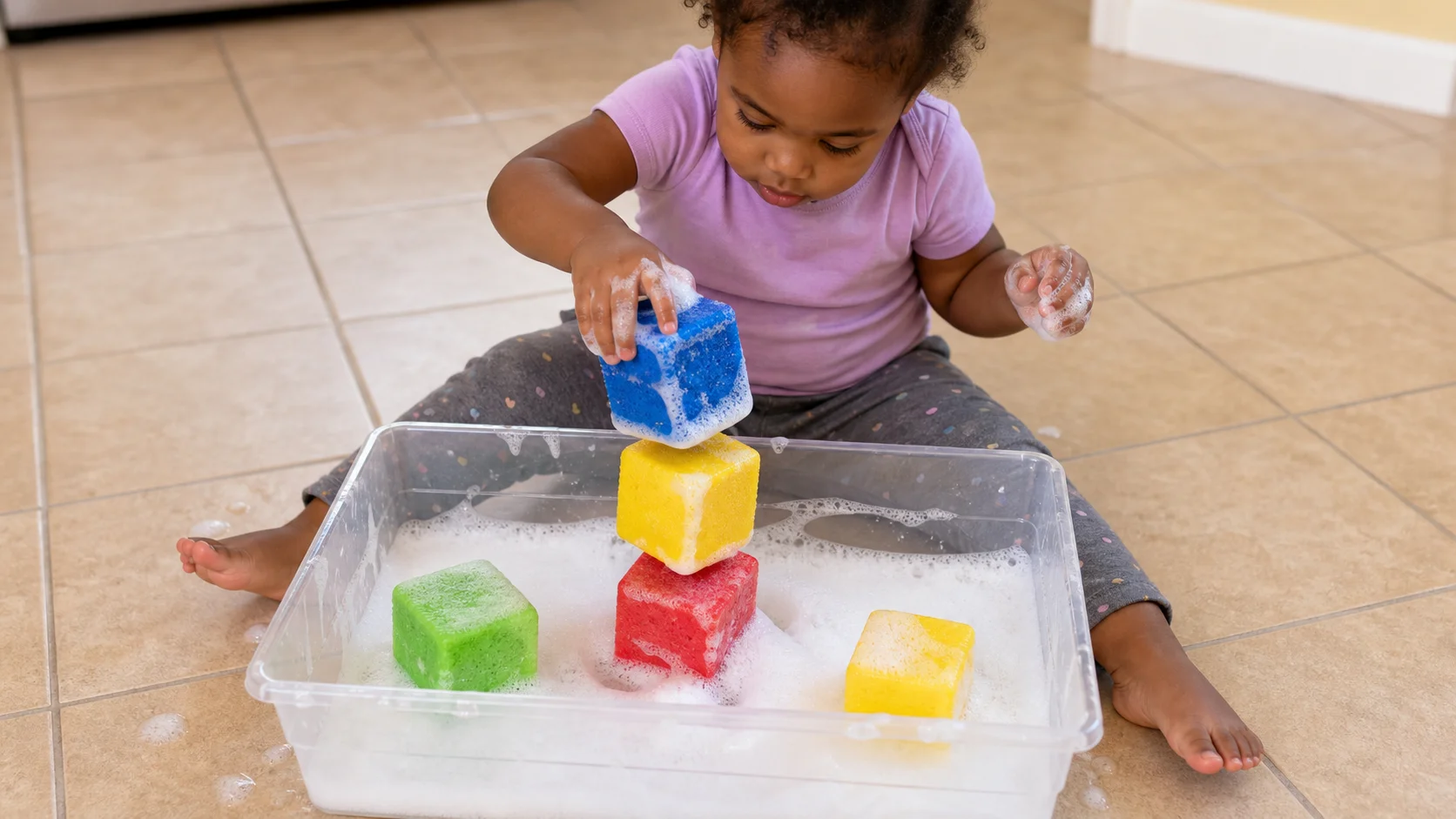
Toddler reaching into a shallow bin of soap foam to grab colorful blocks.
Fine motorPlace With Control`Indoor Sensory Bin Play

Foamy Blocks.

Soap foam and blocks make a quick sensory bin with grabbing, stacking, knocking down, and repeat.

Play time
5-10+ min
Age
1-2 years
Energy
Low
Mess
Low
Effort
Low
Where
Indoor Sensory Bin Play
Start here

The recipe.

Low parent effort
7 things

What you need

  • Baby soap
  • Water
  • 1 hand mixer
  • 1 shoe-box-sized storage bin
  • 5 child-safe blocks in different colors
  • 1 adult for direct supervision
  • 1 child
5 min minimum

Setup

Then start the loop
Step 01
In the storage bin, add a few squirts of baby soap and a little water.
Step 02
Inside the bin, use the hand mixer to whip the soap and water until the bottom is covered with about half an inch of foam.
Step 03
Inside the foam, place the 5 blocks so each one is still easy to see and grab.
Step 04
On a stable indoor floor or low surface, set the bin in front of your child with enough open space for a short tower inside the bin.
Step 05
Next to your child, sit close enough to block tasting, big scoops, or a full-bin dump right away.
"Foam and block."
The loop

How play unfolds.

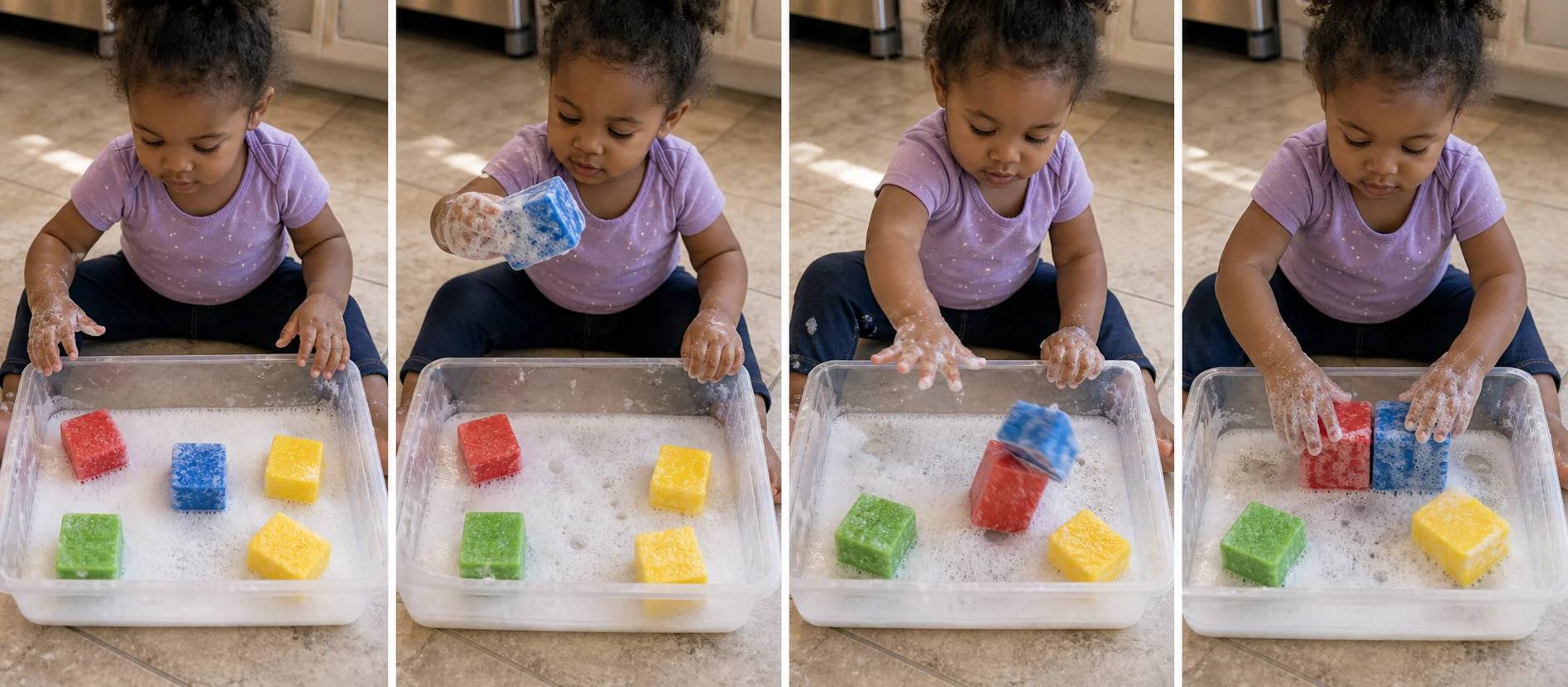
Four-panel sequence showing foam setup, block discovery, tower crash, and rebuilding inside the bin.
  1. 01
    Tap one visible block in the foam and say, "Feel the foam and find a block."
  2. 02
    Let your child touch the foam, lift a block, and push it through the suds.
  3. 03
    When the block play slows, stack two or three blocks into a short tower inside the bin.
  4. 04
    Let your child knock the tower down.
  5. 05
    Put the blocks back in the foam and repeat the touch, grab, tower, and crash loop while interest lasts.

Safety Check

  • Use child-safe soap and stay close the whole time.
  • If your child keeps tasting foam, pause, wipe hands, and restart with less foam or end the activity.
  • Use blocks that are child-safe and too large to mouth.
  • The hand mixer is for adult setup only. Put it away before your child starts playing.
Supporting the play

What to say in the moment

Match what you say to what you see.

Prompt ladder
Level 1 (Start)
Touch the foam and grab 1 block.
Level 2 (Keep going)
Push the block through the bubbles and find another one.
Level 3 (Stretch)
Knock down my tiny tower.
Level 4 (Extend)
Build it again your way.
If your child seems...
What you'd see
Focused
What to do
Say
"You are moving the block through the foam."
Add
Name 1 visible color or block shape while your child keeps moving.
Extend
Stack 2 blocks inside the bin and wait for the knockdown.

Make it easier

Younger end
  • -Keep only 1 block above the foam and 1 block in your hand for a clear choice.
  • -Build the tower for your child and let your child do only the knockdown.
  • -Hold the bin steady between your knees so slippery blocks stay within reach.

Make it harder

Older end
  • +Ask your child to find a named color before you build the tower.
  • +Pause after 1 block is placed and let your child add the next block.
  • +Invite a gentle hand push instead of a full-arm knockdown.

If it's not working

If you see
If child ignores it
Start with only 2 blocks showing above the foam and knock 1 over yourself so your child can copy the easiest part first.
If you see
If child misuses it
If your child keeps tasting foam or starts dumping suds out, pause, wipe hands, say, "Foam stays in the bin," and restart with 1 block at a time.
If you see
If child gets frustrated
Move 1 block close to your child's hand, help stack just 2 blocks, and let your child do only the knockdown for a few turns.
Skill spotlight
Place With Control`

Careful block placement

This helps the child steady a slippery object, aim it toward another object, and keep using hands after a crash. Those same hand skills show up in stacking, cleanup, and simple helping routines.

  • Foam changes how blocks feel, so your child practices adjusting their grasp while still reaching for a clear target.
  • The short tower gives the play an obvious result: build, crash, reset.
  • Repeating the same block loop helps your child return to the activity after something falls apart.
Real-world transfer
  • Stacking and fitting toys with steadier hands
  • Placing objects into bins, baskets, or shelves
  • Staying with a simple play loop after something falls apart

Parent questions