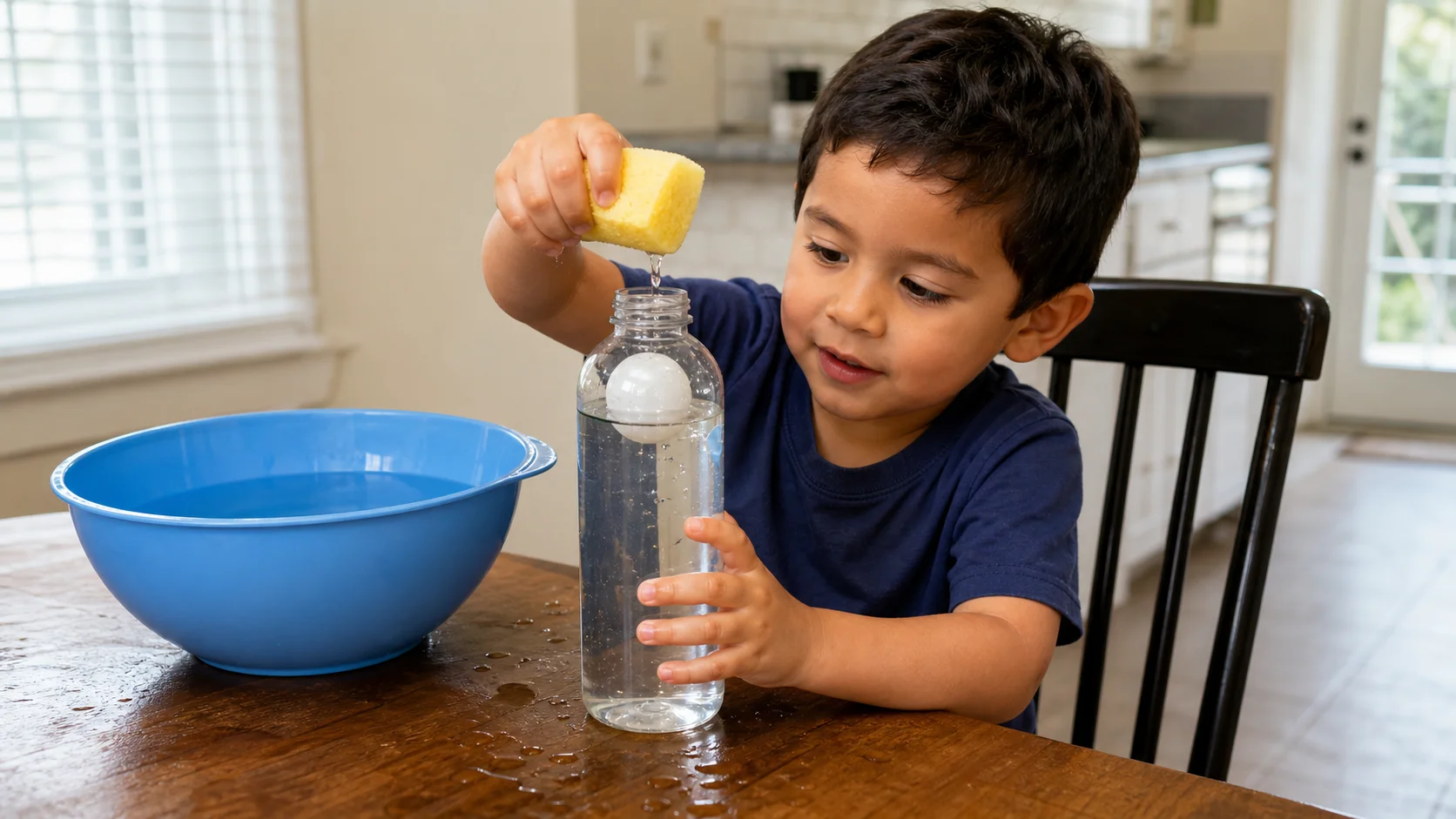
Child squeezing a wet sponge over a clear bottle while a ping pong ball floats upward inside.
Fine motorOT-adjacent supportSqueeze And Release`Indoor Table

Floating Ball Sponge Rescue.

Sponge squeezes raise a floating ball until preschoolers can pinch it out and reset.

Play time
5-10+ min
Age
3-5 years
Energy
Low
Mess
Low
Effort
Low
Where
Indoor Table
Start here

The recipe.

Low parent effort
7 things

What you need

  • 1 empty clear plastic bottle with a wide opening
  • 1 lightweight ping pong ball
  • 1 large bowl
  • Cool water
  • 1 sponge
  • 1 flat table
  • 1 adult for close supervision
5 min minimum

Setup

Then start the loop
Step 01
On a flat indoor table, place the empty clear bottle upright and check that it does not wobble.
Step 02
Inside the bottle, drop the lightweight ping pong ball to the bottom.
Step 03
Beside the bottle, place the large bowl filled with enough cool water to soak the sponge.
Step 04
Next to the bowl, set the sponge where your child can dunk it and lift it straight to the bottle opening.
Step 05
At the table, place your child where one hand can stay on the bottle while the other hand lifts and squeezes the sponge.
"Dip, lift, squeeze."
The loop

How play unfolds.

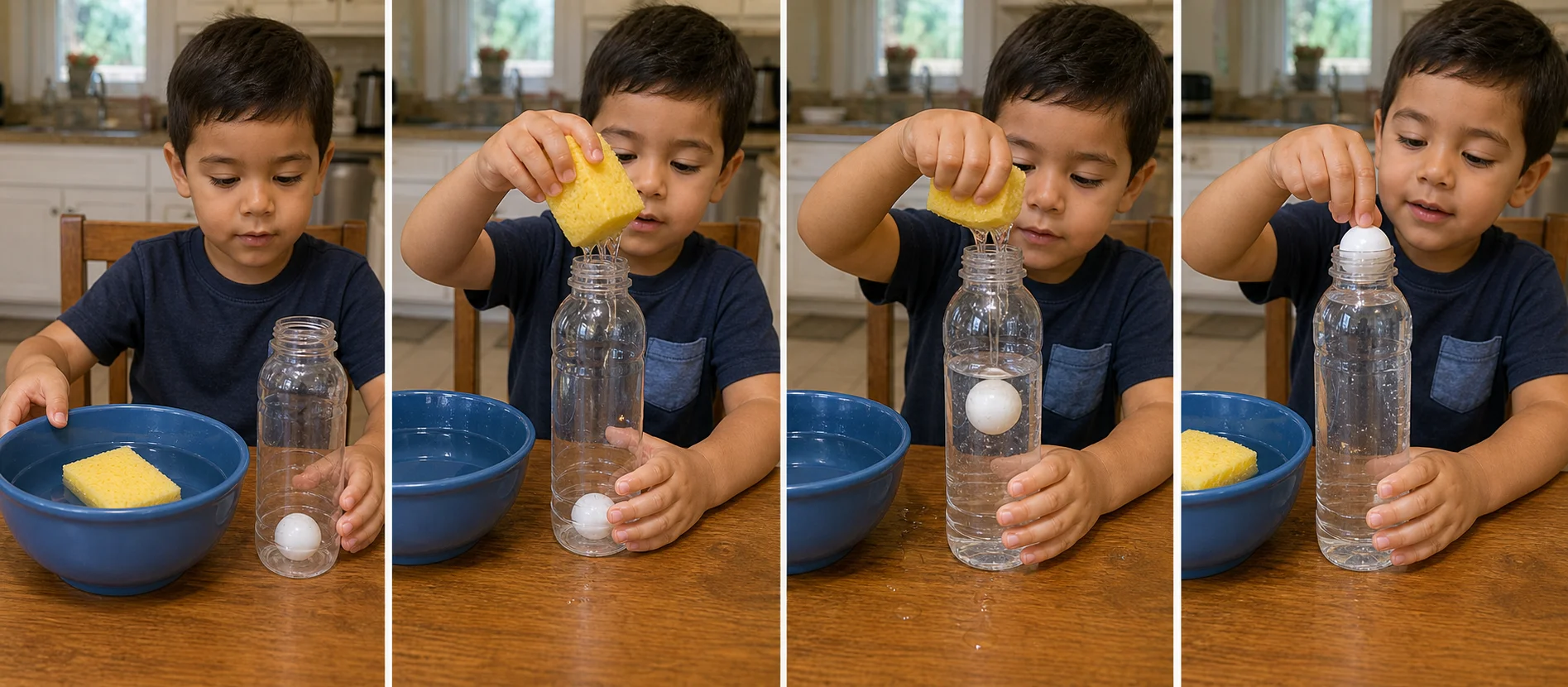
Three-panel sequence showing sponge dunking, water squeezing into the bottle, and the child pinching out the floating ball.
  1. 01
    Squeeze the wet sponge over the bottle once and let your child see the ball rise.
  2. 02
    Say, "Soak the sponge, squeeze over the hole, and make the ball float up."
  3. 03
    Let your child dunk the sponge, steady the bottle, and squeeze water through the opening.
  4. 04
    Pause after each squeeze so your child can watch the ball climb.
  5. 05
    Repeat until the ball reaches the top, then let your child pinch it out.
  6. 06
    Pour the bottle water back into the bowl, drop the ball in again, and start another rescue if your child wants more.

Safety Check

  • Supervise closely during water play.
  • Use a bottle with a wide opening and no sharp plastic edges.
  • Wipe table or floor drips quickly so the water does not become slippery or frustrating.
Supporting the play

What to say in the moment

Match what you say to what you see.

Prompt ladder
Level 1 (Start)
"Dip the sponge and squeeze it over the bottle."
Level 2 (Keep going)
"Watch the ball climb after each squeeze."
Level 3 (Stretch)
"Can you make the next squeeze land right in the opening?"
Level 4 (Extend)
"Rescue the ball, drop it back in, and try one more round."
If your child seems...
What you'd see
Focused
What to do
Say
"You are making the ball climb."
Add
Name the move: "Dip, lift, squeeze."
Extend
Pause after each squeeze so your child can notice the new water line.

Make it easier

Younger end
  • -Start with the bottle already partly filled so the ball rises sooner.
  • -Use two adult fingers to help aim the sponge over the opening.
  • -Ask for one squeeze per turn instead of a full rescue.

Make it harder

Older end
  • +Have your child predict whether the ball will move a little or a lot before squeezing.
  • +Ask your child to keep the helper hand on the bottle for the whole round.
  • +Try a slower squeeze to see if less water still makes the ball rise.

If it's not working

If you see
If child ignores it
Do the first squeeze yourself so your child can see the ball rise, then hand the sponge back for the next turn.
If you see
If child misuses it
If your child splashes or squeezes away from the bottle, slide the bowl beside the bottle and say, "Squeeze over the hole."
If you see
If child gets frustrated
Hold the bottle steady and ask for just one squeeze at a time until the ball starts moving again.
Skill spotlight
Squeeze And Release`

Squeezing with control.

This gives the child repeated practice using hand strength, helper-hand stability, visual focus, and pinching fingers for everyday tool and self-care tasks.

  • Squeezing the sponge gives your child repeated hand-strength practice with an immediate result.
  • Holding the bottle steady while the other hand squeezes keeps the two-hand job visible and concrete.
  • Watching the ball rise helps your child connect each squeeze to a clear cause and effect.
  • Pinching the ball out adds a small finish-line moment for finger control.
Real-world transfer
  • Squeezing bottles, washcloths, or other soft objects with control
  • Holding one item steady while the other hand works
  • Aiming hand movements toward a small target
  • Pinching small objects during dressing, eating, cleanup, and play

Parent questions