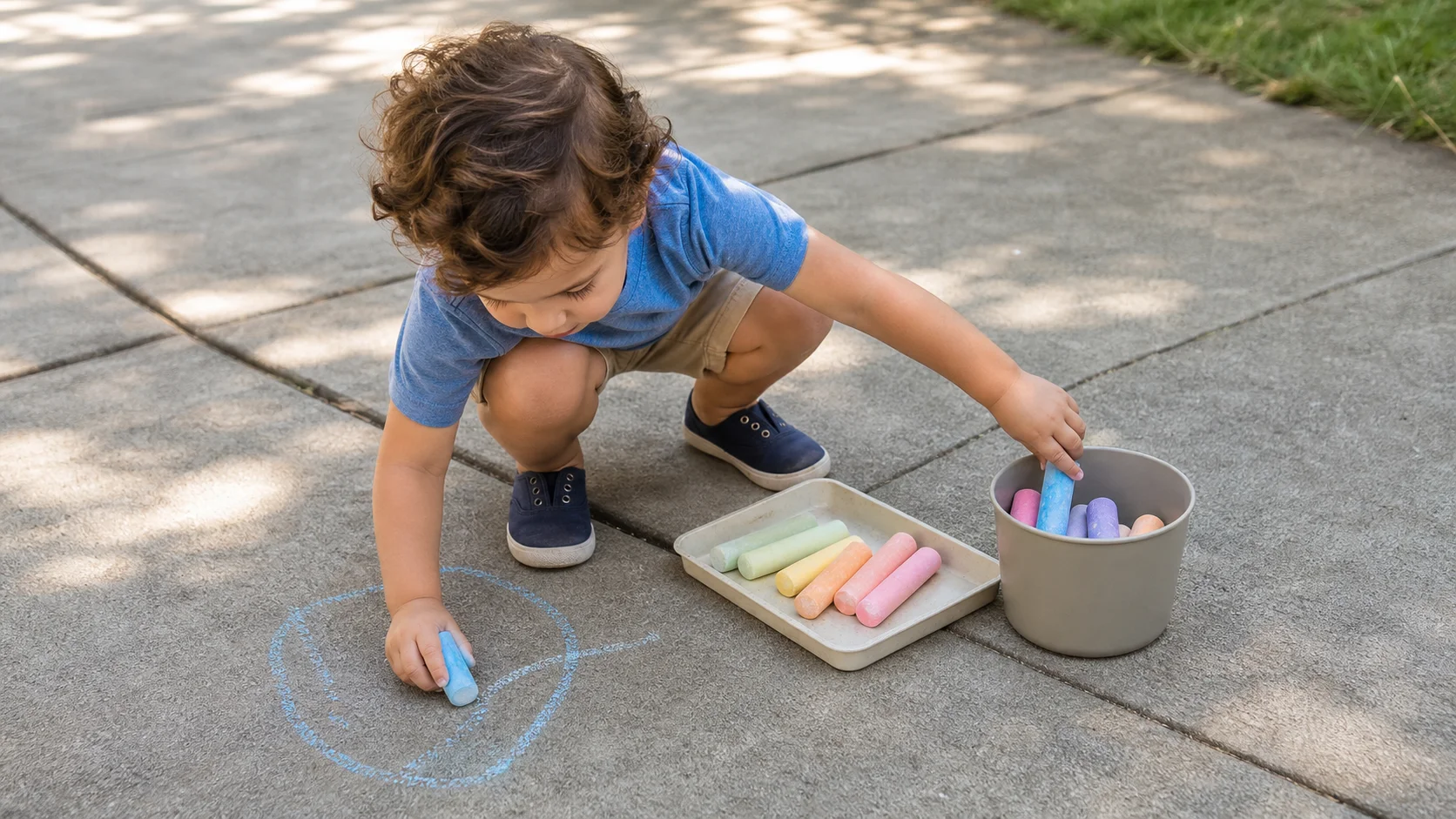
A young child outdoors drawing one chalk line on a driveway while a small finished bucket sits beside a tray of remaining chalk colors.
Skill builderAutism supportFinish And ResetOutdoor

Finished Bucket Chalk.

A simple sidewalk chalk routine where your child uses one color, drops it in a finished bucket, and repeats until the tray is empty.

Play time
5-15+ min
Age
2-4 years
Energy
Low
Mess
Low
Effort
Low
Where
Outdoor
Start here

The recipe.

Low parent effort
4 things

What you need

  • 1 tray
  • Several pieces of sidewalk chalk in different colors
  • 1 small bucket or container for finished chalk
  • 1 sidewalk, driveway, or other outdoor chalk-safe surface
5 min minimum

Setup

Then start the loop
Step 01
On a flat sidewalk or driveway, choose one drawing spot with enough room for your child to stand or squat safely.
Step 02
On the ground beside the drawing spot, place the tray with all the chalk pieces in one visible group.
Step 03
Right beside the tray, place the empty finished bucket close enough for an easy drop after each turn.
"One chalk, one turn."
The loop

How play unfolds.

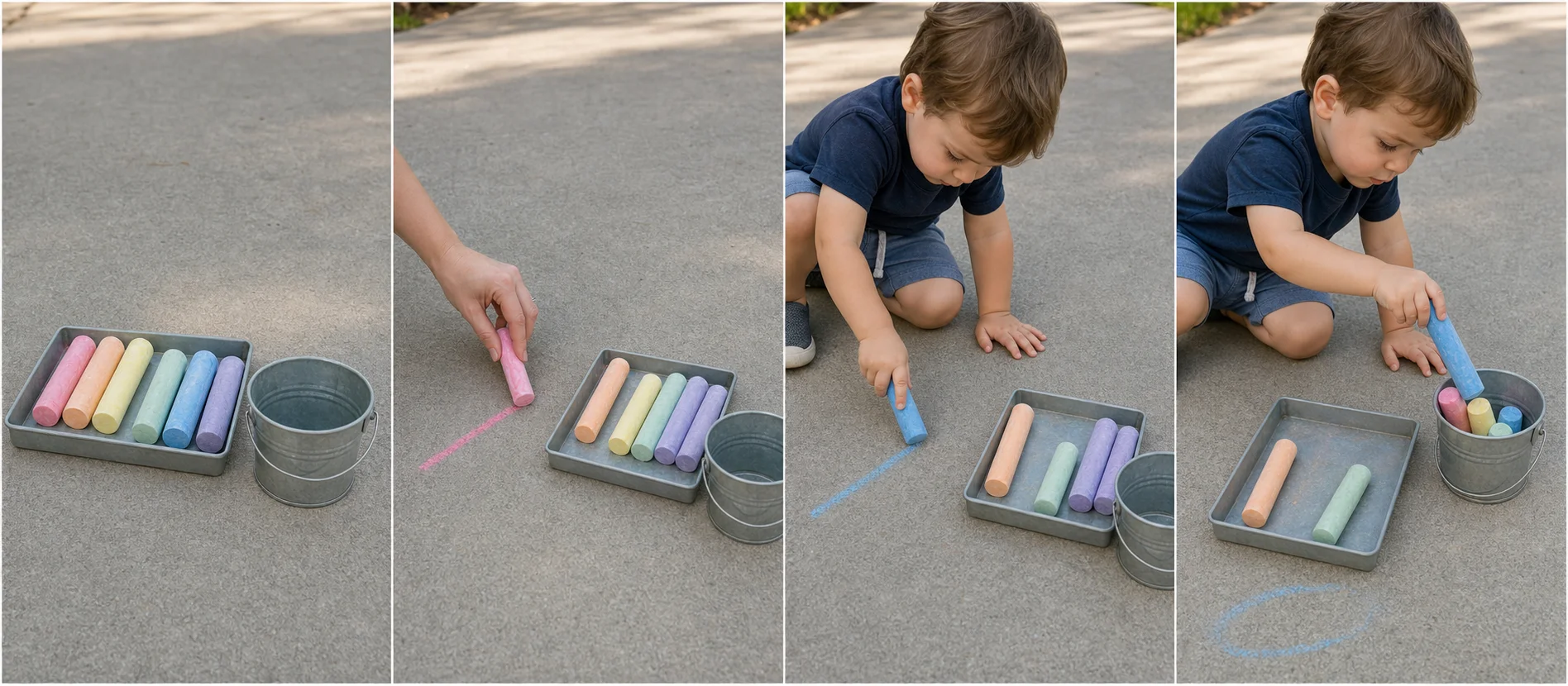
Four panels showing a tray of chalk and bucket on the ground, a grown-up modeling one chalk turn, a child dropping used chalk into the bucket, and the empty tray beside a full bucket at the end.
  1. 01
    Show your child one quick doodle with one chalk piece, then drop that chalk into the bucket.
  2. 02
    Say, "Draw, then bucket," and offer or point to the next color.
  3. 03
    Let your child make a mark and drop that chalk into the bucket before choosing another color.
  4. 04
    If a chalk piece gets skipped, point back to the bucket and restart the same turn.
  5. 05
    Keep going until the tray is empty and all the chalk is in the bucket.

Safety Check

  • Stay close if your child mouths chalk or throws objects.
  • Use a flat outdoor surface so the tray and bucket do not wobble while your child squats or steps around them.
  • Stop and wash hands if chalk dust starts bothering your child.
Supporting the play

What to say in the moment

Match what you say to what you see.

Prompt ladder
Level 1 (Start)
"Pick one color."
Level 2 (Keep going)
"Draw, then bucket."
Level 3 (Stretch)
"Which color goes in next?"
Level 4 (Extend)
"Can you make one more mark before bucket?"
If your child seems...
What you'd see
Focused
What to do
Say
"That one is done. Pick your next color."
Add
Name the color once after it goes in the bucket.
Extend
Let your child choose whether to draw a line, shape, or dot before the drop.

Make it easier

Younger end
  • -Use only two or three chalk colors.
  • -Keep the bucket touching the tray so the finish move is obvious.
  • -Accept one dot or short line as a full turn.

Make it harder

Older end
  • +Put the bucket a small step away from the tray.
  • +Ask your child to name or point to the next color before taking it.
  • +Let your child carry the finished bucket to the cleanup spot when the tray is empty.

If it's not working

If you see
If child ignores it
Use the brightest chalk, make one big line, tap it into the bucket, and offer the next color right away.
If you see
If child misuses it
Hold the tray beside you and offer one chalk piece at a time until the bucket step is clear again.
If you see
If child gets frustrated
Accept one tiny mark as a full turn, help with the bucket drop, and end after a few successful colors.
Skill spotlight
Finish And Reset

Finishing a short routine, Moving a used item to its done spot

This helps a child practice doing one short job, noticing when that job is done, and moving the used item to a clear finish spot. Those same habits show up in cleanup, transitions, and other short routines at home.

  • Early. Your child may need help choosing one chalk piece and may need a point or reminder to use the bucket.
  • Later. Your child runs the whole draw-and-bucket loop with little help and notices when the tray is almost empty.
  • Middle. Your child starts drawing with one color, drops it in the bucket after a prompt, and goes back for another piece.
Real-world transfer
  • Finishing one small task before starting the next one.
  • Putting used items in a clear done spot.
  • Moving through simple cleanup and transition routines.
Back to library
Keep playing

Related activities.