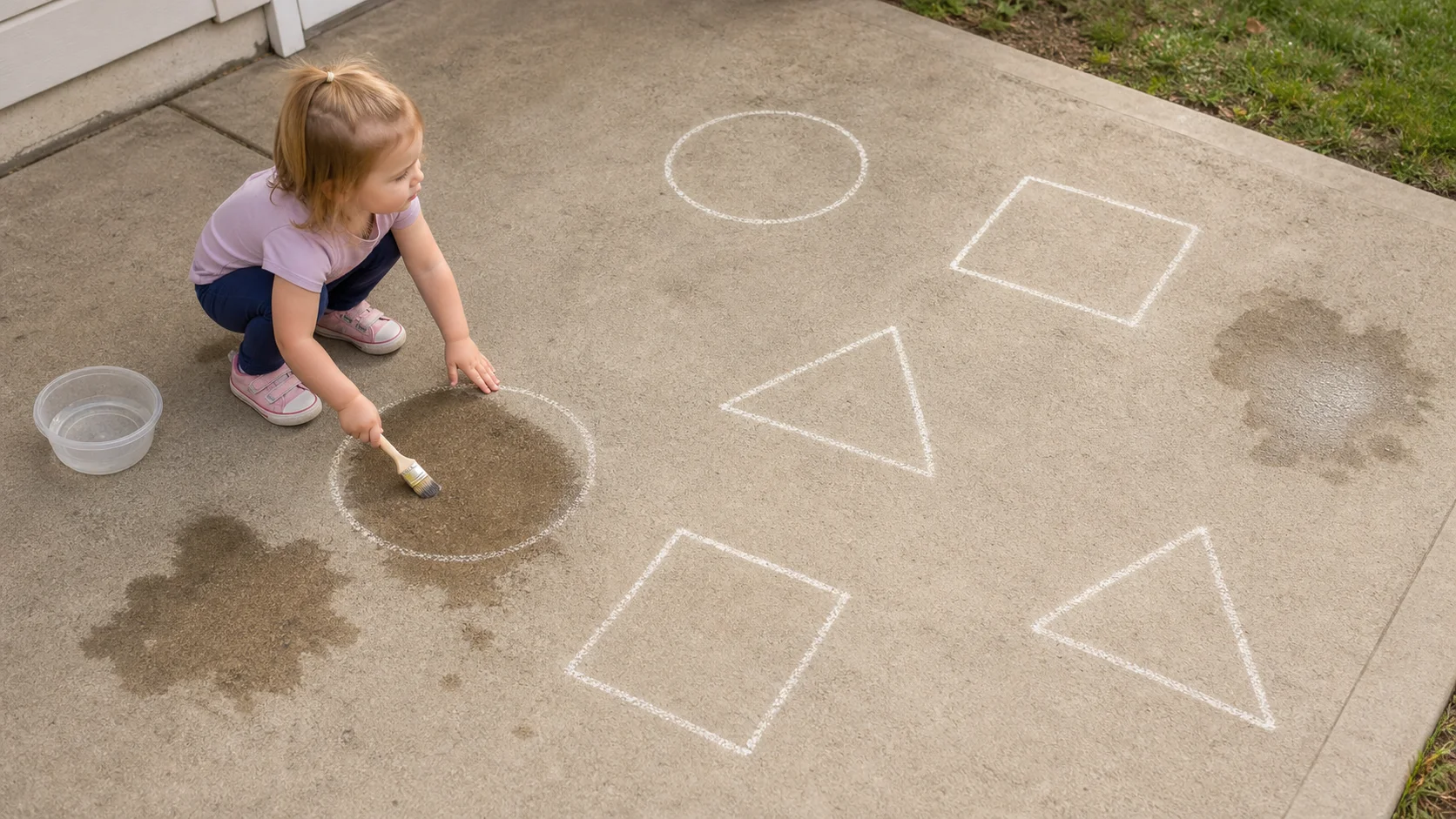
Toddler brushing water over a chalk circle on a sidewalk while matching shapes are nearby.
ThinkingVisual SameOutdoor Sidewalk Or Patio

Find and Erase Shapes.

Brush water over chalk shapes, find the matching partner, and watch each pair disappear.

Play time
10-15+ min
Age
2-3 years
Energy
Medium
Mess
Low
Effort
Low
Where
Outdoor Sidewalk Or Patio
Start here

The recipe.

Low parent effort
5 things

What you need

  • Sidewalk chalk
  • 1 real paintbrush
  • Water
  • 1 small cup or bowl
  • 1 dry sidewalk or patio spot
10 min minimum

Setup

Then start the loop
Step 01
On a dry sidewalk or patio, choose 1 play area where chalk will show clearly and your child can walk without traffic, puddles, or slick patches.
Step 02
In that play area, draw 2 circles, 2 squares, and 2 triangles large enough for your child to spot.
Step 03
Across the same play area, spread the matching shapes far enough apart that your child has to look around, but keep every shape visible from where you start.
Step 04
Beside the first shape, set a small cup or bowl with a shallow amount of water.
Step 05
Beside the water cup, place the paintbrush and wet it once so your child can see that water makes the chalk fade.
"Find one."
The loop

How play unfolds.

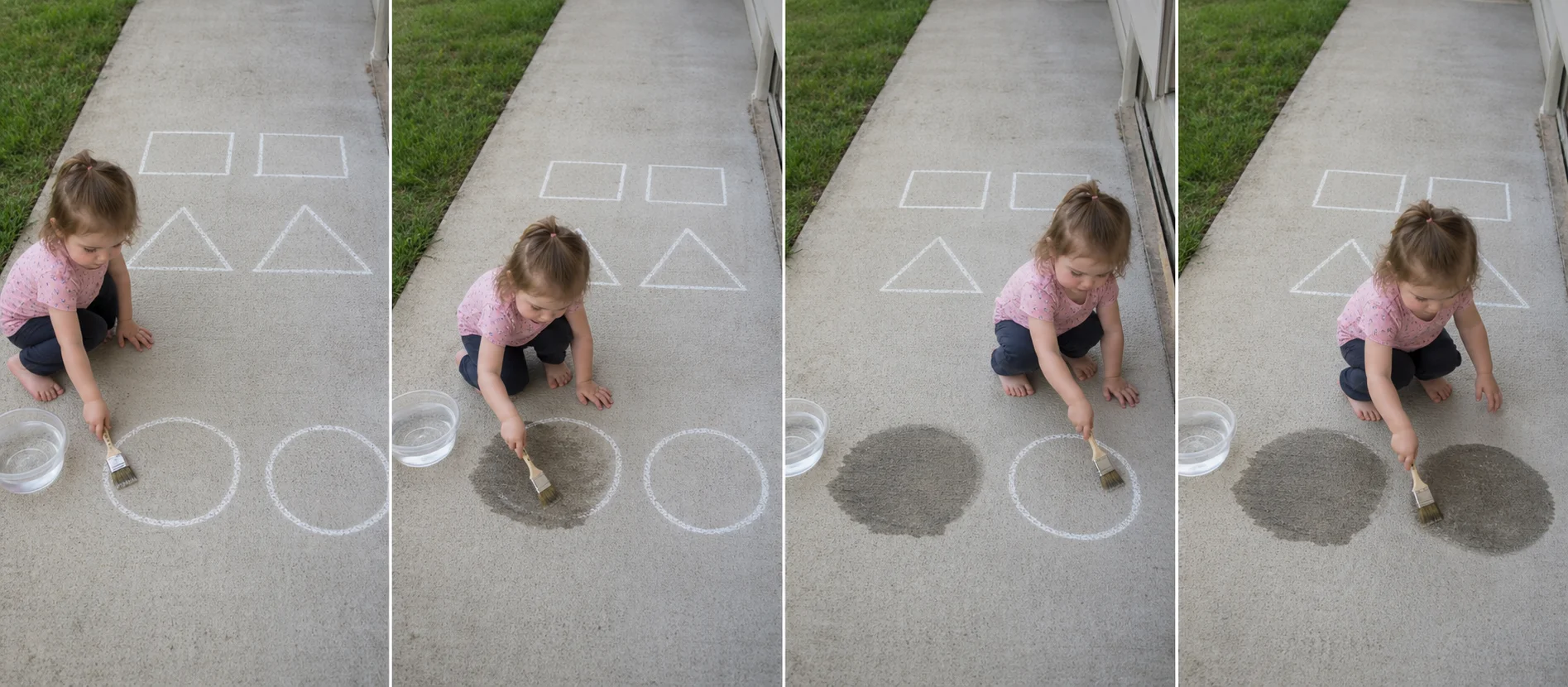
Three-panel sequence showing a grown-up pointing to a chalk shape, a toddler erasing it with water, and the child finding the matching shape.
  1. 01
    Point to 1 chalk shape, hand your child the wet paintbrush, and say, "Erase this shape, then find the same one."
  2. 02
    Let your child brush water over the first shape until the chalk fades.
  3. 03
    Ask, "Can you find the match?" and let your child search.
  4. 04
    Let your child erase the matching shape too.
  5. 05
    Choose a new pair and repeat until the shapes are gone, or draw another pair if your child wants more.

Safety Check

  • Wet pavement can become slippery, so keep the walking path mostly dry and stay close while your child moves between shapes.
  • A real paintbrush can become a poking or mouthing risk if the child stops using it as a brush.
Supporting the play

What to say in the moment

Match what you say to what you see.

Prompt ladder
Level 1 (Start)
"Erase this shape, then find the same one."
Level 2 (Keep going)
"You made one disappear, now hunt for its partner."
Level 3 (Stretch)
"Can you point to the match before your brush touches it?"
Level 4 (Extend)
"Let's do one more pair in green chalk."
If your child seems...
What you'd see
Focused
What to do
Say
"You got that one. Find the same shape again."
Add
Ask 1 simple shape prompt after the erase, such as "What shape was that?"
Extend
Let your child choose which visible pair to erase next.

Make it easier

Younger end
  • -Draw the next round with bigger shapes so the match stands out faster from across the patio.
  • -Walk your child to the first shape instead of sending them out to search alone.
  • -Let matching be the only job and give the shape name yourself after the brush starts moving.

Make it harder

Older end
  • +Ask your child to point to the matching shape before erasing the first one.
  • +Start each turn from the water cup so your child has to remember where the partner is while walking back out.
  • +Add 1 extra pair of a shape your child already knows and place it farther from the others.

If it's not working

If you see
If child ignores it
Start with only 1 pair of circles and erase one yourself. Say, "Your turn to make the other circle disappear."
If you see
If child misuses it
If the brush becomes a poke, splash, or throwing tool, hold the cup yourself and offer one dip at a time.
If you see
If child gets frustrated
Drop the naming demand. Say the shape for them and ask for the match: "This is a square. Can you find another square?"
Skill spotlight
Visual Matching

Matching same shapes by sight.

This helps your child notice what is the same and different, use shape words in real play, and compare what they see before acting. Those same comparison skills show up in puzzles, blocks, socks, picture cards, and simple "find the same one" directions.

  • Erasing one shape and then finding its partner gives same/different comparison an immediate purpose.
  • The wet brush keeps fine motor work visible because each stroke changes the chalk.
  • Repeating the pair loop helps your child hold one shape in mind while looking around.
Real-world transfer
  • Matching puzzle pieces, blocks, socks, or simple picture cards
  • Noticing shape words in books, signs, and toys
  • Comparing 2 choices before picking one
  • Following short "find the same one" directions

Parent questions