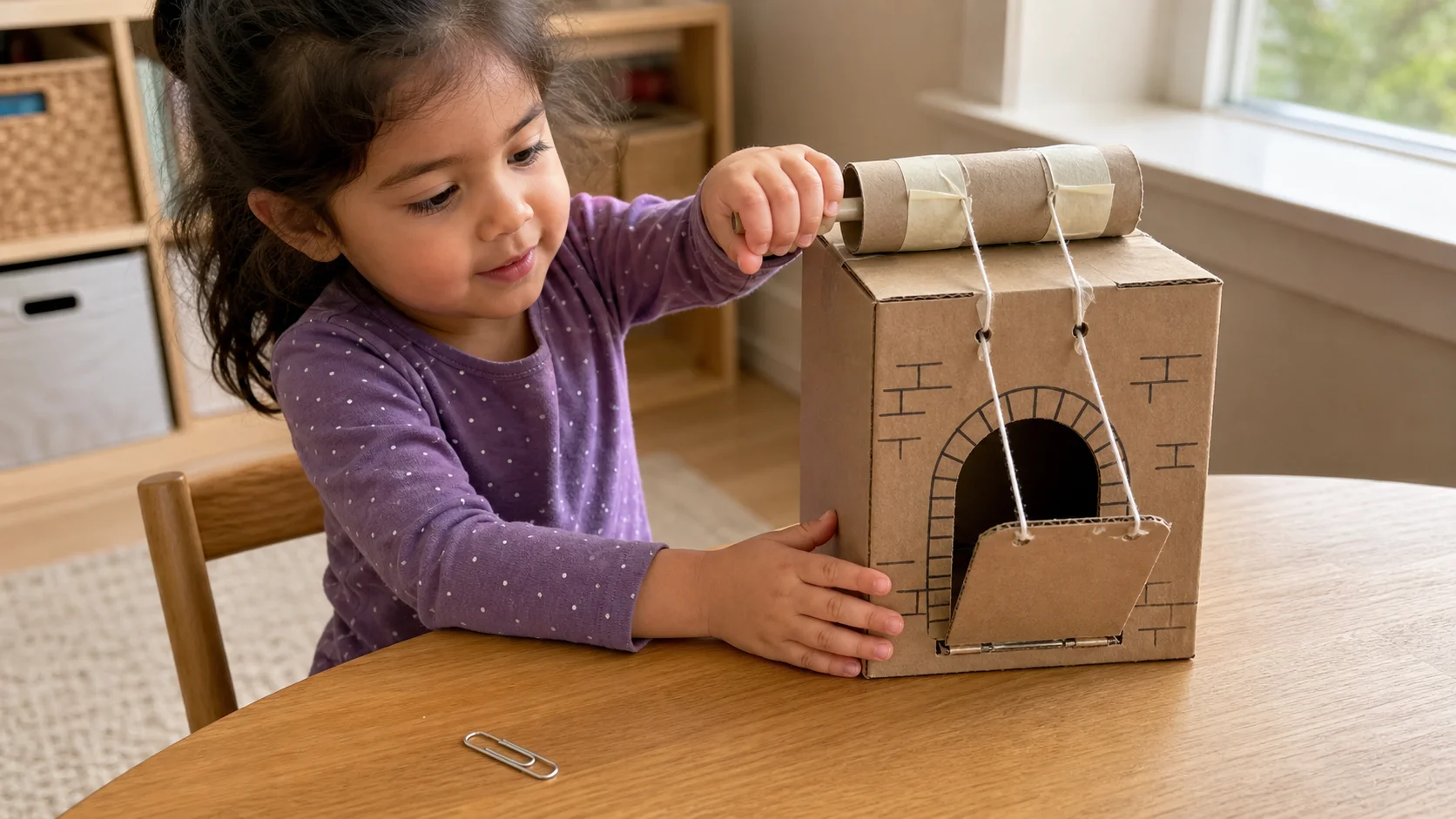
A preschooler twisting a paper-roll crank to lift a yarn-connected cardboard drawbridge.
Fine motorOT-adjacent supportTwo Hand Coordination`Indoor Table Or Floor Play Space

Drawbridge Crank Lift.

Turn a small cardboard box into a drawbridge your child can lift, clip, lower, and try again.

Play time
5-10+ min
Age
3-5 years
Energy
Low
Mess
Low
Effort
Medium
Where
Indoor Table Or Floor Play Space
Start here

The recipe.

Medium parent effort
9 things

What you need

  • 1 small cardboard box
  • Cardboard from the box door
  • 1 paper roll
  • 1 piece of yarn
  • 1 paper clip
  • Masking tape
  • Scissors
  • Markers, optional for decorating the box before play
  • 1 adult for setup and supervision
5 min minimum

Setup

Then start the loop
Step 01
On a counter or table away from your child, cut 1 rectangular door in the front side of the cardboard box.
Step 02
Leave the bottom edge attached so the door flips down like a drawbridge.
Step 03
At the top of the door, poke 2 small holes.
Step 04
Near the top of the box frame above the door, poke 2 more small holes.
Step 05
Through the door holes and the box-frame holes, thread 1 piece of yarn.
Step 06
Across the top of the box above the door, tape the paper roll horizontally so it can turn like a crank.
Step 07
To the paper roll, tie the yarn ends.
Step 08
On the floor or a low table, place the box upright with the drawbridge facing your child.
Step 09
Beside the box, set 1 paper clip where you can reach it easily.
Step 10
Before your child starts, twist the paper roll once to make sure the yarn tightens, the door lifts, and the roll stays taped down.
"Turn, turn, up it goes."
The loop

How play unfolds.

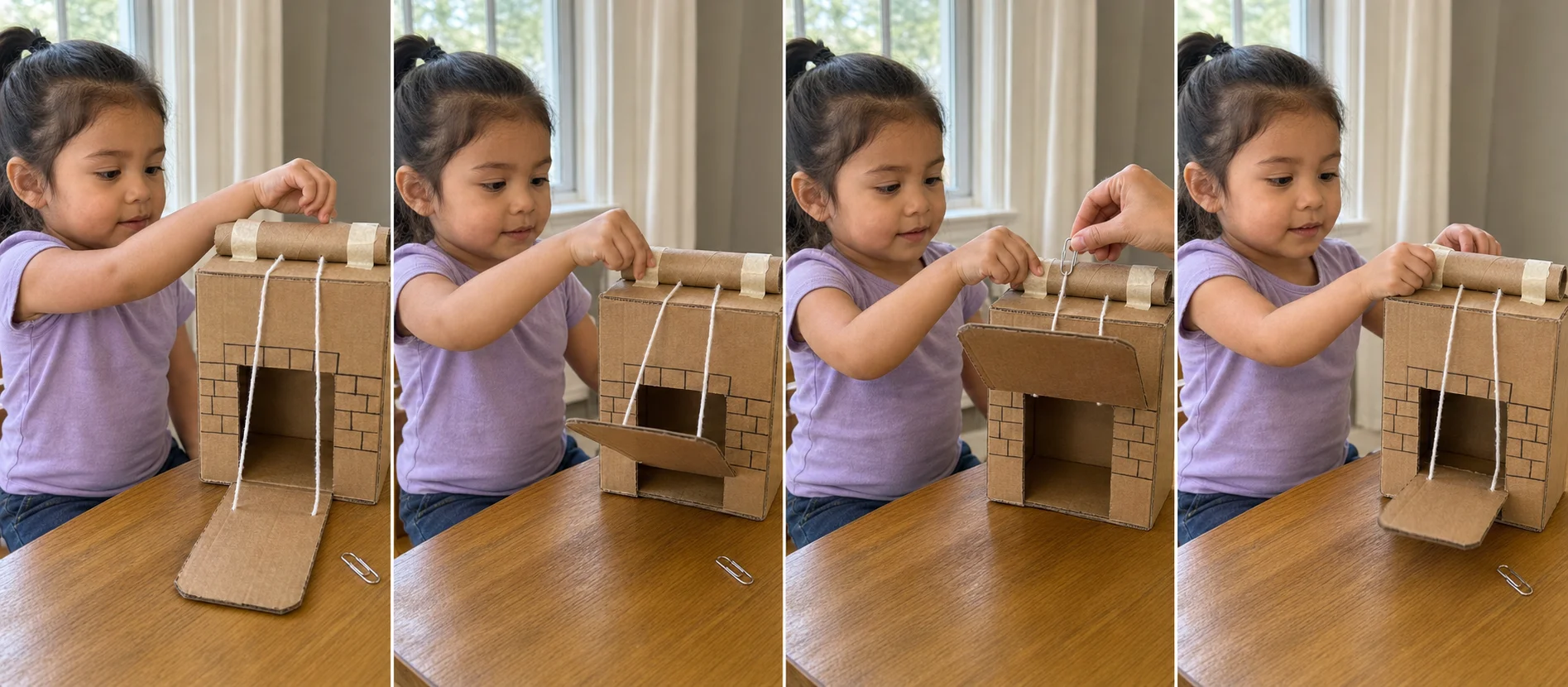
A four-panel sequence showing the child turn the crank, lift the bridge, clip it open, and lower it again.
  1. 01
    Give the paper roll one slow turn and say, "Turn the roll and lift the drawbridge."
  2. 02
    Let your child twist the roll until the yarn pulls the bridge up.
  3. 03
    Help your child clip the yarn so the bridge stays open.
  4. 04
    Remove the clip, lower the bridge slowly, and start another twist, lift, clip, lower round.

Safety Check

  • Adult supervision is required when scissors are used to cut the cardboard.
  • Keep scissors out of reach during play.
  • Watch the yarn and paper clip closely while your child plays.
  • Store the yarn safely after play so no loose strand is left out.
  • Retape the paper roll before play if it shifts or lifts while turning.
Supporting the play

What to say in the moment

Match what you say to what you see.

Prompt ladder
Level 1 (Start)
Turn the roll slowly and watch the bridge rise.
Level 2 (Keep going)
Lift it to the top, then clip it so it stays up.
Level 3 (Stretch)
Lower it slowly and try another smooth lift.
Level 4 (Extend)
Make the bridge open for 1 pretend visitor, then close it again.
If your child seems...
What you'd see
Focused
What to do
Say
"Can you make it rise again?"
Add
Name up, down, open, or closed while the bridge is moving.
Extend
Ask for 1 slow lift and 1 fast lift.

Make it easier

Younger end
  • -Keep 1 adult hand on the box so your child only has to manage the roll.
  • -Start with the bridge already lifted a little so the first turn gives quick movement.
  • -Skip the clip for 1 round and celebrate the lift as soon as the door moves.

If it's not working

If you see
If child ignores it
Do one full turn yourself, let the bridge rise, and hand the roll back with "Your turn to make it rise."
If you see
If child misuses it
Move the paper clip aside for a round, point back to the roll, and keep the job to twisting.
If you see
If child gets frustrated
Clip the yarn for them, shorten the lift, or pause to straighten the yarn before trying again.
Skill spotlight
Two-Hand Coordination`

Using two hands together to lift and hold a moving bridge.

This helps with everyday two-hand jobs, like holding 1 part still while turning, pulling, fastening, or opening another part.

  • Twisting the paper roll while the box stays steady gives your child repeated two-hand coordination practice.
  • The rising bridge makes cause and effect easy to see: turn the crank, watch the door move.
  • Clipping, unclipping, and lowering the bridge turn the same fine-motor job into a short repeatable sequence.
  • Small fixes, like straightening yarn or retaping the roll, keep the play focused on reset and try again.
Real-world transfer
  • Opening and closing simple containers
  • Pulling 1 part while holding another steady
  • Using both hands for early dressing and cleanup jobs

Parent questions