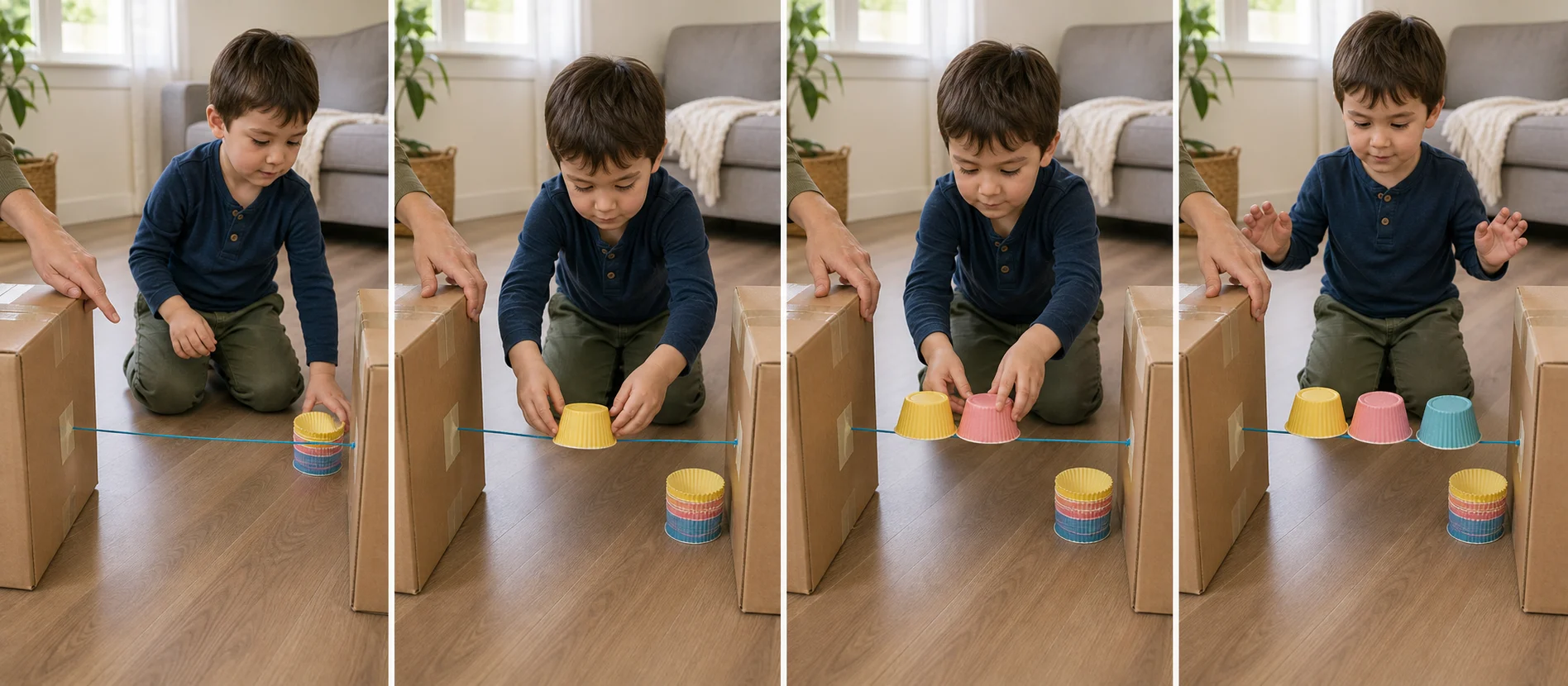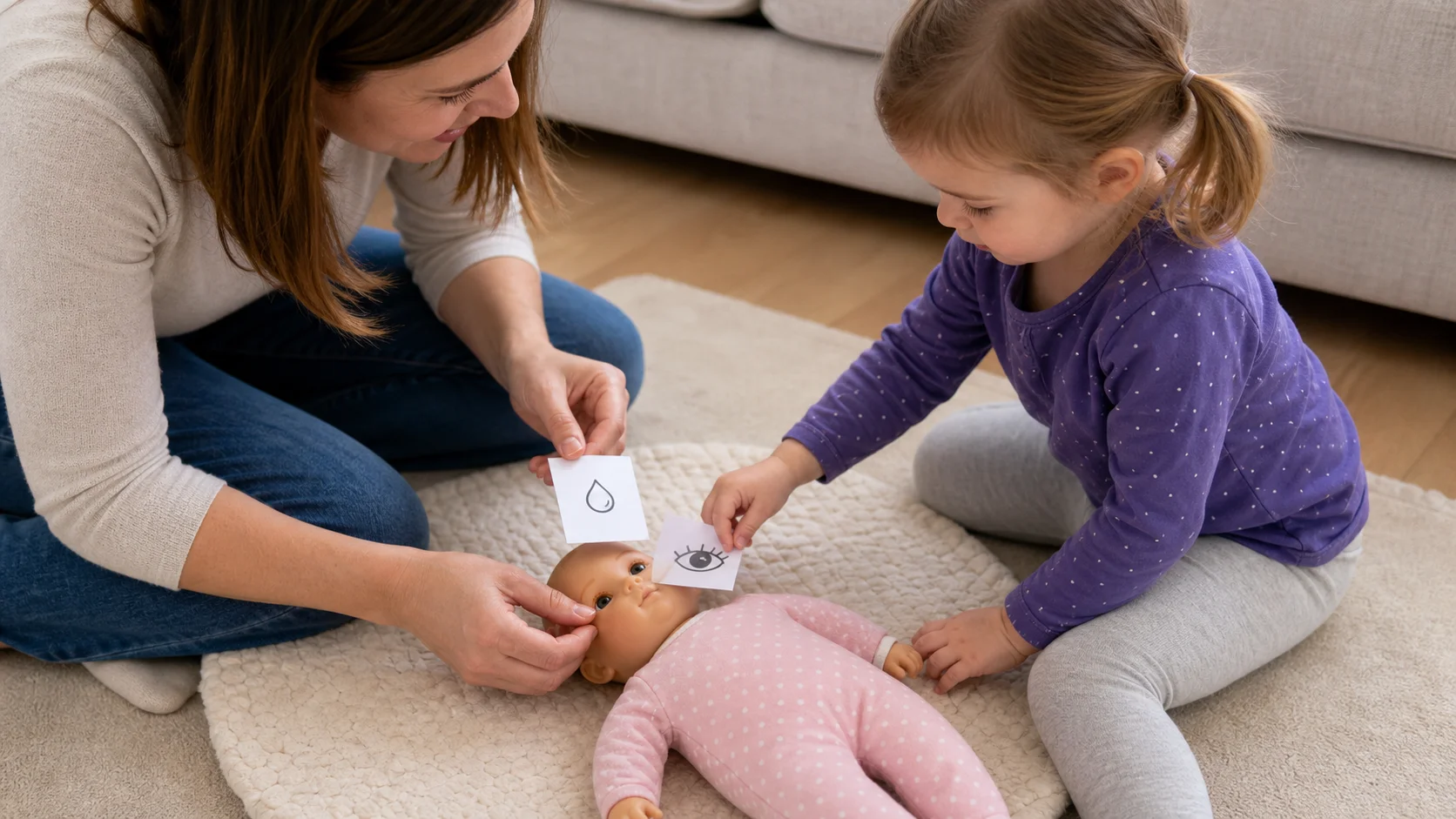
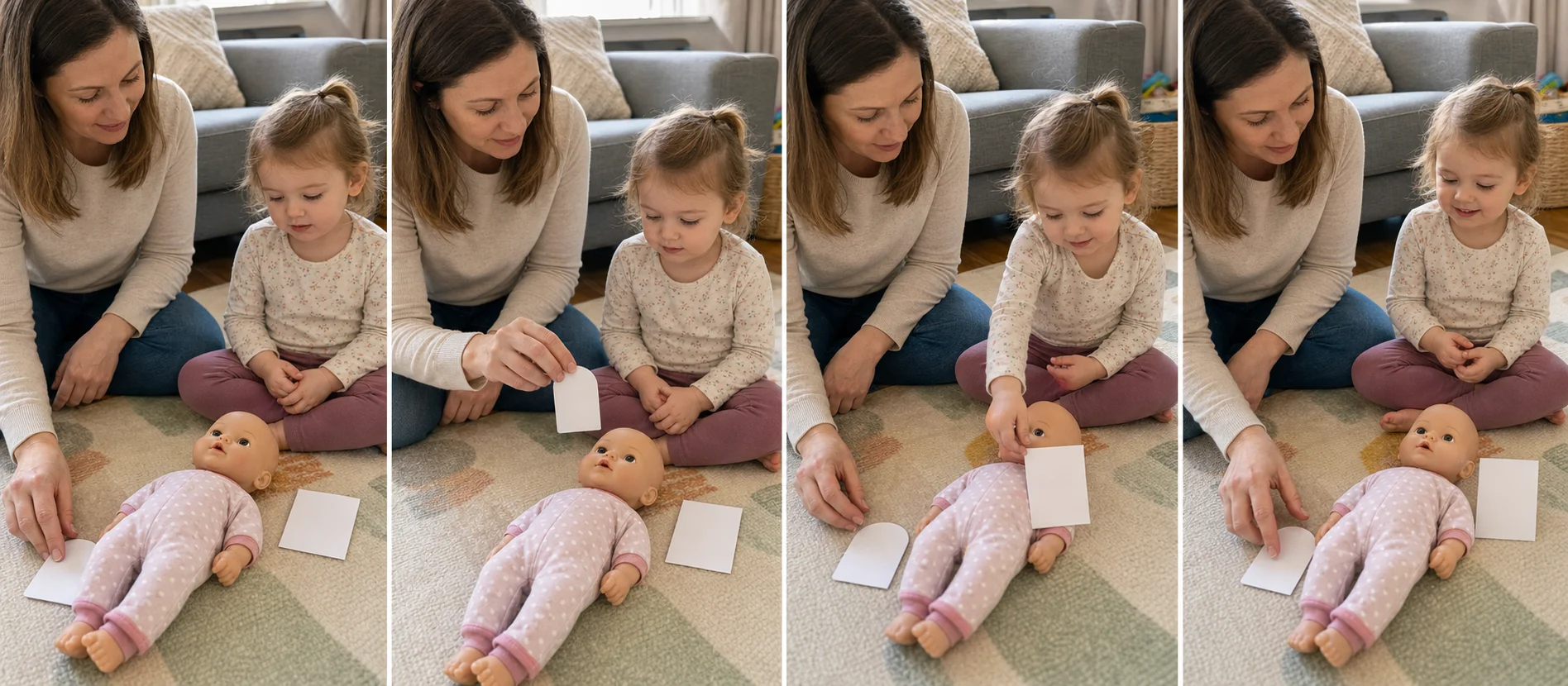
A toddler flipping a paper eye-open card beside a doll while a grown-up holds a pretend drop card above the doll's eye.
Skill builderAutism supportCopy Then TryIndoor

Doll Eye Drop Card.

Use a doll and two paper cards to make one tiny pretend eye-drop turn visible and finished.
Play time
5-10+ min
Age
2-3 years
Energy
Low
Mess
Low
Effort
Low
Where
Indoor
Start here

The recipe.

Low parent effort
3 things

What you need

  • 1 doll or stuffed animal with 1 eye easy to see
  • 1 paper drop card
  • 1 paper eye-open card
5 min minimum

Setup

Then start the loop
Step 01
In one calm indoor spot, sit with your child and place the doll in front of both of you with one eye easy to see.
Step 02
Beside the doll, place the paper drop card where you can lift it first and the eye-open card where your child can flip it after the pretend drop.
Step 03
Beside your child, sit close enough to model one slow turn and help with the eye-open flip if needed.
Step 04
Before you start, decide that both cards stay on the doll only and that any real eye-drop practice happens later as separate adult-handled care.
`Tiny drop for dolly.`
The loop

How play unfolds.

Four panels showing a grown-up model a pretend doll drop, the child flip the eye-open card, both say all done, and the cards reset.
  1. 01
    Hold the drop card above the doll's eye and say `Dolly gets one tiny drop.`
  2. 02
    Move the drop card away, then let your child flip the eye-open card.
  3. 03
    Say `Eyes open. All done.`
  4. 04
    Reset both cards beside the doll and repeat while the turn stays calm.

Safety Check

  • Keep both paper cards over the doll only, never near your child's real eye or face.
  • If any real eye-drop practice happens later, keep it separate from this play routine and adult-handled only.
  • Stop right away if the paper cards turn into mouthing or face-poking props.
Supporting the play

What to say in the moment

Match what you say to what you see.

Prompt ladder
Level 1 (Start)
`Dolly gets one tiny drop.`
Level 2 (Keep going)
`Now help dolly open eyes.`
Level 3 (Stretch)
`Your turn to do the whole doll turn.`
Level 4 (Extend)
`One more calm helper round, then all done.`
If your child seems...
What you'd see
Focused
What to do
Say
`You remembered drop, then open.`
Add
Ask `What comes next?` before the next turn.
Extend
Let your child run the next whole doll turn while you watch close by.

Make it harder

Older end
  • +Let your child place the drop card over the doll's eye and flip the eye-open card without adult hands.
  • +Pause after `tiny drop` and wait to see whether your child remembers the eye-open flip on their own.
  • +Invite your child to reset both cards to the ready spot before the next turn starts.

If it's not working

If you see
If child ignores it
Do one playful doll turn yourself, then invite your child to do only the eye-open flip.
If you see
If child misuses it
Move the cards back to the doll, say `Doll's turn,` and hold the eye-open card until after the pretend drop if your child keeps flipping early.
If you see
If child gets frustrated
Keep the pretend drop in adult hands, let your child do one calm eye-open flip, say `All done helping dolly,` and stop there.
Skill spotlight
Copy After Another Person

Copying a short pretend care step after watching

This helps your child watch one calm care step, copy one part of it, and stay with a short first-then-finished routine without pressure on their own body.

  • Practicing on a doll keeps the near-eye routine outside your child's body while the order becomes familiar.
  • The drop card and eye-open card make the first-then-finished sequence easy to see.
  • The same short words each round support a predictable, low-language turn.
Real-world transfer
  • Copying one care or self-care step after watching you first
  • Staying with a short first-then-finished routine
  • Getting more comfortable with simple pretend preparation before new care tasks

Parent questions