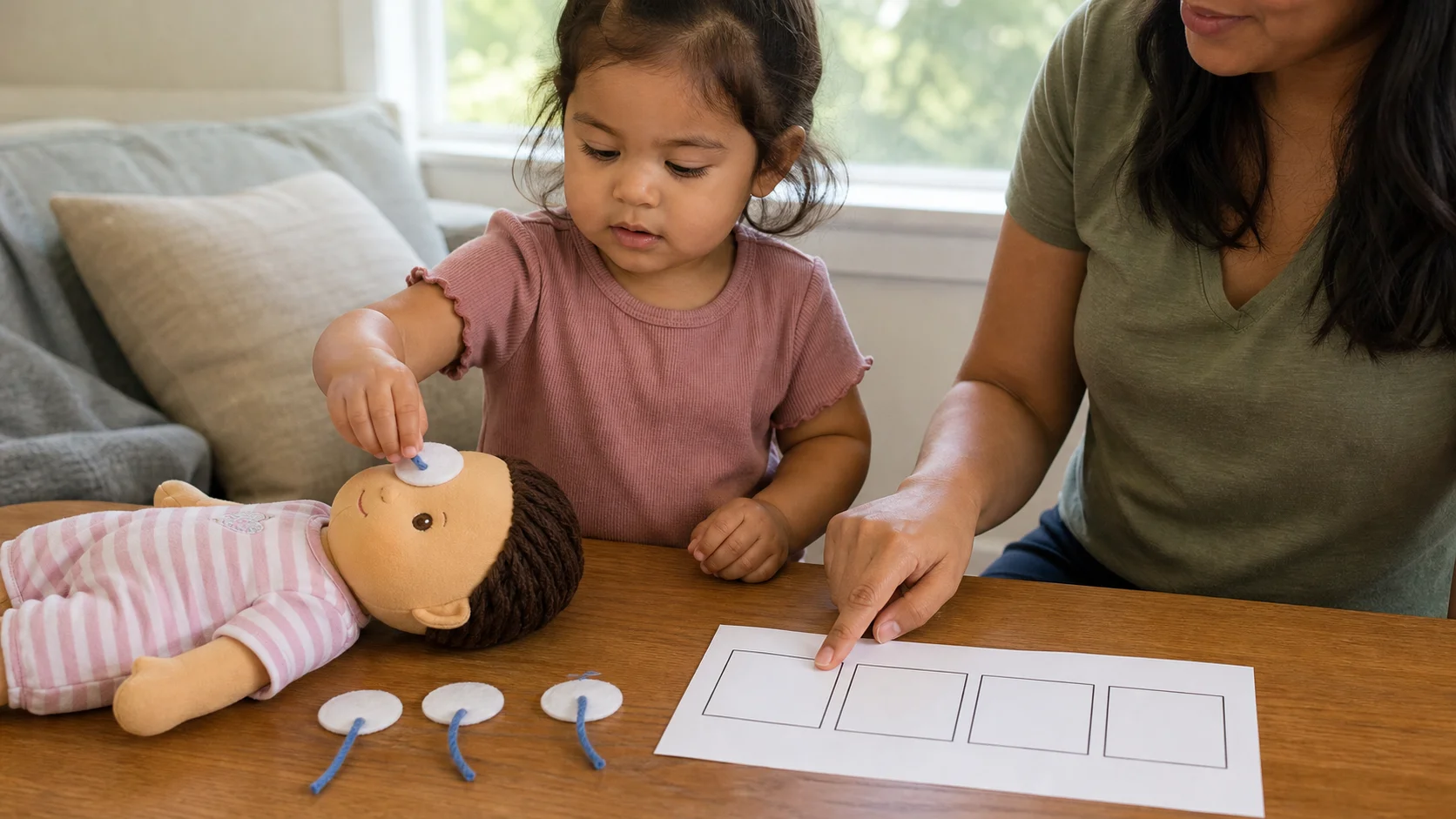
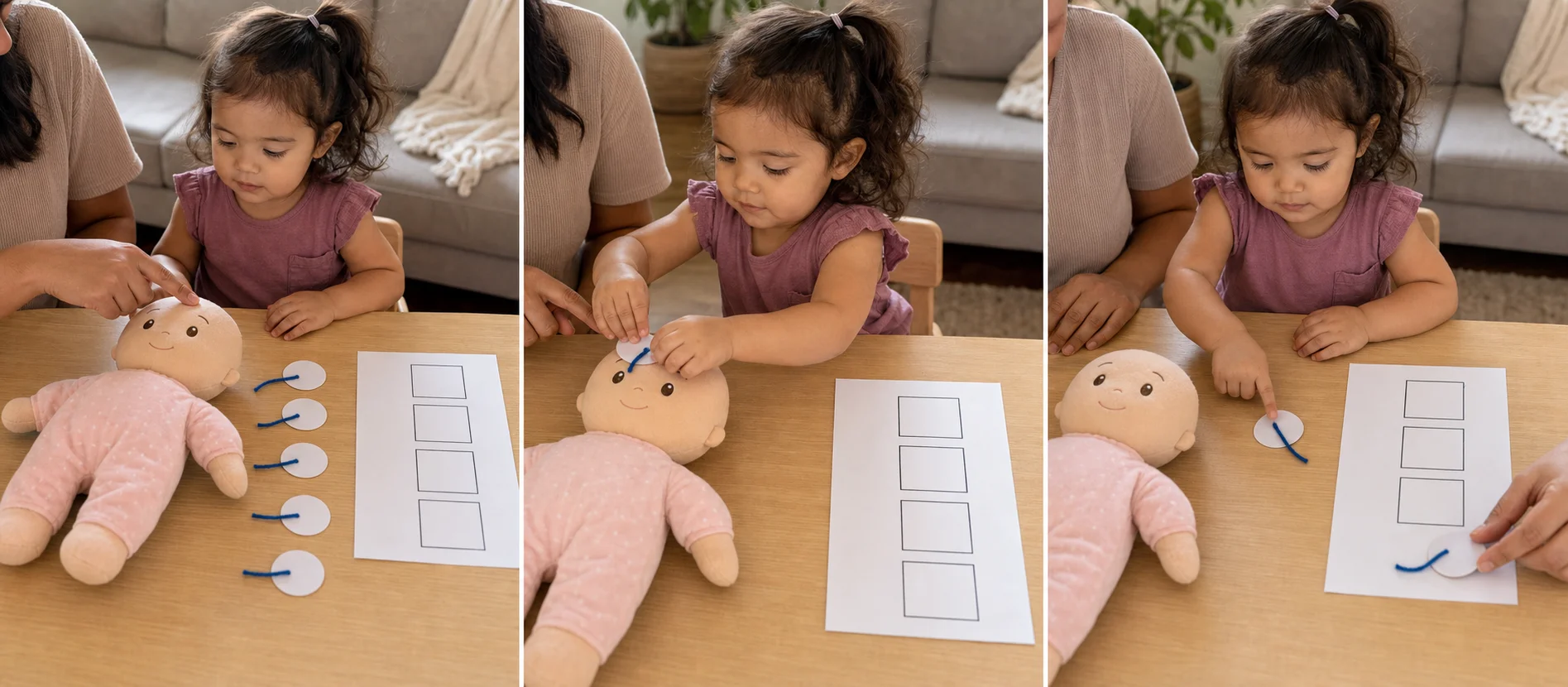
Toddler placing a large removable sticker on a doll head while a grown-up points to a paper done map.
Skill builderAutism supportRepeat LoopIndoor

Doll EEG Sticker Map.

Practice a short sticker-on, box-done, peel-off routine on a doll before an EEG-style visit.
Play time
5+ min
Age
2-3 years
Energy
Low
Mess
Low
Effort
Low
Where
Indoor
Start here

The recipe.

Low parent effort
4 things

What you need

  • 1 doll, stuffed-animal head, or paper head drawing
  • 4 removable stickers
  • 4 short yarn pieces
  • 1 sheet of paper with 4 empty boxes
5 min minimum

Setup

Then start the loop
Step 01
On the floor or at a low table in front of your child, place the doll, stuffed animal, or paper head and put the 4-box paper map beside it.
Step 02
Beside the model head, line up 4 sticker pairs, but slide only 1 pair closest to your child and keep the other 3 beside the head until you need them.
Step 03
Beside your child, sit close enough to point to 1 head spot, offer 1 simple choice like color or location, and keep the practice on the model head only.
Sticker on.
The loop

How play unfolds.

Three-panel sequence showing the child placing a sticker on the model head, tapping the next box, and peeling the sticker off.
  1. 01
    Put 1 sticker pair in front of your child and say, "Sticker on."
  2. 02
    Let your child press it onto 1 clear spot on the model head.
  3. 03
    Tap the next empty box and say, "That one is done."
  4. 04
    Peel the sticker off and set it beside the map.
  5. 05
    Slide the next sticker pair forward and repeat, or stop after 1 calm success.

Safety Check

  • Use large removable stickers and yarn pieces short enough to supervise so nothing turns into a mouthing or wrapping hazard.
  • Keep the whole practice on the doll, stuffed animal, or paper head, and stop before trying it on your child's own head.
  • Stop if sticky texture, loose yarn, or the medical theme itself starts to upset your child.
Supporting the play

What to say in the moment

Match what you say to what you see.

Prompt ladder
Level 1 (Start)
Put one sticker on.
Level 2 (Keep going)
Tap the next box.
Level 3 (Stretch)
Pick a new spot.
Level 4 (Extend)
One more sticker round.
If your child seems...
What you'd see
Focused
What to do
Say
That one is done.
Add
Offer 1 learning prompt after the box tap, such as `Which box is next?`
Extend
Bring the next sticker in quickly before the play turns into free peeling.

Make it easier

Younger end
  • -Use only the first 2 boxes on the page and ignore the rest for this round.
  • -Peel up the edge of the next sticker before your child's turn so it starts faster.
  • -Keep all sticker placements on the same easy-to-see part of the head.

Make it harder

Older end
  • +Wait 1 beat before pointing so your child searches for the next empty box.
  • +Let your child choose a new head spot without reusing the last one.
  • +Have your child peel the finished sticker off cleanly before the next sticker appears.

If it's not working

If you see
If child ignores it
Do 1 more demo turn yourself, then let your child help with only the choice or only the box tap before asking for a full sticker turn.
If you see
If child misuses it
Keep the extra sticker pairs in your hand, offer 1 pair only, and restart with a single `sticker on, box tap, off` turn.
If you see
If child gets frustrated
Let your child point to the spot while you place 1 sticker, tap 1 box together, and stop after that calm success.
Skill spotlight
Medical Visit Practice

Repeating a short pretend head-check routine, Keeping the care steps calm and predictable

This helps a child stay with a short body-care sequence, see what is done and what comes next, and feel less surprised when touch-based prep steps show up in real life.

  • The sticker on, box tap, peel off order turns a medical-looking step into a short visible routine.
  • Practicing on a doll keeps the head-touch idea off your child's body while the sequence becomes familiar.
  • The done map shows what is finished and what comes next, which makes it easier to stop after 1 calm success.
Real-world transfer
  • Joining a short prep or care routine when each step has a clear visual finish
  • Seeing 1 body-care step at a time instead of facing the whole routine at once
  • Getting used to gentle head-touch or sticker-like prep on a toy before a real visit

Parent questions