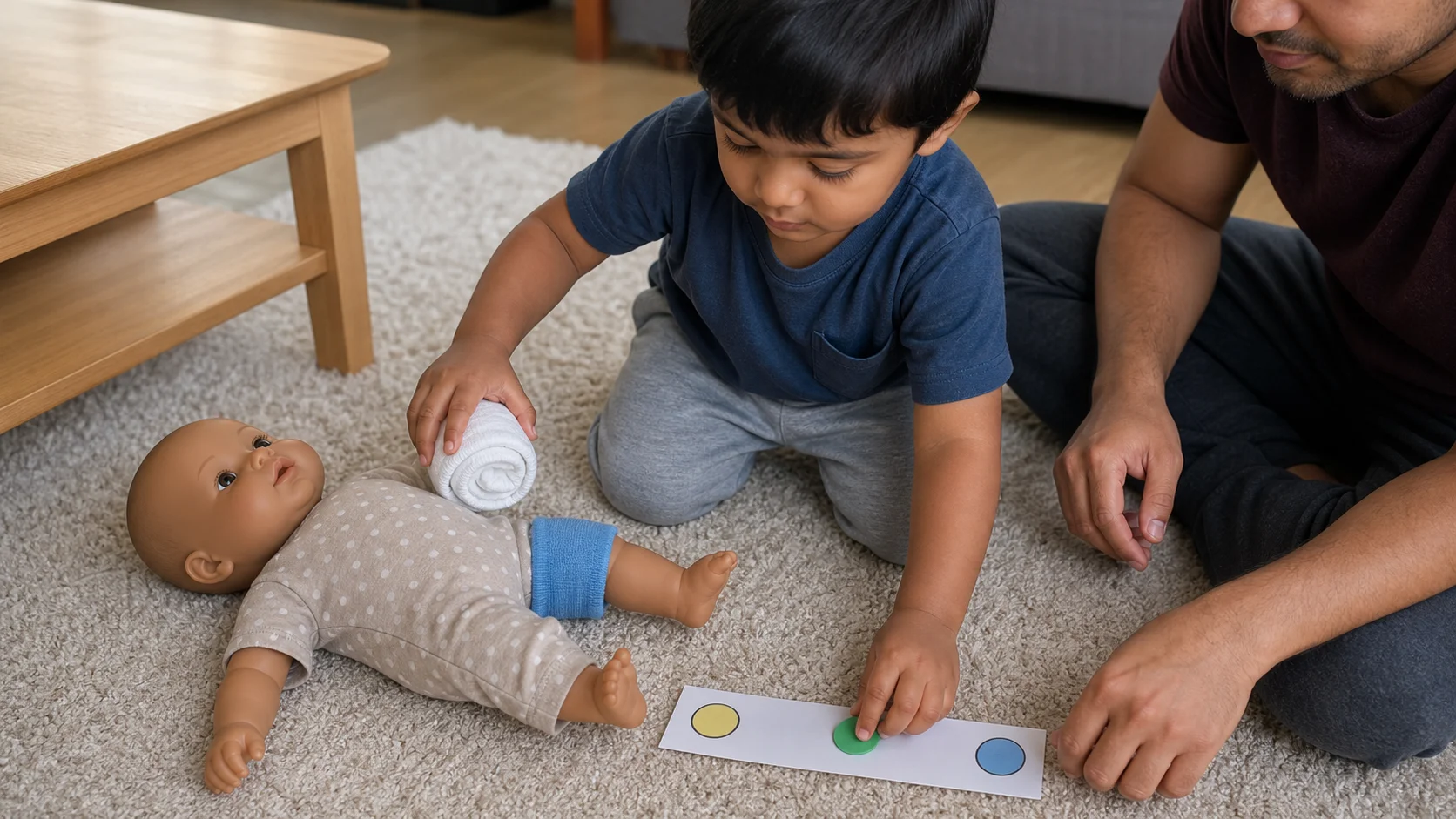
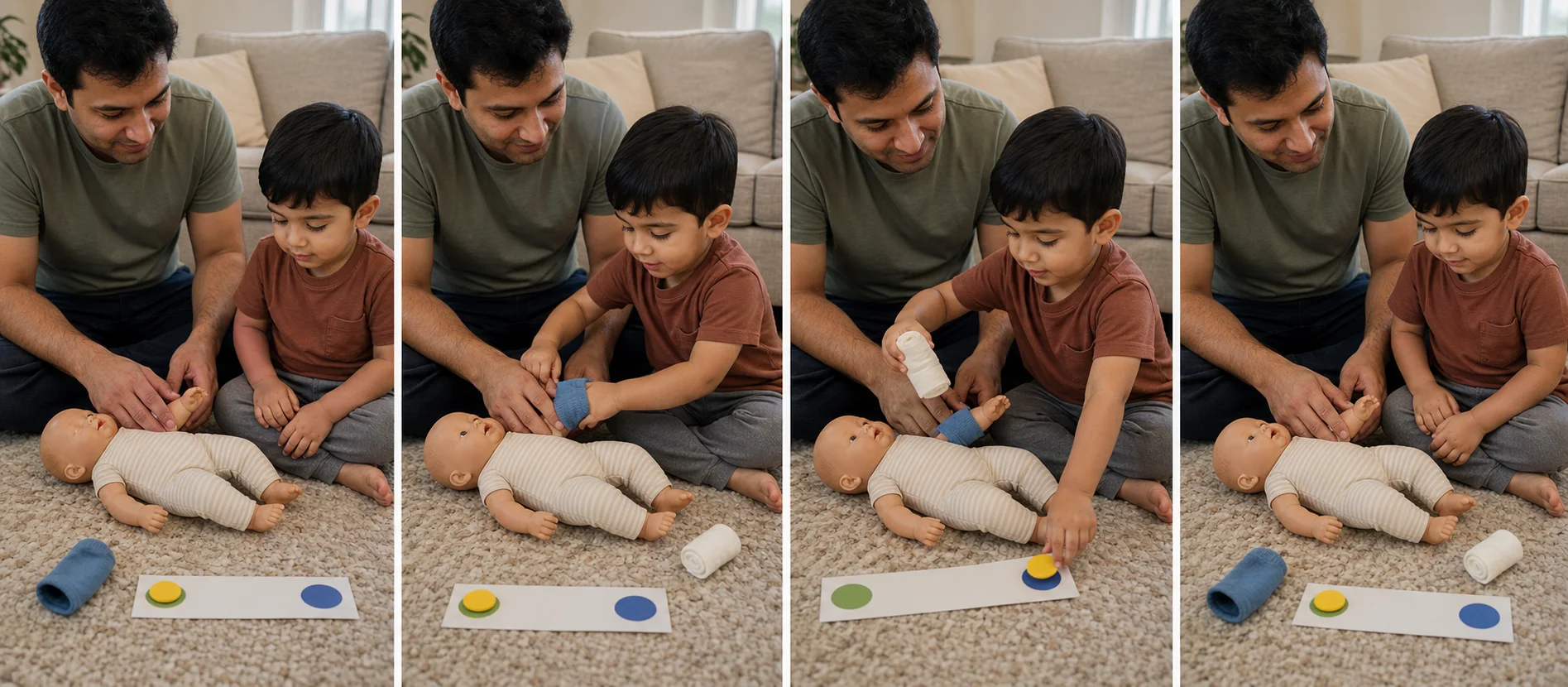
A toddler placing a loose fabric cuff on a doll arm beside a paper start-to-done marker.
Skill builderDevelopmental supportRepeat LoopIndoor

Doll Cuff Gauge.

A doll, cuff, and done marker make medical pretend play calm, predictable, and brief.

Play time
5+ min
Age
2-3 years
Energy
Low
Mess
Low
Effort
Low
Where
Indoor
Start here

The recipe.

Low parent effort
5 things

What you need

  • 1 doll or stuffed animal with 1 arm easy to reach
  • 1 loose sock cuff or soft fabric loop that slides on and off the doll arm easily
  • 1 soft ball or 1 rolled sock that fits in a whole hand and is not a tiny loose piece
  • 1 paper strip with 1 start spot and 1 done spot
  • 1 paper gauge marker or small card that is easy to see and easy to grab
5 min minimum

Setup

Then start the loop
Step 01
In a calm indoor spot on the floor or at a low table, place the doll in front of your child with 1 arm facing up or toward them.
Step 02
Beside the doll arm, place the loose cuff and the soft squeeze prop within easy reach, then put the paper strip and marker on the other side of the doll with the marker at `start`.
Step 03
Beside your child, sit close enough to show 1 calm model turn, keep the cuff loose on the doll arm, and help reset the pieces after each round.
Cuff on baby.
The loop

How play unfolds.

A toddler repeats the doll cuff check by putting on the cuff, squeezing a soft prop, moving the marker to done, and taking the cuff off.
  1. 01
    Start with the cuff off the doll arm and the marker at `start`.
  2. 02
    Help your child place the loose cuff on the doll arm.
  3. 03
    Say, `Soft squeeze`, then let your child squeeze the ball or rolled sock once and slide the marker to `done`.
  4. 04
    Take the cuff off, move the marker back to `start`, and repeat the same calm check.
  5. 05
    Stop after 1 finished turn if the props still feel new.

Safety Check

  • Keep the cuff loose and use it on the doll only, not on your child's body.
  • Use props that are easy to see and easy to grab, and stop if the marker or squeeze prop turns into mouthing, chewing, or throwing.
Supporting the play

What to say in the moment

Match what you say to what you see.

Prompt ladder
Level 1 (Start)
Put the cuff on baby.
Level 2 (Keep going)
Nice check, give 1 soft squeeze.
Level 3 (Stretch)
Slide it to done for baby.
Level 4 (Extend)
Give baby 1 more calm check.
If your child seems...
What you'd see
Focused
What to do
Say
Nice check. Baby is ready.
Add
Name 1 part only, like `cuff` or `baby`.
Extend
Let your child reach for the cuff first on the next turn.

Make it easier

Younger end
  • -Start with the cuff already opened wide so it slips onto the doll arm faster.
  • -Let your child keep 1 hand on the doll arm while you help with the cuff.
  • -Turn the doll arm toward your child before each round so the cuff lands in the same easy spot.

Make it harder

Older end
  • +Let your child find the doll arm and place the cuff without your finger point.
  • +Have your child move the marker back to `start` before the next turn begins.
  • +Pause 1 extra beat before your `squeeze` cue so waiting lasts a little longer.

If it's not working

If you see
If child ignores it
Let your child start by only touching the cuff or squeezing the soft prop while you do the first model turn, then praise that small join-in.
If you see
If child misuses it
If the marker or squeeze prop turns into throwing, remove that extra piece for the next turn and do a simpler cuff-on, cuff-off doll practice round.
If you see
If child gets frustrated
Help with 1 shared turn, say `all done` as soon as the cuff comes off, and stop there so the practice stays low-stress.
Skill spotlight
Medical Visit Practice

Repeating a short pretend cuff-check routine, Keeping the medical steps calm and predictable

This helps a child get used to a short care sequence, see that each step has a clear end, and stay calmer when familiar medical-looking steps show up in real life.

  • The cuff-on, squeeze, done, cuff-off order gives the medical-looking prop a clear beginning and end.
  • The marker lets your child see when the doll check is finished instead of relying on extra explanation.
  • Practicing on a doll keeps the routine outside your child's body while the steps become more familiar.
Real-world transfer
  • Getting used to medical-looking props before a real visit
  • Moving through 1 short care step at a time instead of facing the whole visit at once
  • Showing `done` and resetting after a care step

Parent questions