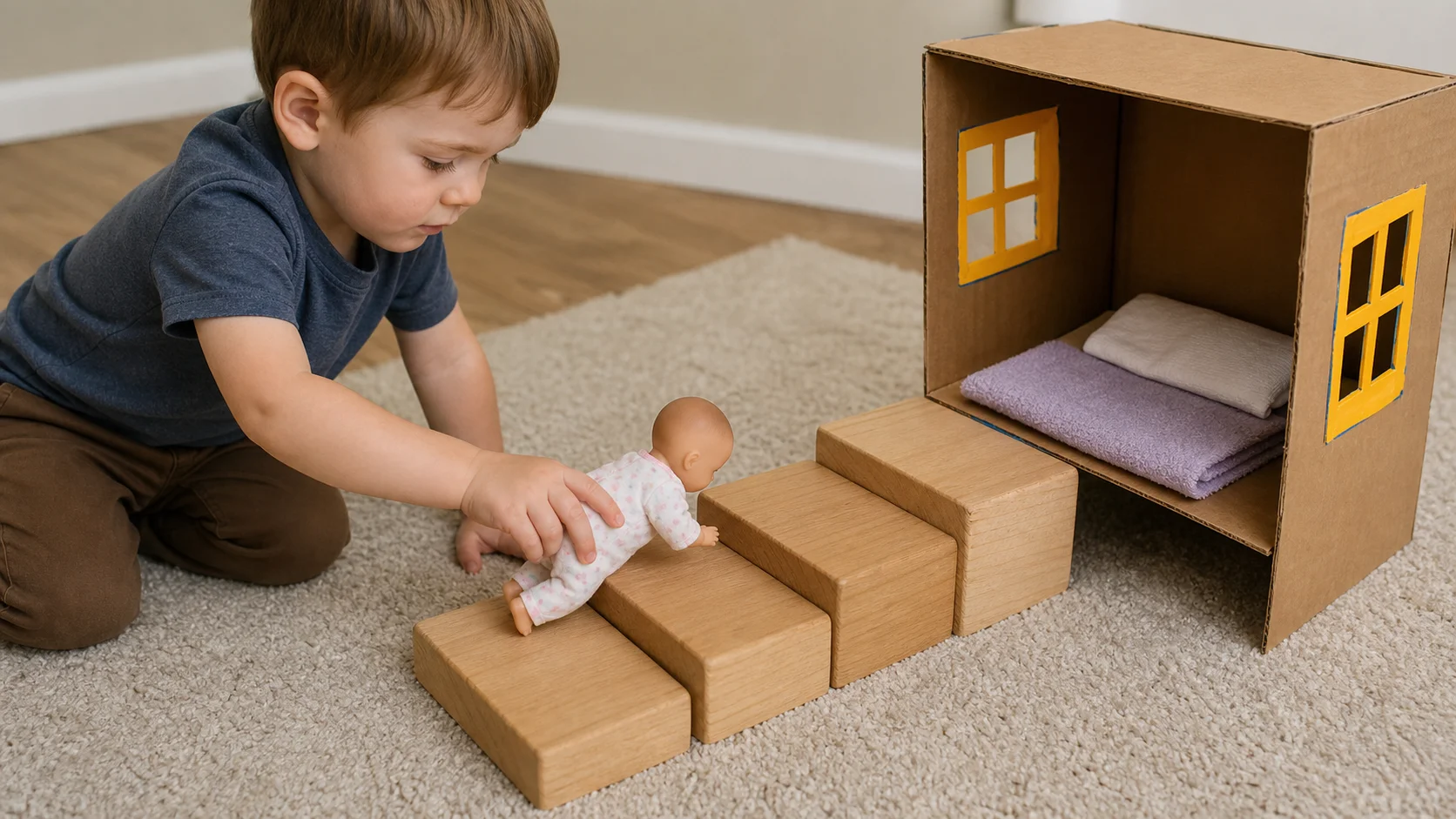
Child moving a small doll up low block stairs toward a bedtime spot on the floor.
ThinkingAutism supportDevelopmental supportMove Through Path`Indoor Floor Or Table Play Space

Doll Bedtime Stairs.

Build a tiny block stair path so a doll can walk to bed and start again.

Play time
5+ min
Age
2-4 years
Energy
Low
Mess
Low
Effort
Medium
Where
Indoor Floor Or Table Play Space
Start here

The recipe.

Medium parent effort
6 things

What you need

  • 1 small doll or stuffed figure
  • Several blocks for 1 short stair path
  • 1 simple bedtime spot, such as a dollhouse room or a clear spot at the top of the stairs
  • 1 indoor floor or table play space
  • 1 adult for modeling, prompting, and direct participation
  • 1 child
5 min minimum

Setup

Then start the loop
Step 01
On the floor or a low table, arrange several blocks into 1 short, steady stair path.
Step 02
At the top end of the stair path, place the bedtime spot so the doll can step straight from the last block into bed.
Step 03
At the bottom of the stairs, place the doll facing upward within your child's reach.
Step 04
Beside your child, sit close enough to model the first turn and steady the blocks if needed.
Step 05
Before you start, walk the doll up the stairs once with two fingers and make sure the blocks do not wobble.
"Sleepy doll."
The loop

How play unfolds.

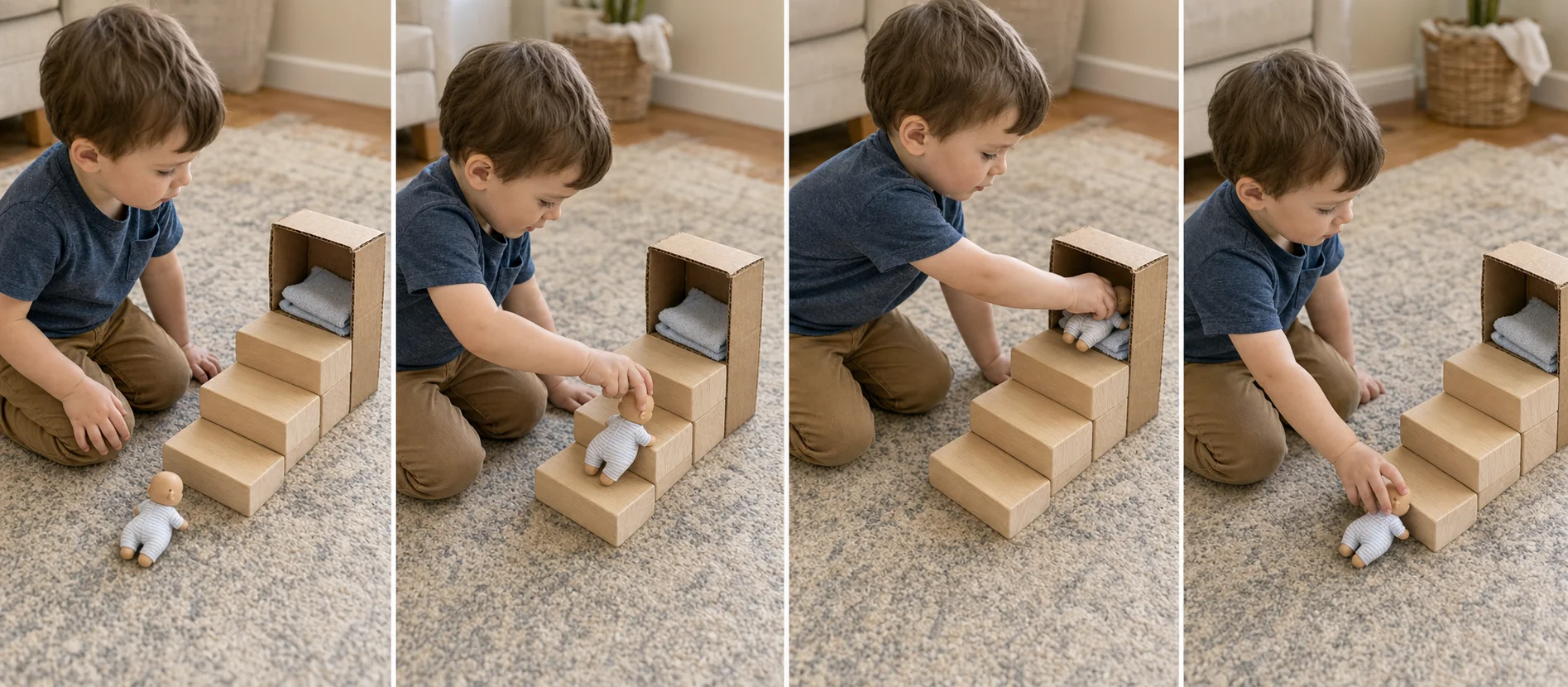
Steps showing a grown-up model the doll walk, a child move it up the block stairs, place it in bed, and reset at the bottom.
  1. 01
    Walk the doll up once and say, "Can you help the doll climb the stairs to bed?"
  2. 02
    Let your child move the doll one step at a time up the block stairs.
  3. 03
    Place the doll in the bedtime spot at the top.
  4. 04
    Bring the doll back to the bottom and repeat for another short trip.
  5. 05
    Stop after a few turns or when your child looks done.

Safety Check

  • Keep direct adult supervision throughout the activity.
  • Keep the stair path low and steady so blocks do not tip or scatter during play.
  • Use doll and block pieces that fit your child safely, especially if your child mouths toys.
Supporting the play

What to say in the moment

Match what you say to what you see.

Prompt ladder
Level 1 (Start)
"The doll is sleepy and needs help up the stairs."
Level 2 (Keep going)
"One step, next step, bed."
Level 3 (Stretch)
"Can the doll climb slowly this time?"
Level 4 (Extend)
"Can the doll go back down and try bedtime again?"
If your child seems...
What you'd see
Focused
What to do
Say
"The doll is climbing."
Add
Invite 1 small choice, such as slow steps or quiet steps.
Extend
Reset the doll at the bottom and let your child start the next trip.

Make it easier

Younger end
  • -Let your child place the doll straight onto the top step, then into bed.
  • -Hold the doll's body while your child moves the feet.
  • -Pause between steps so your child only copies 1 move at a time.

Make it harder

Older end
  • +Ask your child to start the doll without a model.
  • +Add a quiet voice rule for the final step into bed.
  • +Invite your child to remember where the doll starts after each reset.

If it's not working

If you see
If child ignores it
Do one quick sleepy walk yourself, make the doll yawn at the top, then hand the doll back at the bottom.
If you see
If child misuses it
If the doll gets tossed or skips straight to bed, place it back on the first stair and say, "Stairs first, then bed."
If you see
If child gets frustrated
Shorten the stair path to 2 or 3 steps, or move the doll together for one successful trip before trying again.
Skill spotlight
Move Through Path`

Walking a pretend character through a short route, Finishing a familiar pretend routine

This helps a child use a toy as the actor, follow a tiny start-to-finish routine, and connect pretend play to familiar daily life.

  • Moving the doll step by step gives your child a visible beginning, middle, and end.
  • The bedtime route turns a familiar routine into pretend play your child can copy.
  • Resetting the doll at the bottom helps the same short sequence feel predictable.
Real-world transfer
  • Acting out familiar routines during play.
  • Following a short sequence with a clear ending.
  • Copying 1 modeled action and then trying it alone.
  • Understanding "first this, then that" in everyday routines.

Parent questions