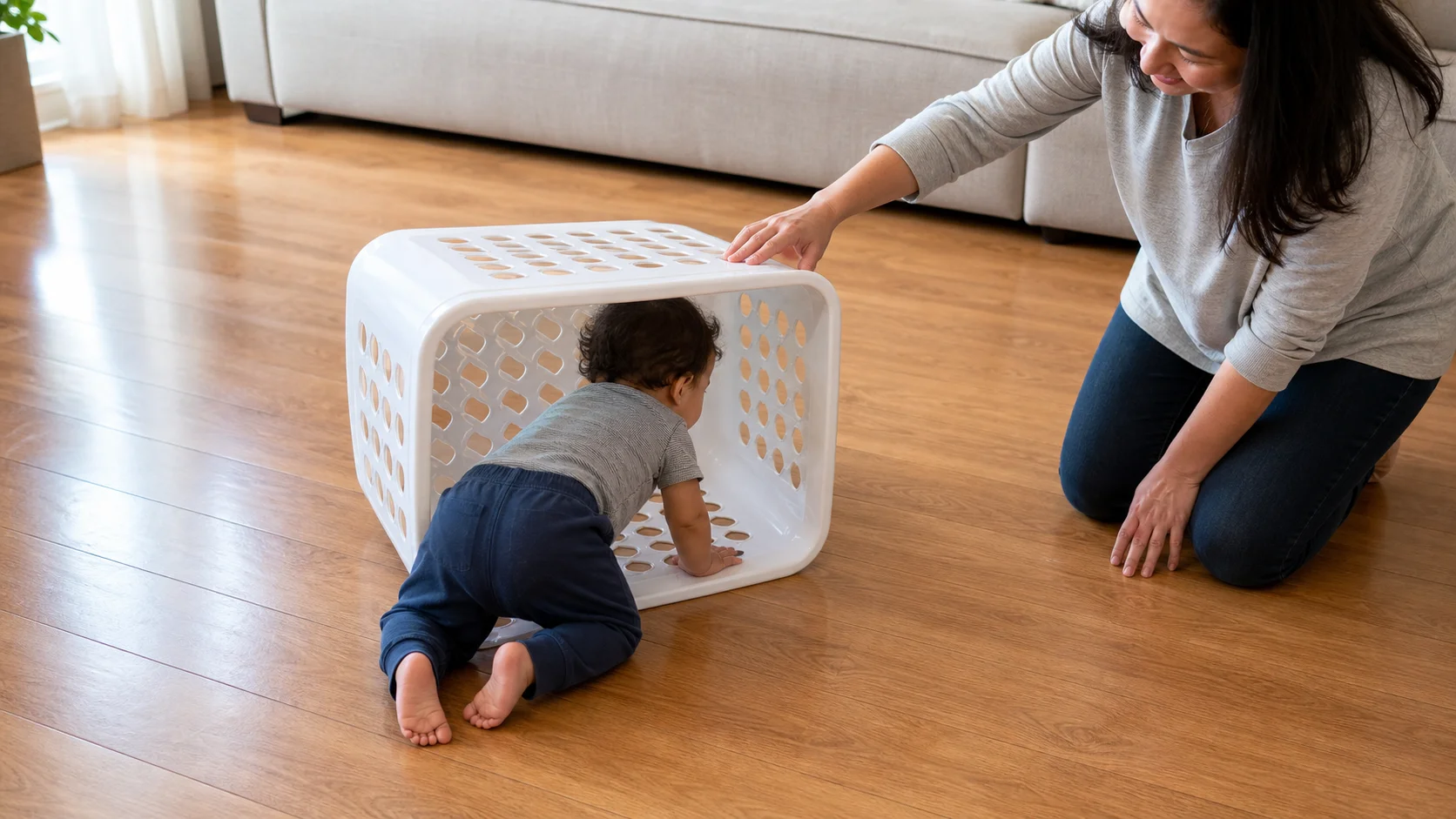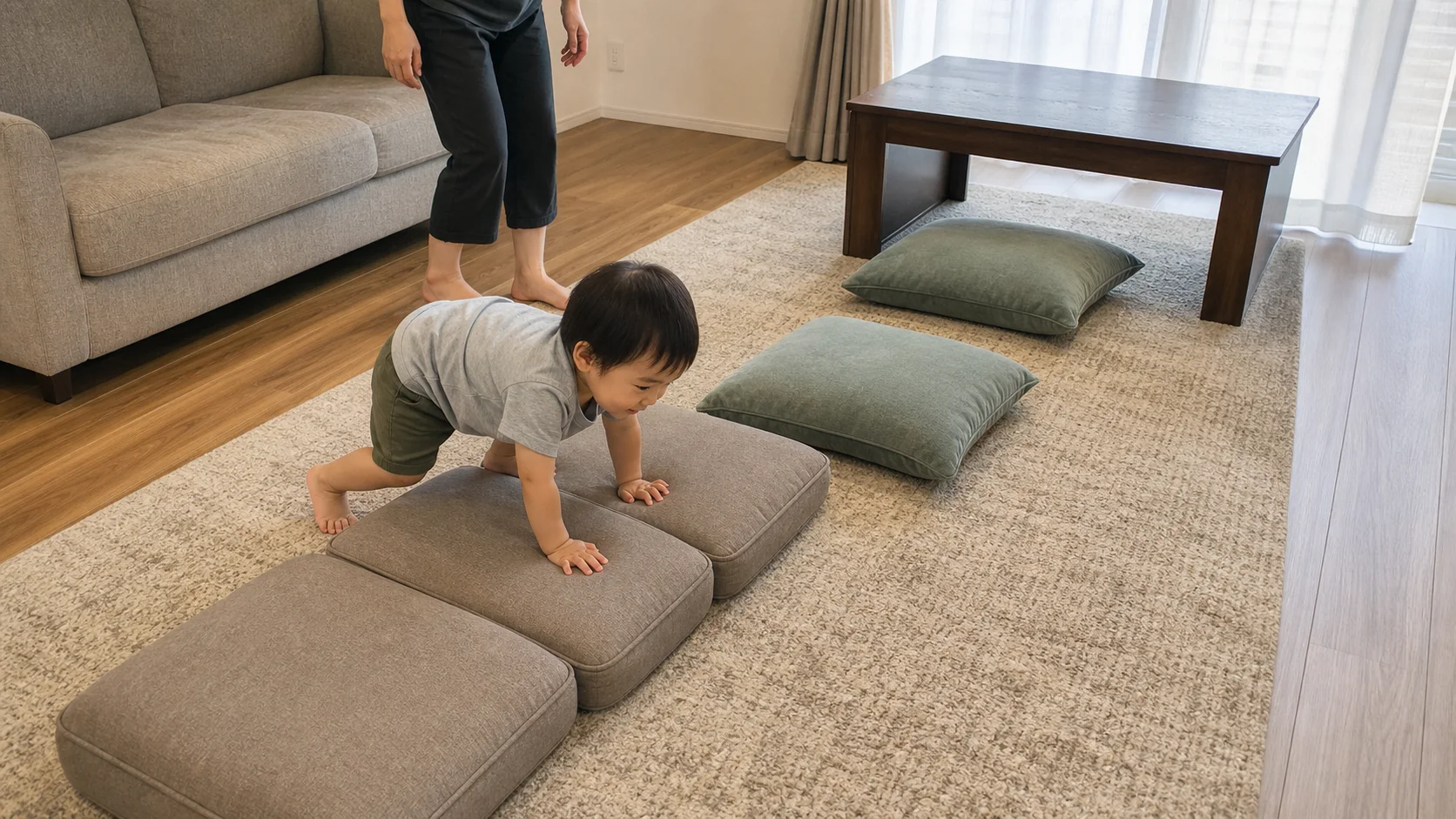
A toddler crawling over couch cushions and heading under a low table while a grown-up kneels nearby in a living room.
Gross motorOT-adjacent supportNavigate PathIndoor

Cushion Obstacle Course.

A short home obstacle route that lets your child go over, around, and under the same path again and again.

Play time
5-10+ min
Age
1-3 years
Energy
High
Mess
Low
Effort
Low
Where
Indoor
Start here

The recipe.

Low parent effort
4 things

What you need

  • 2 or 3 couch cushions
  • 1 or 2 pillows
  • 1 stable table
  • 1 open floor space
5 min minimum

Setup

Then start the loop
Step 01
On a carpet, rug, or other non-slippery floor spot, clear one short lane with room for your child to move forward and turn around safely.
Step 02
On the floor at the start of the lane, place 2 or 3 couch cushions close enough together that your child can crawl, step, or climb over them without a big gap.
Step 03
After the cushions, place 1 or 2 pillows so there is one obvious path around them.
Step 04
At the end of the lane, use a stable table as the under-the-table part of the route, with a clear crawl-in side and clear crawl-out side.
Step 05
Stand beside the lane where you can point to the next obstacle and step in quickly if a cushion shifts.
"Here we go."
The loop

How play unfolds.

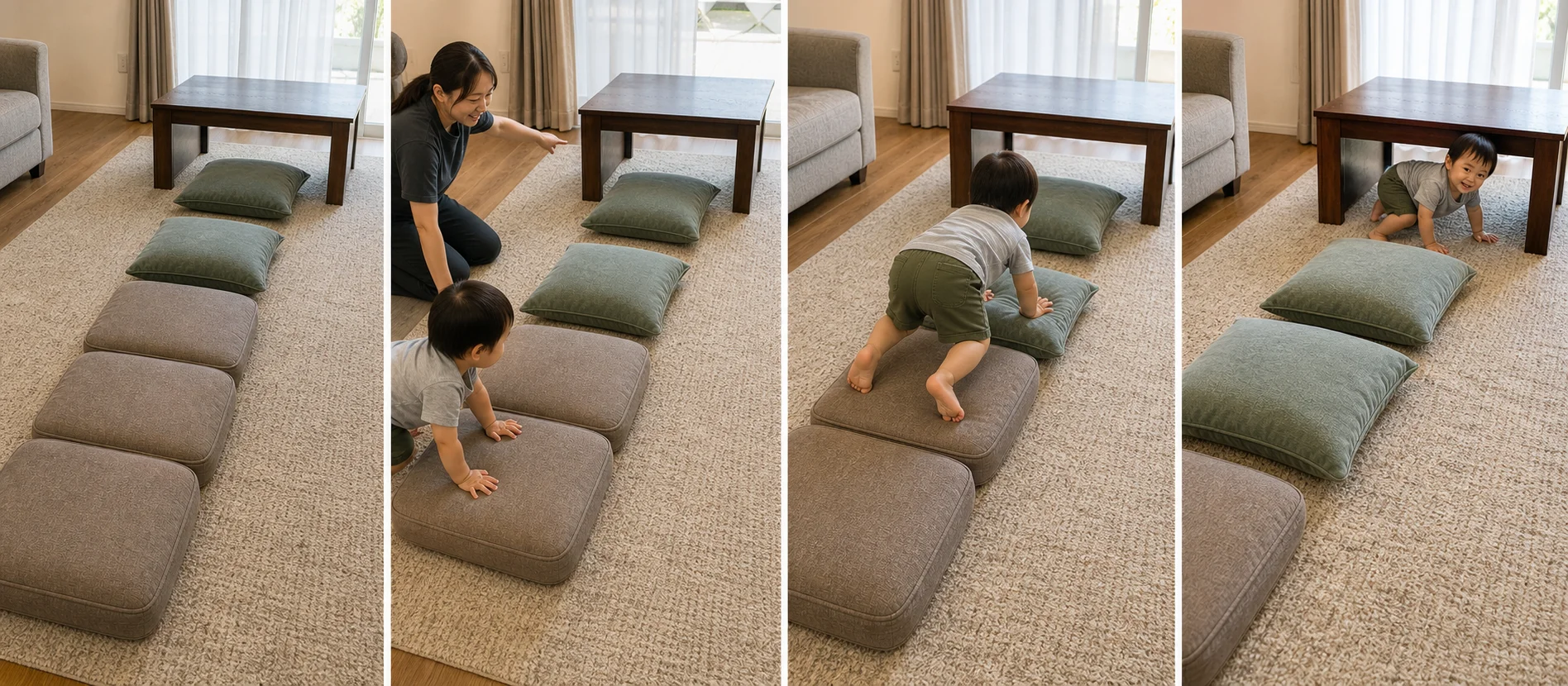
Four panels showing cushions and pillows set on the floor, a grown-up pointing through the path, a toddler going over cushions and around pillows, and the toddler crawling under a table before starting again.
  1. 01
    Point through the route once and say, "Over, around, under. Your turn."
  2. 02
    Let your child go over the cushions, around the pillows, and under the table.
  3. 03
    Meet your child at the table exit and turn back toward the start.
  4. 04
    Run the same short route again for another round.

Safety Check

  • Stay with your child the whole time.
  • Use only a stable table and floor-level cushions or pillows.
  • Stop if the course turns into jumping from furniture height, diving, or rough crashing.
  • Shorten the route if your child keeps getting stuck at one obstacle or moving too fast to stay safe.
Supporting the play

What to say in the moment

Match what you say to what you see.

Prompt ladder
Level 1 (Start)
"Over, around, under."
Level 2 (Keep going)
"Back to the start."
Level 3 (Stretch)
"Can you do the whole path again?"
Level 4 (Extend)
"Let's make one more trip."
If your child seems...
What you'd see
Focused
What to do
Say
"You know the path."
Add
Point to the next obstacle only when your child needs it.
Extend
Pause at the end and let your child turn back toward the start before you cue the next round.

Make it easier

Younger end
  • -Keep the route in a straight line.
  • -Use only one pillow to go around.
  • -Accept walking around the whole route before asking for crawling or climbing.

Make it harder

Older end
  • +Add one more cushion after the child is finishing the short route smoothly.
  • +Ask your child to pause for one second before going under the table.
  • +Let your child lead the return to the start without your pointing.

If it's not working

If you see
If child ignores it
Go through the route yourself once, then stop at the end and invite your child to try.
If you see
If child misuses it
Reduce the course to one cushion, one pillow, and the table so the path is easier to follow.
If you see
If child gets frustrated
Count one obstacle at a time as success and guide your child straight to the next part.
Skill spotlight
Navigate Path

Navigating a short whole-body obstacle path

This helps a child coordinate the body across changing floor levels and simple obstacle positions while staying with one short movement sequence from start to finish.

  • The route gives your child a clear whole-body job with a visible start, finish, and repeat.
  • Going over, around, and under the same path helps your child practice changing body position on purpose.
  • The short repeat loop keeps the movement active without needing lots of words or new setup each round.
Real-world transfer
  • Moving through cushions, furniture gaps, and play spaces with more body control.
  • Handling simple over, around, and under movement jobs during everyday play.
  • Staying with a short active routine from beginning to end.

Parent questions

Back to library
Keep playing

Related activities.