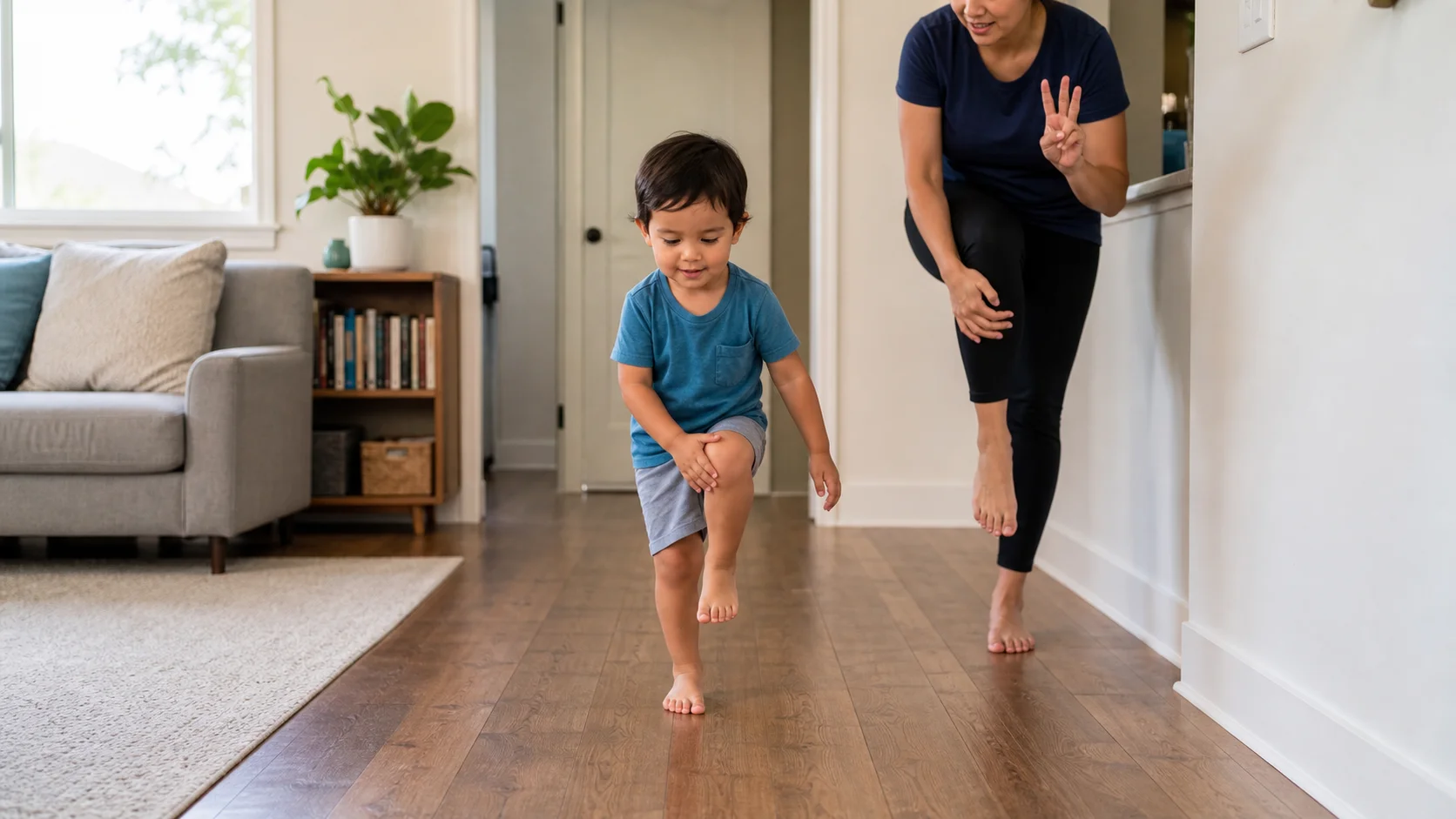
A young child marches across a clear indoor floor lane while touching one knee with the opposite hand as a grown-up models beside them.
Gross motorOT-adjacent supportCross Body CoordinationIndoor

Cross-Crawl March.

Give your toddler a quick no-equipment coordination challenge. They march while bringing each knee to the opposite hand or elbow, practicing cross-body coordination, balance, and timing through a repeating left-right pattern.

Play time
1-5+ min
Age
2-4 years
Energy
Medium
Mess
No
Effort
Low
Where
Indoor
Start here

The recipe.

Low parent effort
3 things

What you need

  • 1 open indoor floor space
  • 1 grown-up to model the movement and count or time the round
  • 1 stopwatch or phone timer if you want timed rounds
1 min minimum

Setup

Then start the loop
Step 01
Clear enough floor space for your child to take several marching steps.
Step 02
Choose a short number of counts or set a brief timer for the round.
"March, tap, march."
The loop

How play unfolds.

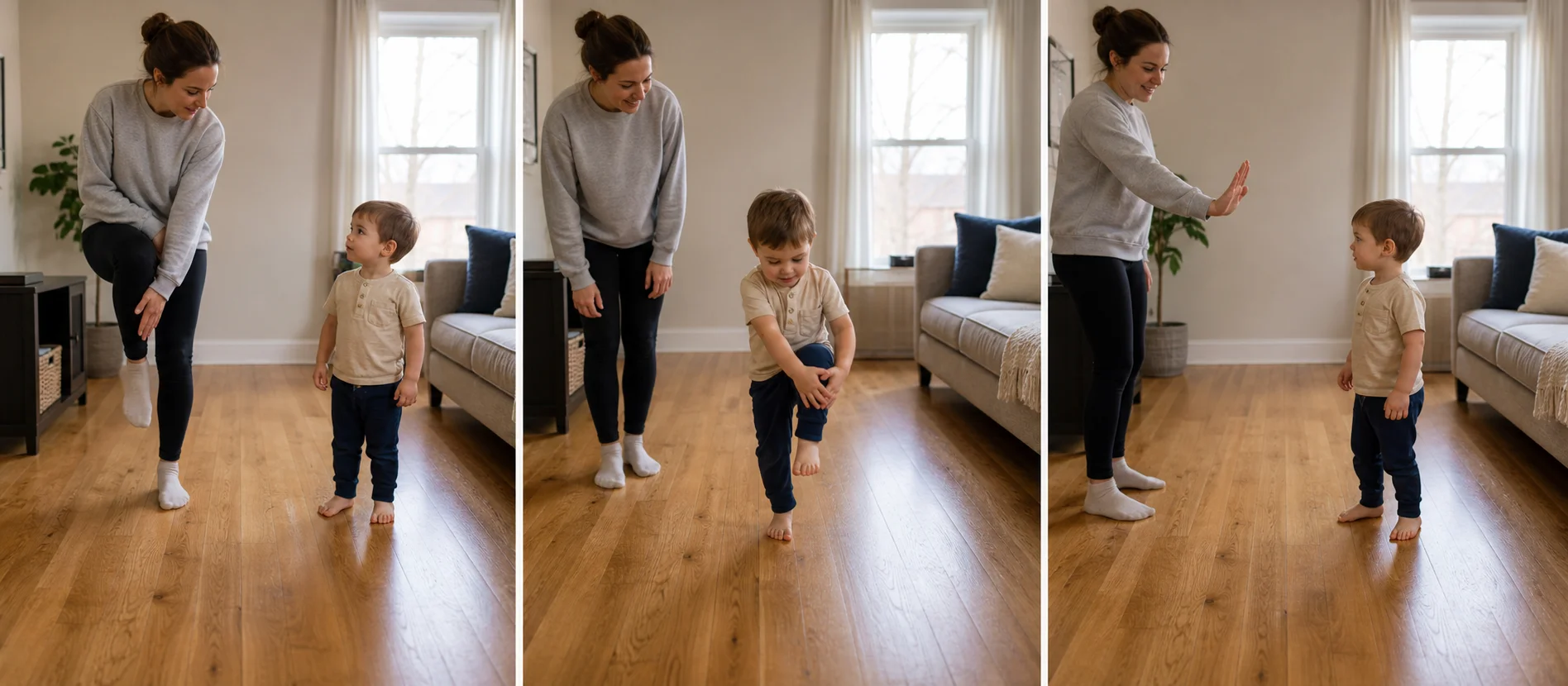
A multi-panel sequence shows a grown-up modeling a cross-crawl tap, a child marching and tapping opposite knees, and the pair stopping to reset for another round.
  1. 01
    Model one slow cross-body tap by lifting a knee to meet the opposite hand or elbow, then switch sides.
  2. 02
    Have your child march while alternating each knee to the opposite hand or elbow.
  3. 03
    Continue until the chosen count or timer ends, then stop and repeat another round.

Safety Check

  • Supervise the whole activity.
  • Keep the marching lane clear of furniture edges, loose toys, and slippery spots.
  • Stop and simplify if your child starts crashing, loses balance, or cannot keep the cross-body reach safely.
Skill spotlight
Cross-Body Coordination

Coordinating opposite sides of the body in a repeating march pattern

This helps a child coordinate both sides of the body in one movement pattern, stay with a short motor sequence, and manage a simple stop-and-restart routine.

  • The cross-body tap gives your child repeated practice coordinating both sides of the body in one simple pattern.
  • Short rounds make it easier to stay with the movement from start to stop without losing the job.
  • The clear count or timer gives the activity a predictable ending and a simple reset.
  • The standing version lets you keep the same mechanic when the traveling march is still too hard.
Real-world transfer
  • Coordinating both sides of the body during movement games.
  • Staying with a short action sequence from start to stop.
  • Managing a clear movement break that begins, ends, and resets the same way each time.
Supporting the play

What to say in the moment

Match what you say to what you see.

Prompt ladder
Level 1 (Start)
"March and tap."
Level 2 (Keep going)
"Tap the other side."
Level 3 (Stretch)
"Can you keep the left-right rhythm?"
Level 4 (Extend)
"Let's do one more short round."
If your child seems...
What you'd see
Focused
What to do
Say
"You got the other side."
Add
Count one short round out loud so the rhythm stays steady.
Extend
Let your child finish the round while you stop modeling for a moment.

Make it easier

Younger end
  • -Keep the child in one spot instead of marching around the room.
  • -Use opposite-hand-to-knee taps before adding elbow taps.
  • -Stop after one very short round.

Make it harder

Older end
  • +Count a slightly longer round before stopping.
  • +Switch from hand taps to elbow taps for the same march.
  • +Pause your own model and see if your child can keep the pattern going alone.

If it's not working

If you see
If child ignores it
Do one silly short round yourself and stop right in front of your child after two or three taps.
If you see
If child misuses it
Slow the pattern down, stay in one spot, and tap one knee at a time instead of traveling.
If you see
If child gets frustrated
Drop the marching part and practice opposite-hand knee taps while standing still before trying the full march again.