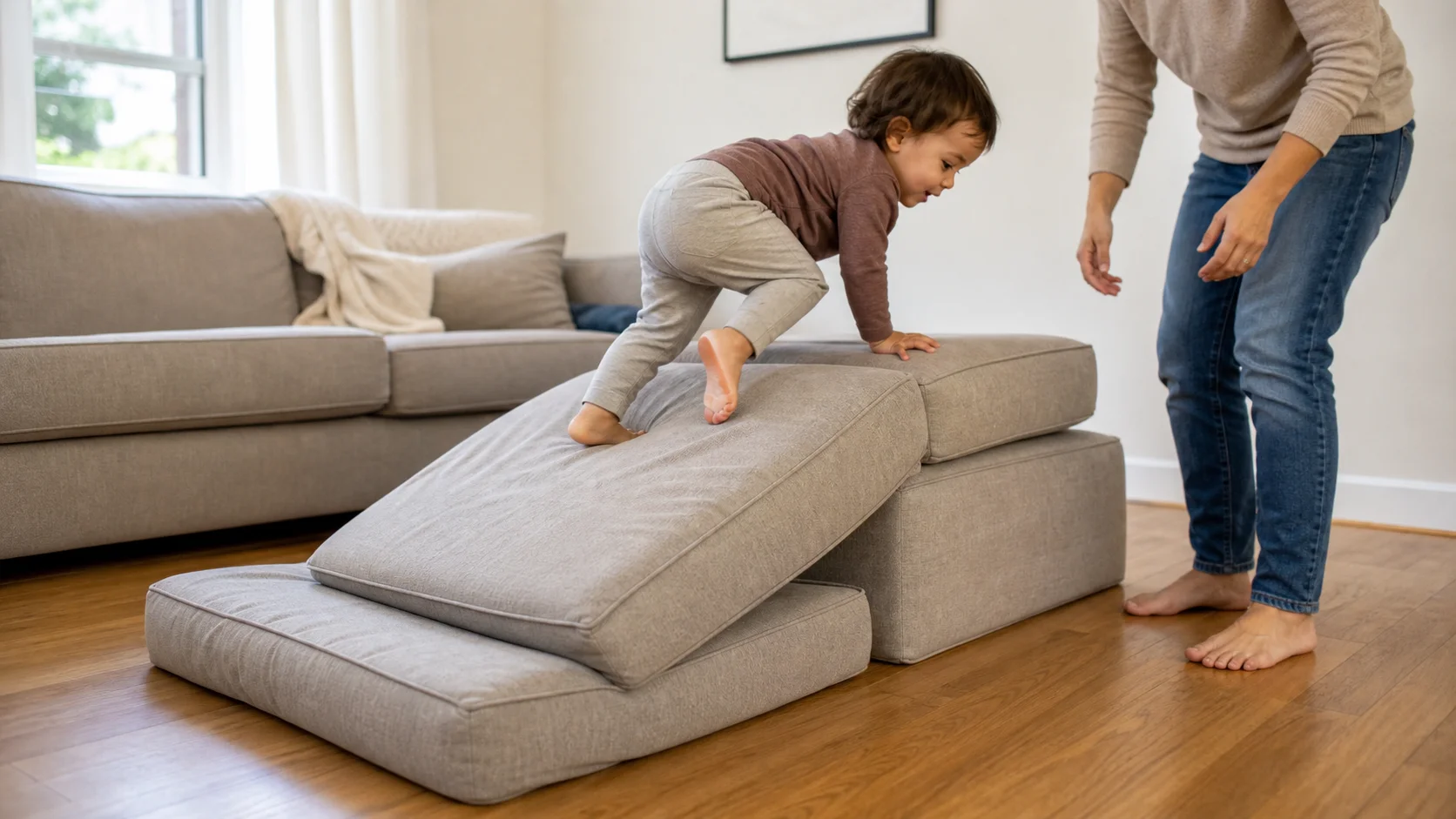
Toddler climbing up a low stack of couch cushions on a living room floor while a grown-up stays close beside the stack
Fine motorDevelopmental supportChange Body LevelIndoor

Couch Cushion Mountain.

Stack two or three couch cushions into a low mountain and let your child climb up and down in short, satisfying turns.

Play time
5-10+ min
Age
1-3 years
Energy
Medium To High
Mess
Low
Effort
Medium
Where
Indoor
Start here

The recipe.

Medium parent effort
2 things

What you need

  • 2 to 3 couch cushions or firm pillows
  • 1 clear floor space beside a couch or open wall
5 min minimum

Setup

Then start the loop
Step 01
Clear a floor area beside the couch or an open wall so your child can climb up one side and get down the other without bumping furniture.
Step 02
Put the flattest cushion or pillow on the floor as the bottom layer.
Step 03
Stack one or two more cushions or pillows on top to make a short soft mountain.
Step 04
Push on the stack from the top and both sides. If it slides or leans, flatten it and restack before your child climbs.
Step 05
Stand close on the climb-down side so you can steady a shoulder or reset a cushion fast.
"Up the mountain."
The loop

How play unfolds.

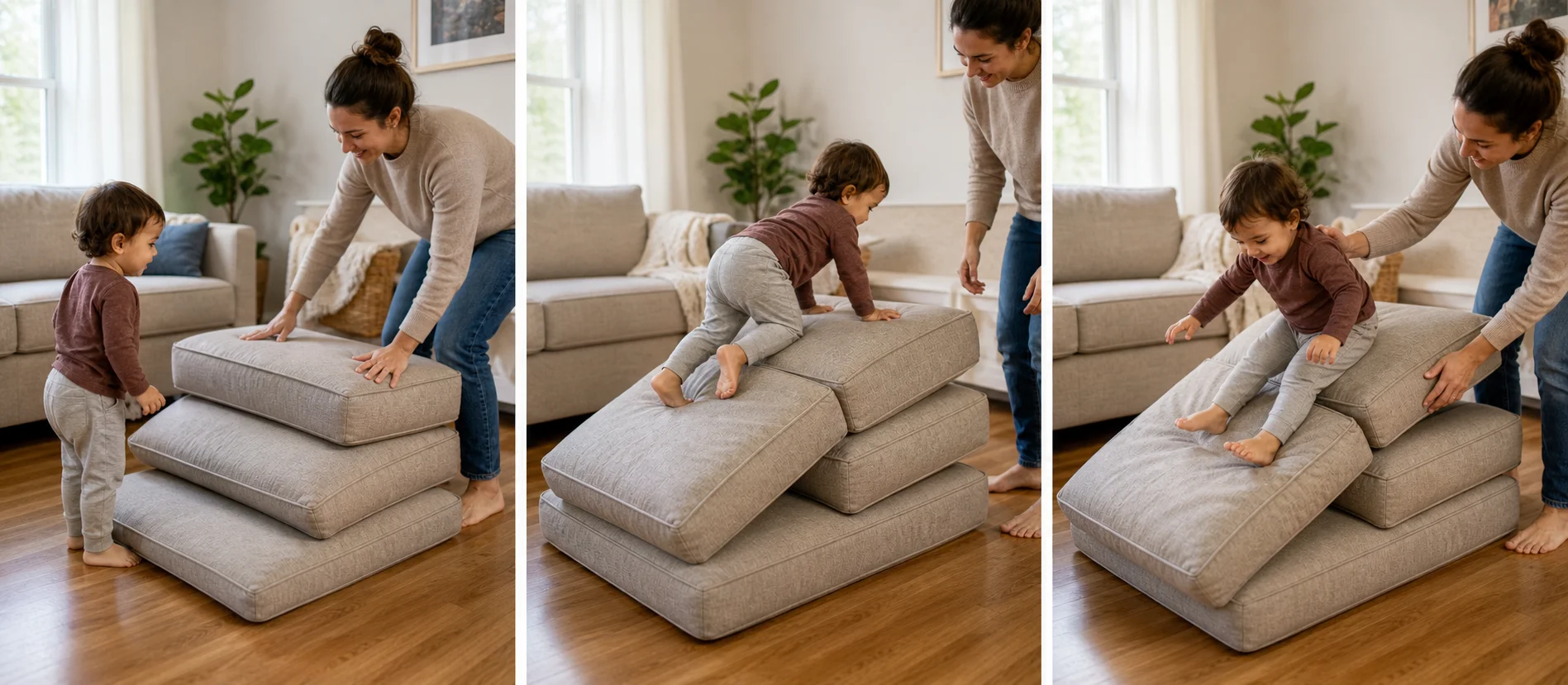
Three-panel sequence showing a grown-up stacking couch cushions, a toddler climbing to the top, and the toddler climbing back down for another turn
  1. 01
    Pat the bottom cushion, point to the top, and say, "Climb up the mountain."
  2. 02
    Let your child climb up and get back down.
  3. 03
    Reset any shifted cushion and offer another turn.
  4. 04
    Stop after a few successful climbs or sooner if the body play stops looking steady.

Safety Check

  • Stay close because the child is climbing on a soft unstable surface and can slip or tip sideways on the way down.
  • Keep the stack low. Stop if the child would need to jump from the top.
  • Keep the floor around the mountain clear of hard toys, tables, and sharp furniture edges.
Supporting the play

What to say in the moment

Match what you say to what you see.

Prompt ladder
Level 1 (Start)
Climb up.
Level 2 (Keep going)
Get to the top.
Level 3 (Stretch)
Climb down slow.
Level 4 (Extend)
One more climb.
If your child seems...
What you'd see
Focused
What to do
Say
"Up and down."
Add
Wait until your child gets to the top before speaking again.
Extend
Offer one more climb before resetting the stack.

Make it easier

Younger end
  • -Use two cushions instead of three.
  • -Keep the top wide and flat.
  • -Help on the climb down before the child loses balance.

Make it harder

Older end
  • +Let your child climb up, turn, and climb down without your hand on the stack.
  • +Ask your child to carry one small pillow to the stack before the next turn.
  • +Add one more short climb only if the stack still stays low and steady.

If it's not working

If you see
If child ignores it
Climb one knee onto the bottom cushion yourself, pat the top, and say, "Can you come up?"
If you see
If child misuses it
If the child starts jumping, crashing sideways, or pulling the stack apart, flatten the mountain right away and restart with one lower climb.
If you see
If child gets frustrated
Keep the stack to two cushions, help on the way down, and count reaching the top once as the win.
Skill spotlight
Change Body Level

Climbing onto and off a low soft surface with body control

This helps the child practice body control, balance, and using arms and legs together during a small climbing challenge.

  • Repeated climbing gives your child a clear chance to use arms, legs, and balance together.
  • The short up-and-down route keeps the movement goal obvious without adding a lot of instructions.
  • Resetting the same low mountain each turn supports repetition without changing the play.
Real-world transfer
  • Climbing onto safe soft surfaces with more body control.
  • Handling small height changes during everyday play.
  • Using balance and planning during indoor obstacle play.
Back to library
Keep playing

Related activities.