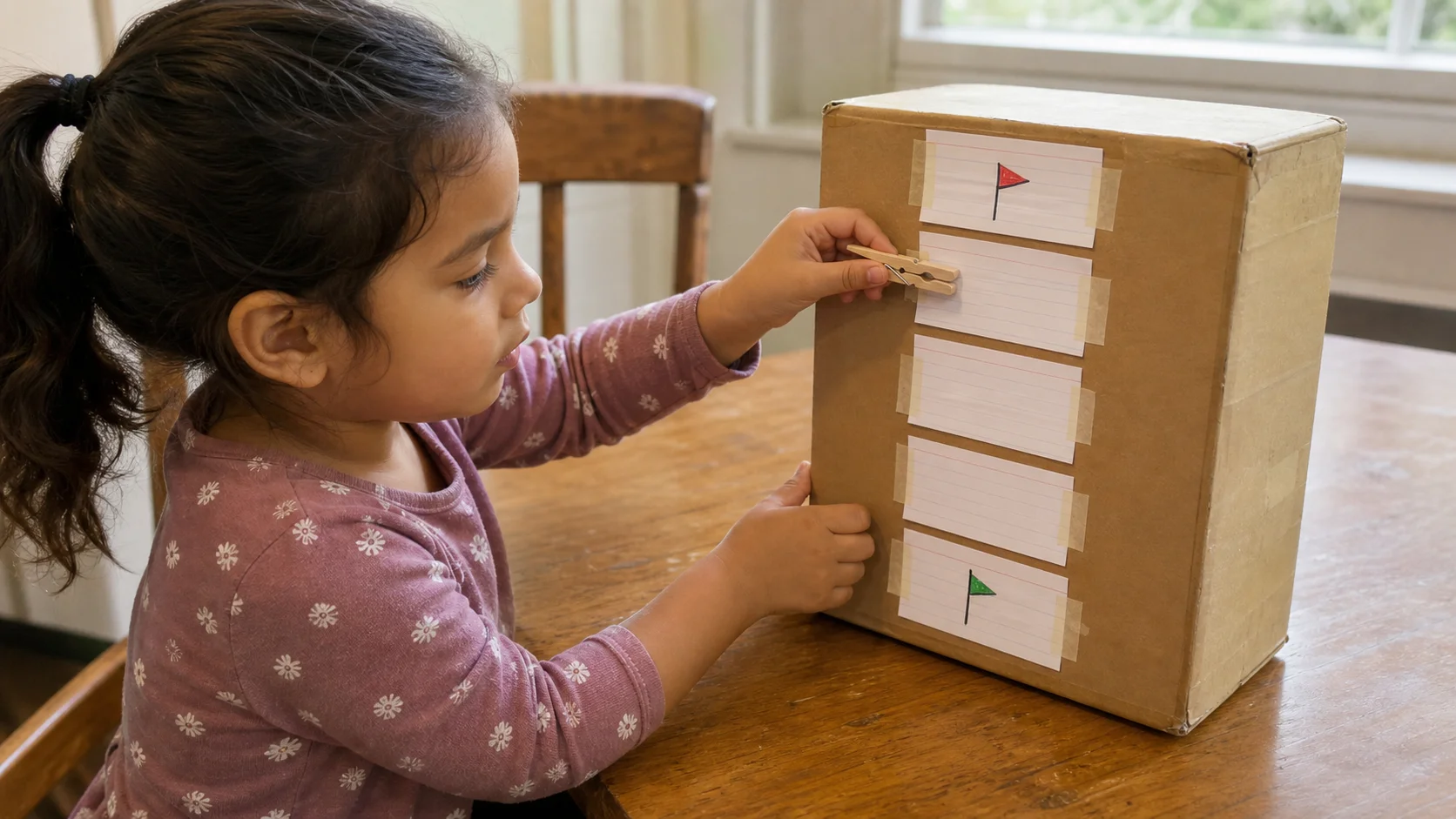
A child clips a clothespin onto index-card steps taped to the side of a shoe box.
Fine motorOT-adjacent supportSqueeze And Release`Indoor Table

Clothespin Cliff Climber.

Build a tiny card ladder on a shoe box and let one clothespin climb from start flag to finish flag.

Play time
5+ min
Age
3-5 years
Energy
Low
Mess
Low
Effort
Low
Where
Indoor Table
Start here

The recipe.

Low parent effort
8 things

What you need

  • 1 shoe box
  • 5 index cards
  • Masking tape
  • 1 marker
  • 1 clothespin
  • 1 flat table
  • 1 adult for setup and direct supervision
  • 1 child
5 min minimum

Setup

Then start the loop
Step 01
On the flat table, place the shoe box on its side so the wide side faces your child like a small climbing wall.
Step 02
On the side of the box, tape 5 index cards vertically with space between them like ladder steps.
Step 03
On the bottom card, draw 1 small start flag.
Step 04
On the top card, draw 1 small finish flag.
Step 05
On the table beside the bottom card, place the clothespin.
Step 06
At the table, seat or stand your child facing the card ladder.
Step 07
Before the first clip, check that the box stays steady, the taped cards do not peel when touched, and the bottom card is easy for your child to reach.
"Clip on."
The loop

How play unfolds.

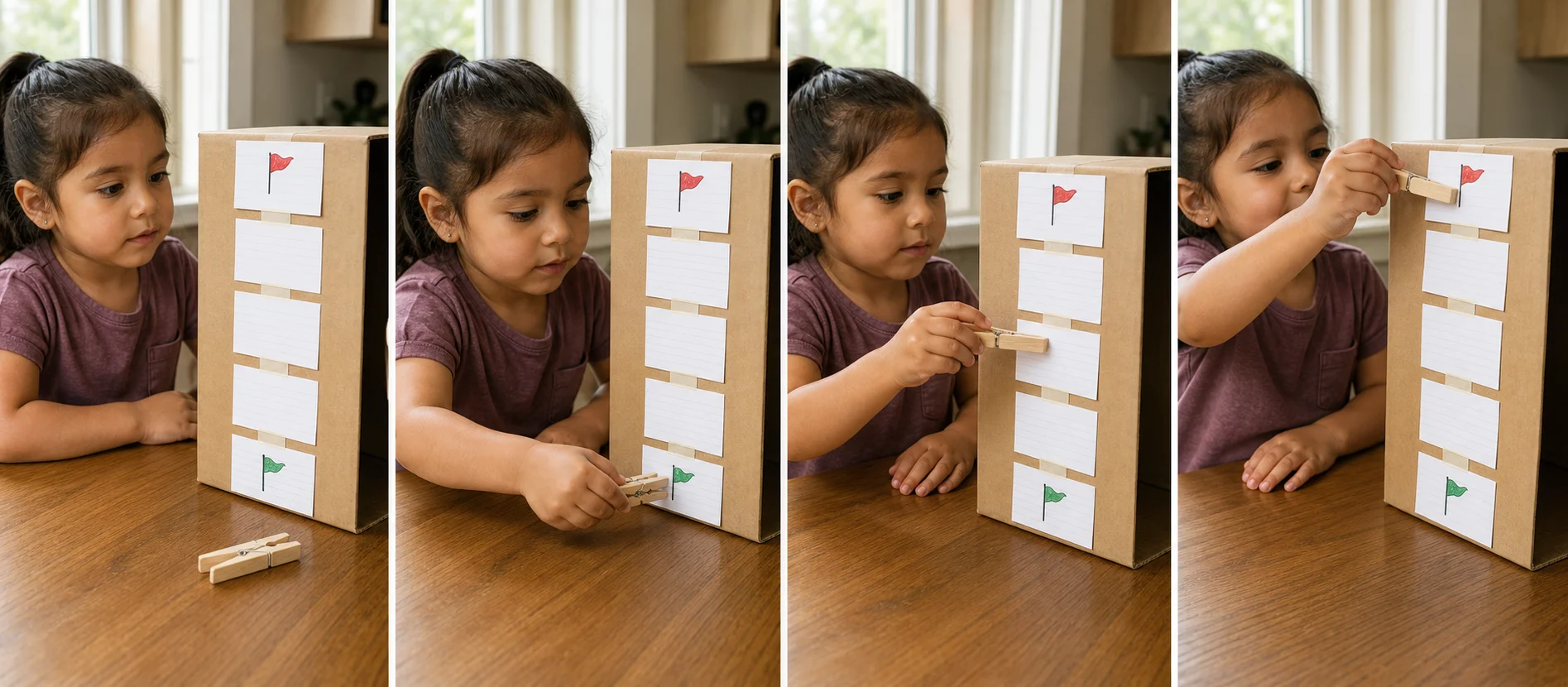
A sequence showing the clothespin starting at the bottom card, climbing card by card, and reaching the finish flag.
  1. 01
    Hold the box steady, point to the bottom card, and say, "Clip your climber on the start flag."
  2. 02
    Let your child squeeze the clothespin open and clip it onto the card.
  3. 03
    Move the clothespin up one card at a time: unclip, aim, clip again.
  4. 04
    Keep climbing until the clothespin reaches the finish flag.
  5. 05
    Move the clothespin back to the start for another climb.

Safety Check

  • Keep direct adult supervision throughout the activity.
  • Use the clothespin only on the cards.
  • Retape loose cards and steady the box before continuing.
  • Stop or switch activities if the clothespin pinches skin, your child throws the clothespin, pushes the box, or finds the squeeze painful or upsetting.
Supporting the play

What to say in the moment

Match what you say to what you see.

Prompt ladder
Level 1 (Start)
"Put your climber on the start flag."
Level 2 (Keep going)
"Move up one step."
Level 3 (Stretch)
"Can your climber reach the next card?"
Level 4 (Extend)
"Try one slow climb and one quick climb."
If your child seems...
What you'd see
Focused
What to do
Say
"Next step."
Add
Ask for one color, top, or bottom name while the clothespin is already moving.
Extend
Invite one slower climb with the same 5 cards.

Make it easier

Younger end
  • -Start with the clothespin already clipped to the bottom card so your child only has to move it up.
  • -Use only every other card for one short climb.
  • -Let your child use two hands on the clothespin while you steady the box.

Make it harder

Older end
  • +Ask your child to pause for one breath after each successful clip.
  • +Have your child climb down from the finish flag after climbing up.
  • +Challenge your child to keep the box from moving while you stop holding it.

If it's not working

If you see
If child ignores it
Clip the clothespin onto the start card yourself, move it up 1 card, and say, "Your climber's turn."
If you see
If child misuses it
Pause the round, put the clothespin back on a card, and say, "Clips only on the steps."
If you see
If child gets frustrated
Hold the box steady, start the clothespin half-open, or shorten the climb to 3 cards.
Skill spotlight
Squeeze And Release`

Squeezing and releasing with control

This helps the child build the finger control used for pencil grip, tool use, fasteners, and other small hand jobs.

  • Squeezing the clothespin gives your child repeated finger-strength practice with a clear purpose.
  • Aiming for each card helps your child coordinate eyes and fingers around one small target.
  • Moving from start flag to finish flag gives the play a simple sequence your child can see and repeat.
Real-world transfer
  • Holding a pencil or crayon with more control.
  • Opening and closing small clips or fasteners.
  • Using fingers and eyes together for careful table work.
  • Staying with a short sequence until it is finished.

Parent questions