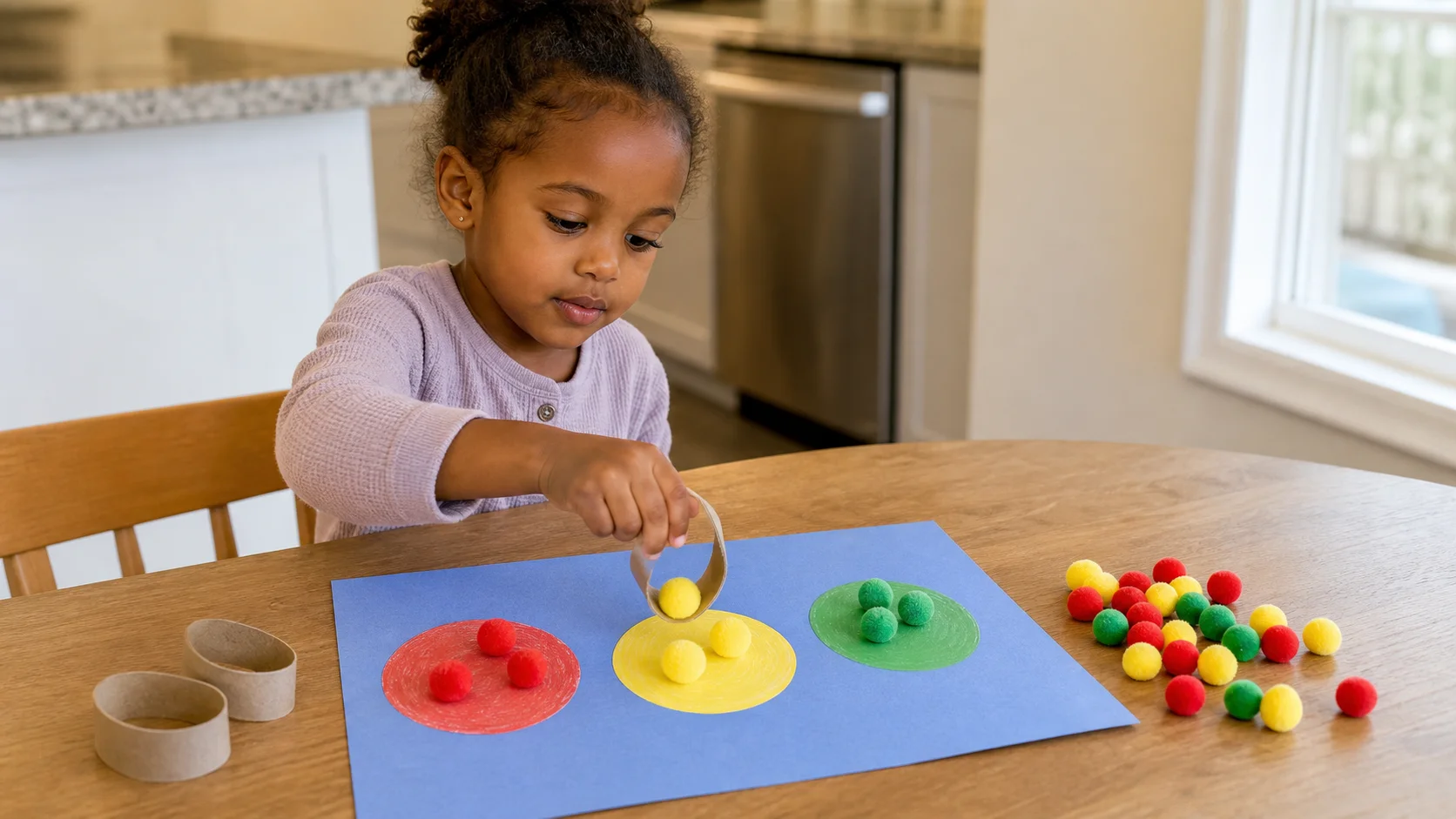
Child squeezing a cardboard ring around a pom-pom beside colored circles on paper.
Fine motorOT-adjacent supportSqueeze And Release`Indoor Table

Cardboard Ring Squeezer.

Squeeze a cardboard ring around a pom-pom, carry it to the paper, and drop it on the matching color.

Play time
5-10+ min
Age
3-5 years
Energy
Low
Mess
Low
Effort
Medium
Where
Indoor Table
Start here

The recipe.

Medium parent effort
7 things

What you need

  • 1 piece of construction paper
  • Markers
  • 1 empty paper roll
  • Scissors for adult setup
  • Colorful pom-poms
  • 1 indoor table
  • 1 adult for setup and direct supervision
5 min minimum

Setup

Then start the loop
Step 01
On the construction paper, draw 3 big circles and color each circle a color that matches at least some of the pom-poms.
Step 02
Before your child starts, cut the empty paper roll into 4 cardboard rings.
Step 03
Out of your child's reach, put the scissors away.
Step 04
On the table in front of your child, place the colored-circle paper flat.
Step 05
On the table beside the paper, place a small pile of matching pom-poms.
Step 06
On the table closest to your child's working hand, place 1 cardboard ring and keep the extra rings nearby as backups.
Step 07
At the table, seat your child close enough to reach the paper, ring, and pom-poms with both hands.
"Squeeze and grab."
The loop

How play unfolds.

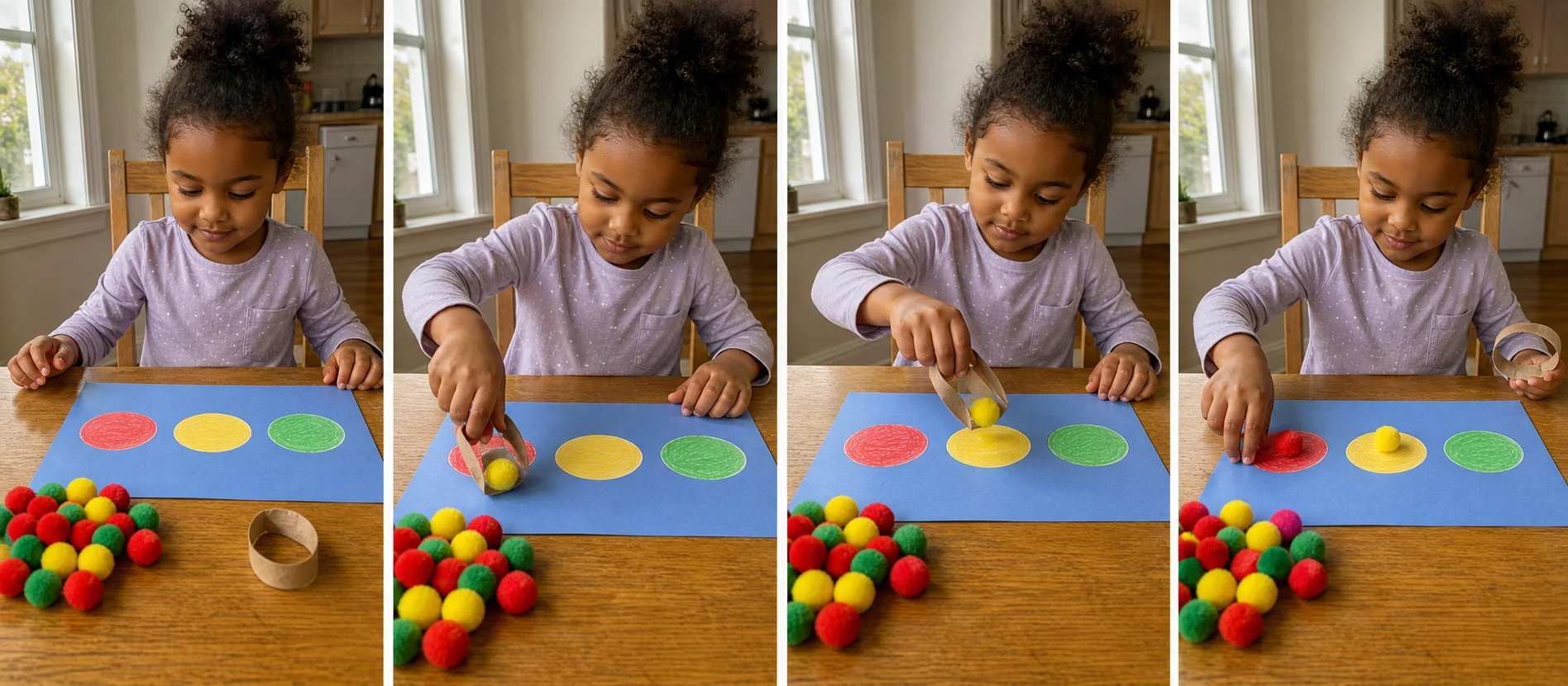
Three steps showing a child squeeze the cardboard ring, carry a pom-pom, and drop it on the matching colored circle.
  1. 01
    Pick up one cardboard ring and say, "Watch me squeeze, grab, and drop."
  2. 02
    Squeeze the ring around one pom-pom, then drop it onto the matching colored circle.
  3. 03
    Hand the ring to your child.
  4. 04
    Let your child squeeze one pom-pom, carry it to the paper, and drop it on the matching circle.
  5. 05
    Repeat until the matching pom-poms are sorted or your child is done squeezing.

Safety Check

  • Keep direct adult supervision throughout the activity.
  • Keep scissors out of reach during play.
  • Pom-poms are a choking hazard. Keep them away from younger siblings and children who mouth small objects.
  • Stop or switch activities if pom-poms go near the mouth.
Supporting the play

What to say in the moment

Match what you say to what you see.

Prompt ladder
Level 1 (Start)
Squeeze the ring around one pom-pom.
Level 2 (Keep going)
Drop it on the color that matches.
Level 3 (Stretch)
Try one slow squeeze, then one fast squeeze.
Level 4 (Extend)
Sort one whole color before switching colors.
If your child seems...
What you'd see
Focused
What to do
Say
"You are squeezing with control."
Add
Name the color after the drop.
Extend
Try making a tiny color pile before moving to the next color.

Make it easier

Younger end
  • -Use only 1 circle and 1 matching pom-pom color for the first round.
  • -Put each pom-pom directly beside its matching circle before your child squeezes.
  • -Let your child squeeze the ring after you slide the pom-pom into the opening.

Make it harder

Older end
  • +Ask your child to keep the pom-pom inside the ring until it is over the circle.
  • +Invite your child to sort by color groups instead of nearest pom-pom first.
  • +Pause before each drop so your child checks the color match.

If it's not working

If you see
If child ignores it
Do 1 full slow turn yourself, then hand over the ring with 1 pom-pom already partly pinched.
If you see
If child misuses it
If the ring becomes a bracelet, telescope, or stacker, name that play once, then return to "squeeze, grab, drop" with 1 pom-pom.
If you see
If child gets frustrated
Use a softer ring, let your child squeeze with two hands, or switch to dropping 3 pom-poms by hand before trying the ring again.
Skill spotlight
Squeeze And Release`

Squeeze-and-release control

This helps the child control finger pressure for small daily hand jobs, like picking up tiny pieces, using crayons, opening simple containers, and placing things where they belong.

  • The cardboard ring gives your child a clear squeeze-and-release job with visible feedback.
  • Carrying one pom-pom at a time helps your child practice holding pressure during movement.
  • Dropping onto the matching circle adds a simple visual target without turning the activity into a lesson.
Real-world transfer
  • Picking up small toys or snack pieces without crushing them
  • Holding crayons or small tools with steadier pressure
  • Dropping items into a bowl, box, or matching spot
  • Using eyes and hands together during tabletop play

Parent questions