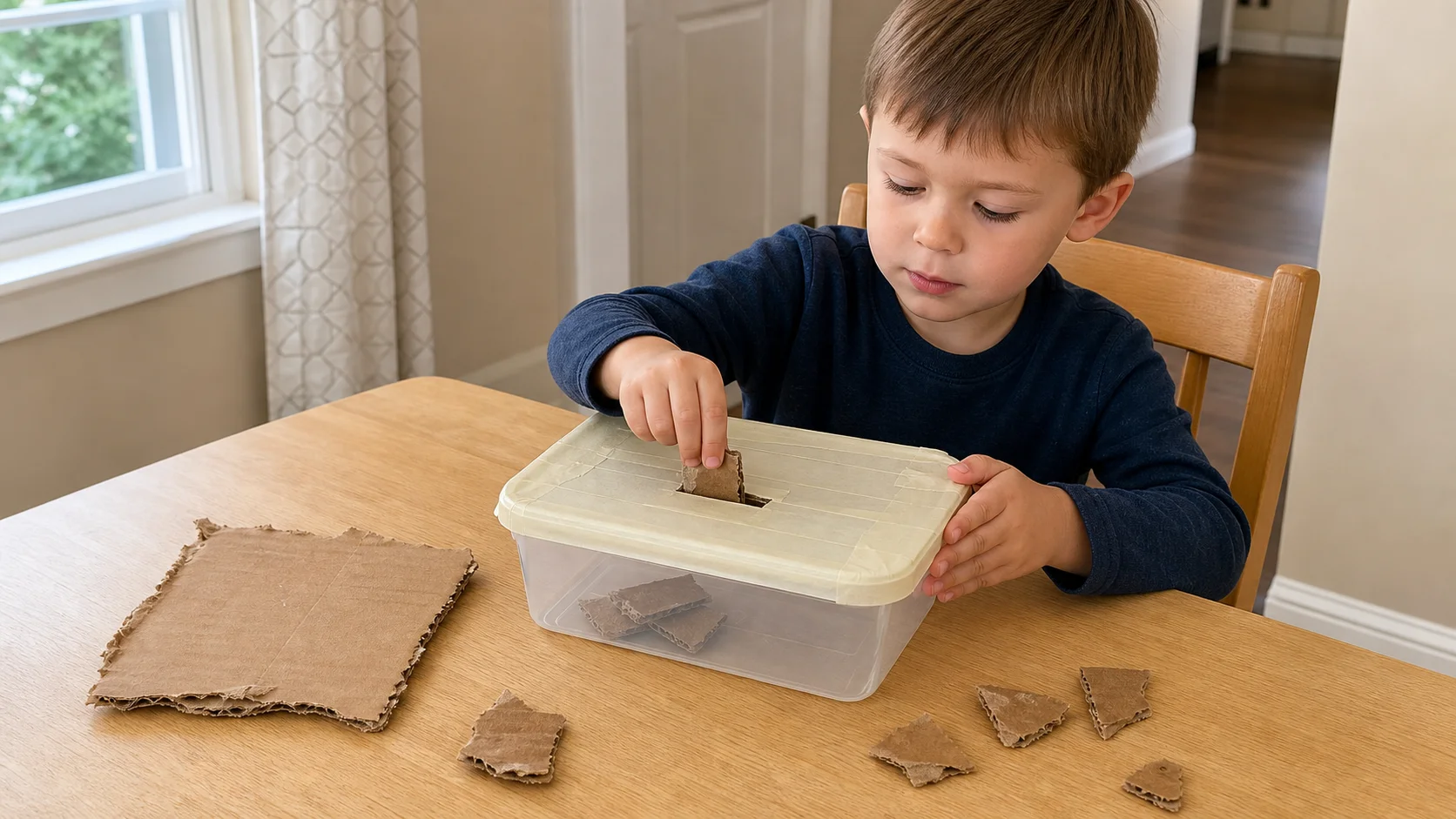
A child seated at a table pushing a torn cardboard piece through a narrow taped slot on a plastic container.
Fine motorOT-adjacent supportPush Through Resistance`Indoor Stable Table

Cardboard Crunch Slot.

Tear firm cardboard, find the skinny edge, and push each piece through a taped slot.

Play time
5-10+ min
Age
3-5 years
Energy
Low
Mess
Low
Effort
Medium
Where
Indoor Stable Table
Start here

The recipe.

Medium parent effort
6 things

What you need

  • 1 plastic container with an open top
  • Masking tape
  • 1 piece of firm cardboard
  • Scissors for adult-only preparation
  • 1 stable table
  • 1 adult for setup and direct supervision
5 min minimum

Setup

Then start the loop
Step 01
On a stable table, place the plastic container flat in front of where your child will sit.
Step 02
Across the container opening, stretch masking tape until the whole top is covered and no open gaps show.
Step 03
In the center of the taped top, cut 1 very narrow slot about 1.5 inches long.
Step 04
On the table beside your child's working hand, place the firm cardboard within easy reach.
Step 05
At the table, seat your child close enough to keep one helper hand on the container while you stay within reach.
Step 06
Before starting, press near the slot to check that the tape is stuck down, the slot still looks narrow, and the container does not slide easily.
"Rip, turn, push."
The loop

How play unfolds.

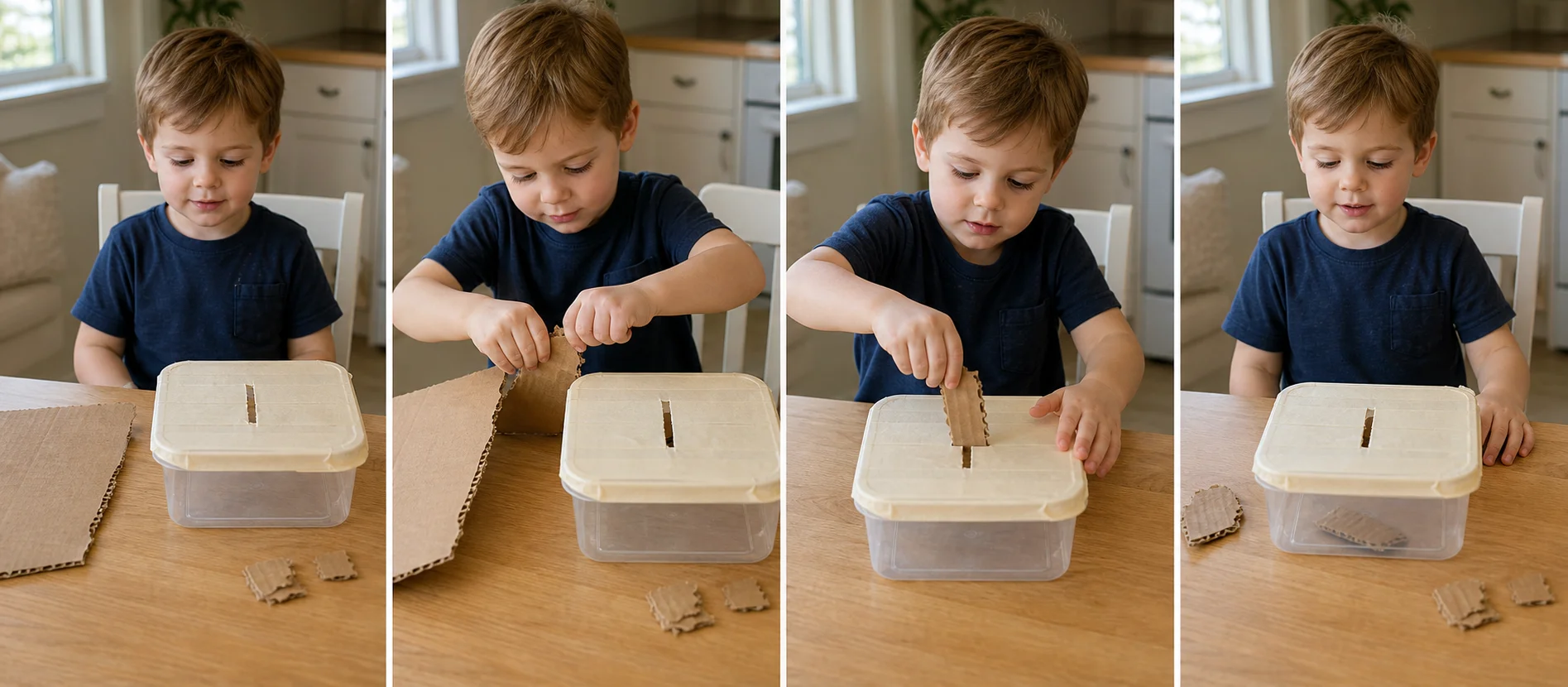
Three-panel sequence showing cardboard tearing, turning the piece to fit, and pushing it through the slot.
  1. 01
    Hand your child the cardboard, tap the slot, and say, "Rip, turn, push."
  2. 02
    Let your child tear off one small piece.
  3. 03
    Have your child steady the container, turn the piece until an edge fits, and push it through the slot.
  4. 04
    Repeat with the next piece until the cardboard is posted or attention fades.

Safety Check

  • Keep constant direct adult supervision throughout the activity.
  • Cardboard scraps and masking tape are choking hazards.
  • Keep your child seated and stop right away if any cardboard or tape goes near the mouth.
  • Adults handle the scissors and check the taped slot before play.
Supporting the play

What to say in the moment

Match what you say to what you see.

Prompt ladder
Level 1 (Start)
"Rip, turn, push."
Level 2 (Keep going)
"Find the skinny way."
Level 3 (Stretch)
"Can your helper hand keep the box still?"
Level 4 (Extend)
"Make a few tiny pieces and post them one at a time."
If your child seems...
What you'd see
Focused
What to do
Say
"That piece is ready."
Add
Count one posted piece after it drops inside.
Extend
Invite one slower turn before the push.

Make it easier

Younger end
  • -Pre-tear one starter piece so the child begins with posting success.
  • -Hold the container with your hand while the child uses both hands to guide the piece.
  • -Use only two pieces before offering more.

Make it harder

Older end
  • +Ask the child to find the flattest edge before pushing.
  • +Wait for the child to steady the container without your hand.
  • +Post three pieces in a row before opening the container.

If it's not working

If you see
If child ignores it
Tear and post one piece yourself, then hand over the next piece and say, "Your turn." Start with just two or three pieces.
If you see
If child misuses it
If your child peels tape, shakes the container, or brings scraps toward the mouth, pause, remove the loose scraps, and restart with one piece at a time.
If you see
If child gets frustrated
Pick the smallest torn piece, guide the helper hand back onto the container, and cue, "Turn it, now push." If tearing is hard, do one tear together and let your child handle the posting.
Skill spotlight
Push Through Resistance`

Strong fingertip pushing, Two-hand control

Strong, controlled fingertips help with everyday hand tasks like pencil grip, crayon use, and scissors.

  • Tearing firm cardboard gives the fingers real resistance before the posting part begins.
  • Turning each rough piece helps your child notice fit, angle, and edge shape.
  • The helper hand keeps the container steady while the working hand pushes, which makes the two-hand job visible.
  • A tight slot gives immediate feedback: the piece either fits, needs turning, or needs to be torn smaller.
Real-world transfer
  • Holding paper while coloring, drawing, or cutting.
  • Using controlled finger pressure with small tools.
  • Pushing or pulling pieces through tight spaces during dressing and play.

Parent questions