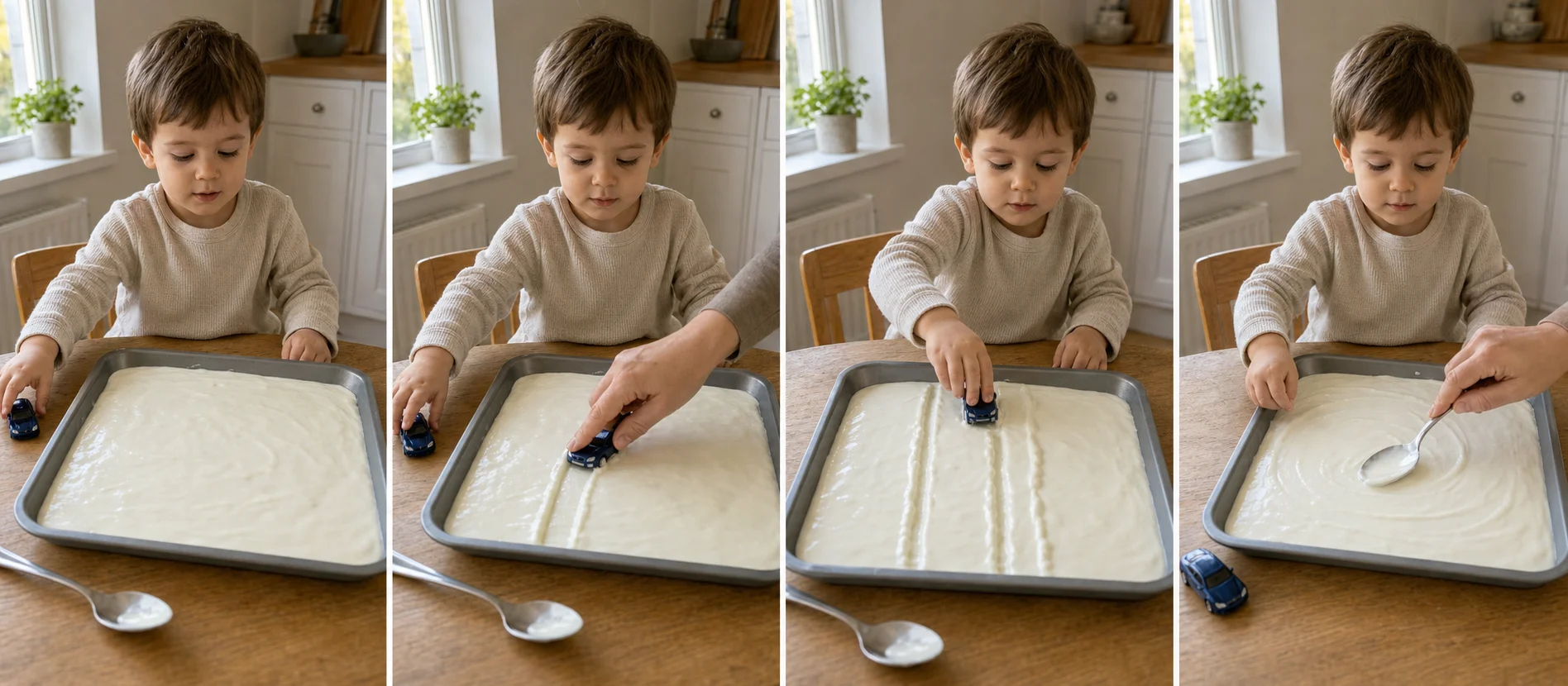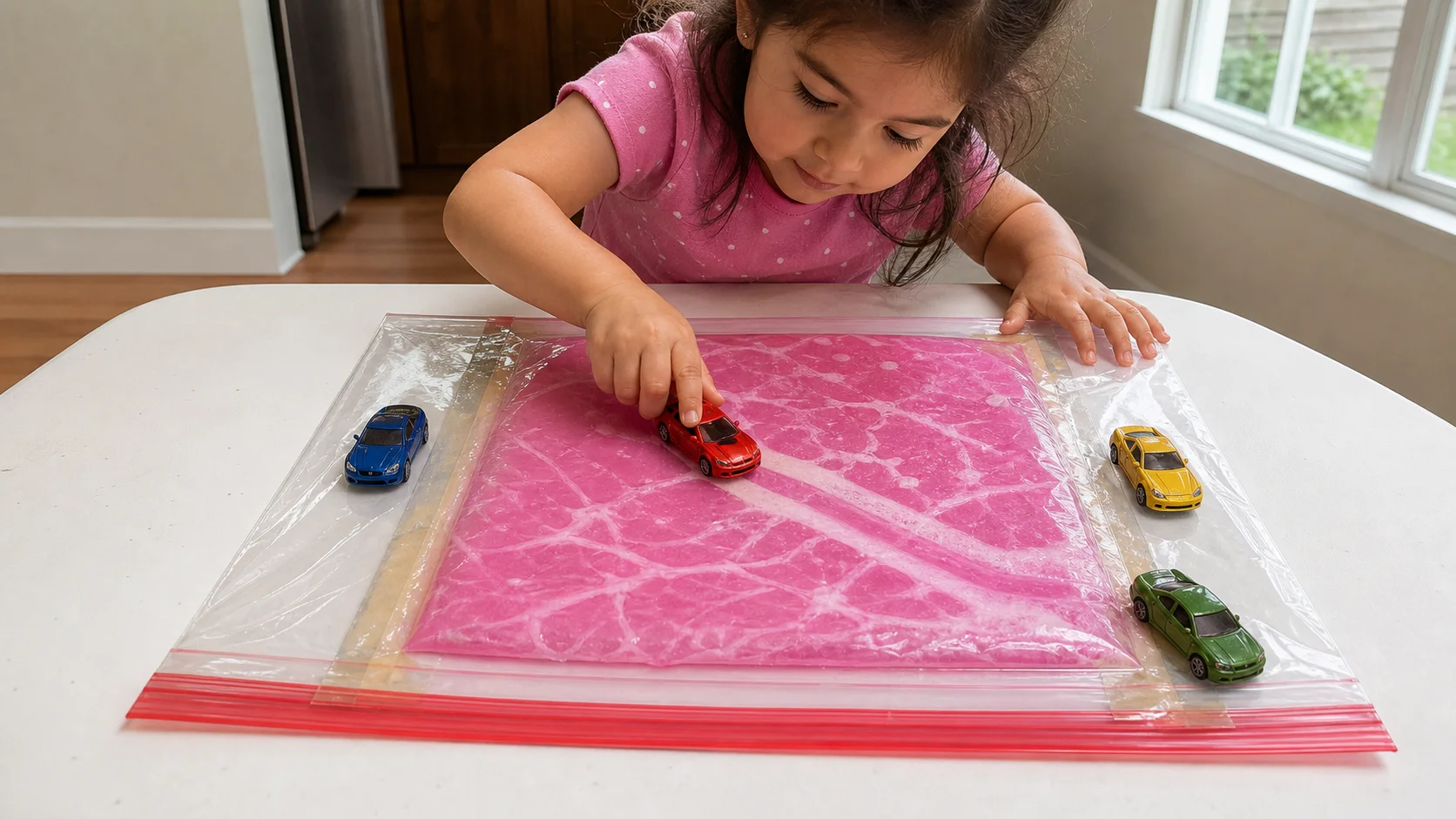
Preschooler pushing a toy car across a sealed soap busy bag and making visible tracks.
ThinkingMove Through PathIndoor Table Or Floor

Car Tracks Busy Bag.

Toy cars glide over a sealed soap bag, leaving visible roads your child can park, trace, and make again.

Play time
10-15+ min
Age
3-5 years
Energy
Low
Mess
Low
Effort
Low
Where
Indoor Table Or Floor
Start here

The recipe.

Low parent effort
4 things

What you need

  • 2 zip-top bags, with 1 bag slightly smaller than the other
  • Colored body wash, shampoo, shaving cream, or similar soap
  • Packing tape
  • 3 to 4 toy cars that fit inside the larger bag
10 min minimum

Setup

Then start the loop
Step 01
In the smaller zip-top bag, add only enough colored soap, shampoo, body wash, shaving cream, or similar material to make a thin squishy layer when the bag lies flat.
Step 02
At the bag opening, press out extra air, seal the smaller bag, and tape the closure shut.
Step 03
Inside the larger zip-top bag, place the sealed soap bag with 3 to 4 toy cars beside it.
Step 04
At the larger bag opening, seal the bag so the cars stay outside the soap bag.
Step 05
On the floor or a low table, lay the larger bag flat where your child can push on it without pulling at the zipper.
Step 06
Before your child starts, check that both closures are shut and the soap layer is thin enough for car tracks to show.
"Make a road."
The loop

How play unfolds.

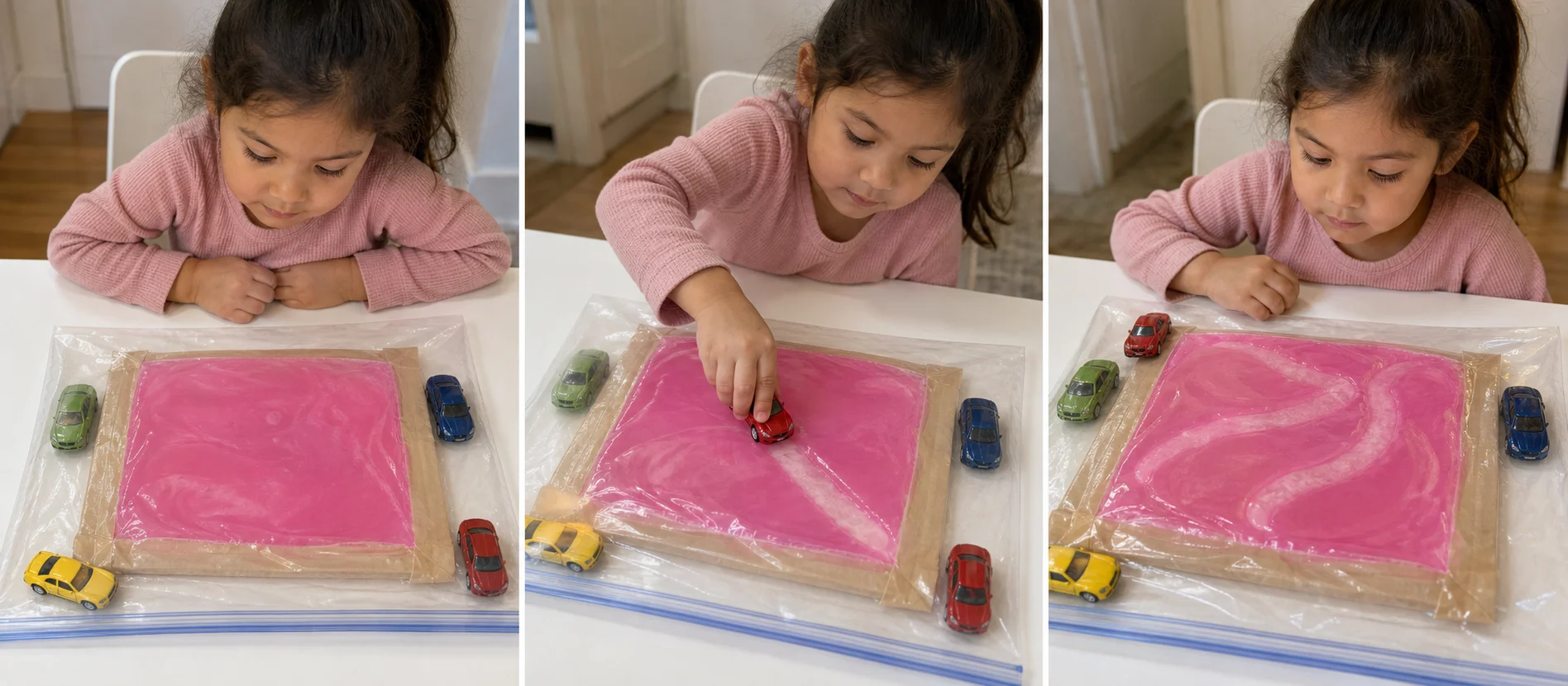
Three-step sequence showing a grown-up sealing the busy bag, a child driving a car to make a track, and cars parked after several roads.
  1. 01
    Drive 1 car across the soap area and say, "Watch this car make a road."
  2. 02
    Let your child push a car across the bag and watch the track appear.
  3. 03
    Park the car in a new spot or switch to another car.
  4. 04
    Repeat the drive, watch, and park loop until the bag has several visible roads.
  5. 05
    If interest fades, draw 1 simple line or favorite letter in the gel with your finger and invite your child to trace it with a car.

Safety Check

  • Inspect both bag seals before play and stay close while your child uses the bag.
  • Stop and retape or throw away the bag if a closure opens, soap leaks, or a toy car comes out.
  • Pause the activity if your child mouths the bag, pulls at the zipper, or tries to dump out the cars.
Supporting the play

What to say in the moment

Match what you say to what you see.

Prompt ladder
Level 1 (Start)
Drive 1 car slowly across the soap and watch the road appear.
Level 2 (Keep going)
Park that car somewhere new and make another road.
Level 3 (Stretch)
Try a short road, then a long road.
Level 4 (Extend)
Trace 1 line I draw, then park your car at the end.
If your child seems...
What you'd see
Focused
What to do
Say
"Your car made a clear road."
Add
"Can you make a road beside it?"
Extend
"Draw 1 short line with your finger and invite the car to follow it."

Make it easier

Younger end
  • -Start with the car already sitting on the clearest part of the soap bag.
  • -Count 1 short push as a full turn.
  • -Let your child press with fingers first, then offer the car after the track is easy to see.

Make it harder

Older end
  • +Ask for 2 roads that do not touch.
  • +Invite your child to park each car in a different corner.
  • +Make 1 curved road after a straight road works.

If it's not working

If you see
If child ignores it
Drive 1 car very slowly, point to the track as it appears, then offer your child the same car without adding more instructions.
If you see
If child misuses it
Hold the bag flat with one hand and say, "Cars stay outside the soap." Pause if your child keeps testing the seal.
If you see
If child gets frustrated
Use fewer cars, make 1 short straight track together, and count that as a full turn before trying another path.
Skill spotlight
Path And Direction

Car path control

This helps your child connect hand movement to a visible path, which supports drawing, tracing, steering small toys, and following simple routes.

  • The visible track shows your child exactly how their hand movement changed the bag.
  • Parking the car before the next drive keeps the repeat loop clear and predictable.
  • Short, long, straight, and curved roads give simple practice with path control.
  • Tracing 1 modeled line can stretch the same car movement toward early drawing.
Real-world transfer
  • Drawing lines with crayons, chalk, or fingers
  • Steering small toys through a path
  • Following a simple route from one spot to another
  • Seeing how a hand movement changes what appears on the surface

Parent questions