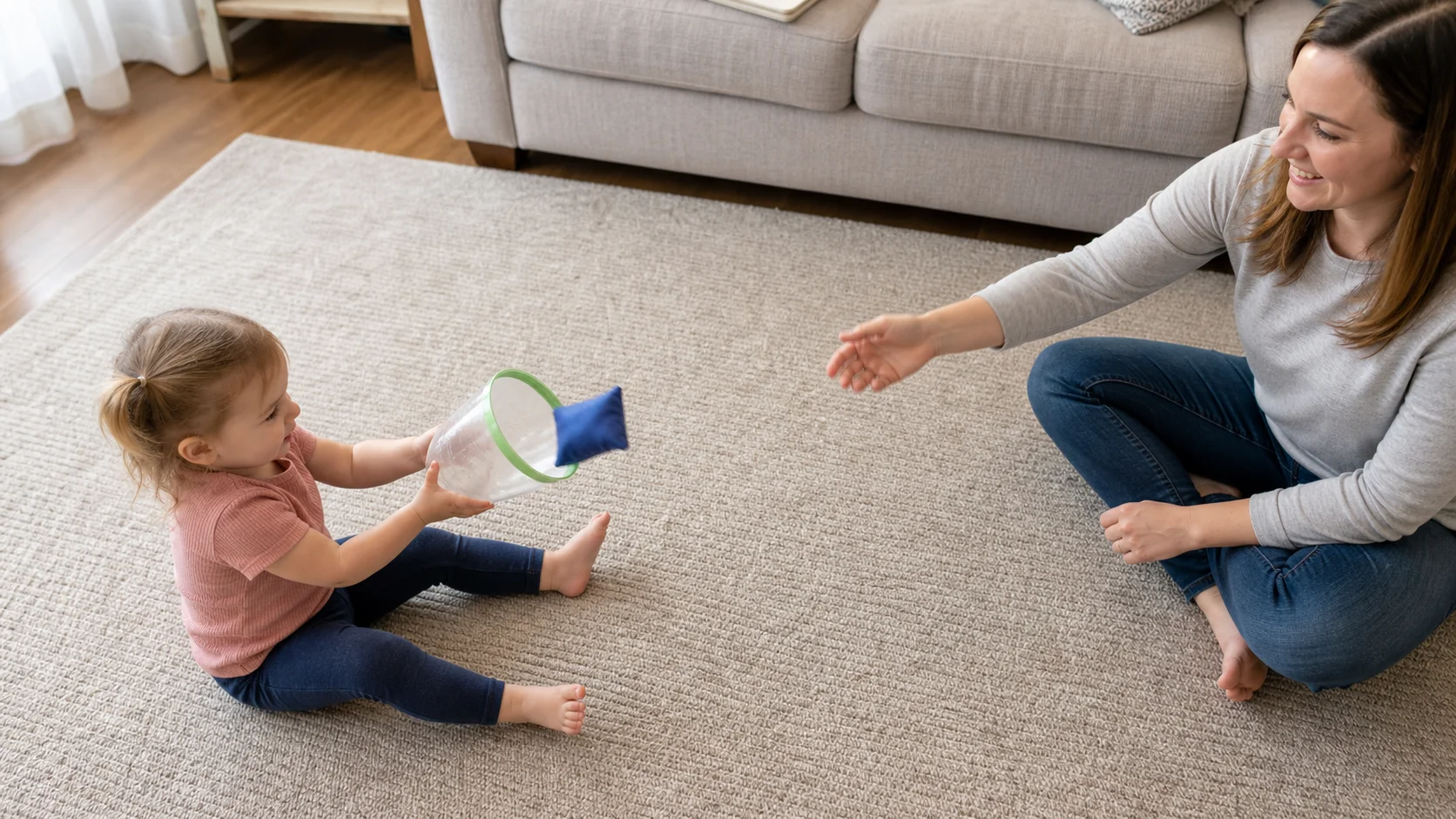
A toddler holding a smooth-edged plastic bottle scoop to catch a soft beanbag from a grown-up sitting nearby.
Fine motorOT-adjacent supportTwo Hand CoordinationIndoor

Bottle Scoop Catch.

A smooth bottle scoop turns one soft toss into a quick catch, tip, and reset game.

Play time
5+ min
Age
2-3 years
Energy
Medium
Mess
Low
Effort
Low
Where
Indoor
Start here

The recipe.

Low parent effort
3 things

What you need

  • 1 adult-cut plastic bottle scoop with a smooth edge
  • 1 soft beanbag or soft ball
  • 1 clear floor space
5 min minimum

Setup

Then start the loop
Step 01
On the floor, sit or kneel facing your child in 1 clear spot with enough room for a short toss and a small scoop swing.
Step 02
In your child's two hands, place the scoop with the opening tipped slightly up toward you. If your child will not hold it yet, rest it on the floor directly in front of their knees with the opening facing you.
Step 03
On your side of the space, hold 1 soft beanbag or ball that is too large to fit fully in your child's mouth.
Step 04
About 2 to 3 feet in front of your child, stay close enough to make 1 gentle underhand toss straight toward the middle of the scoop.
Scoop ready.
The loop

How play unfolds.

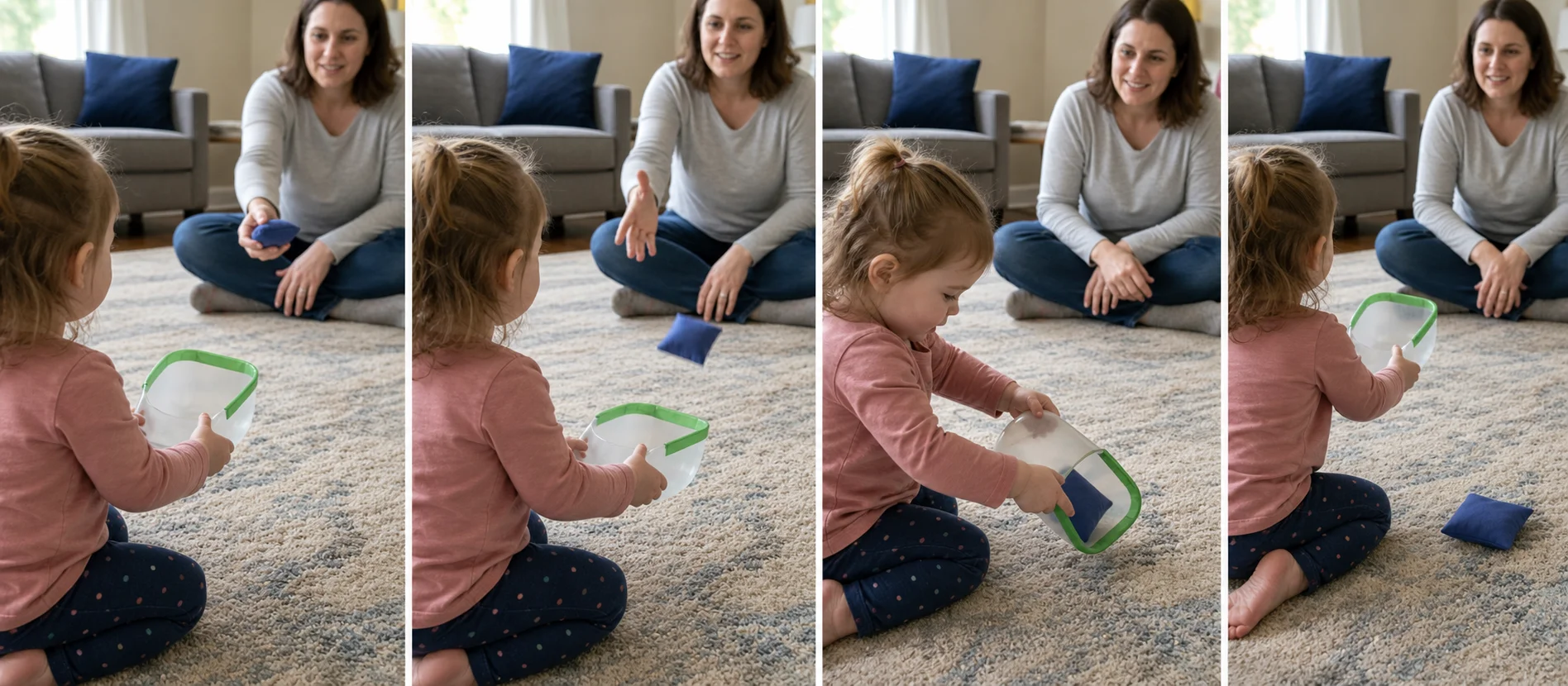
A multi-panel sequence showing a child holding the scoop ready, catching a soft toss, tipping it out, and resetting for another turn.
  1. 01
    Help your child hold the scoop low and facing you.
  2. 02
    Say, `Scoop ready`, then make 1 gentle underhand toss toward the middle of the scoop.
  3. 03
    If the item lands in the scoop or your child traps it there, let your child tip it back out.
  4. 04
    Bring the scoop back to ready and repeat until your child gets a few calm catches or starts turning away.

Safety Check

  • Check the cut edge of the bottle scoop with your finger before every round. Do not use it if it feels sharp, cracked, or scratchy.
  • Use only a soft catching item that is too large to fit fully in your child's mouth.
  • Keep the toss slow and close so the game stays controlled instead of startling.
Supporting the play

What to say in the moment

Match what you say to what you see.

Prompt ladder
Level 1 (Start)
Hold your scoop ready.
Level 2 (Keep going)
Tip it out and catch again.
Level 3 (Stretch)
Keep the scoop still for the next catch.
Level 4 (Extend)
Let's finish with 1 more catch.
If your child seems...
What you'd see
Focused
What to do
Say
Nice catch. Tip it out.
Add
After the tip, add 1 learning prompt only, like `ball` or `beanbag`.
Extend
Start the next toss right away while the scoop is still facing you.

Make it easier

Younger end
  • -Let the scoop rest on your child's knees between turns so they only lift it for the catch.
  • -Aim every toss to the same side of the scoop so the target does not keep changing.
  • -End after 1 clean catch-and-tip turn instead of aiming for a longer round.

Make it harder

Older end
  • +Wait for your child to tip the scoop back to ready position before you toss again.
  • +Send the toss a little left or right while staying at the same short distance.
  • +Aim for 4 calm catches in 1 round after 3 feels easy.

If it's not working

If you see
If child ignores it
Do 1 exaggerated demo catch yourself, then hand the scoop back and try the same short cue again.
If you see
If child misuses it
Lower the item directly into the scoop for 1 turn so your child practices holding and tipping before the next toss.
If you see
If child gets frustrated
Move closer, switch to the beanbag if you have both options, get 1 easy catch, and stop there.
Skill spotlight
Two-Hand Coordination

Using both hands together to catch and tip with the scoop

This helps a child use both hands for 1 tool job, steady that tool while a moving item comes in, and repeat a short catch-and-empty routine that can carry into other container and ball-play tasks.

  • Holding the scoop with both hands gives your child one shared job for both sides of the body.
  • Watching the soft toss come in helps your child connect eye tracking with a ready hand position.
  • Tipping the item out after each catch makes the reset visible, so the next turn is easier to predict.
Real-world transfer
  • Holding bowls, scoops, or containers steady with both hands.
  • Watching something come toward the body and getting hands ready in time.
  • Emptying or returning items from a container during simple helper play.

Parent questions