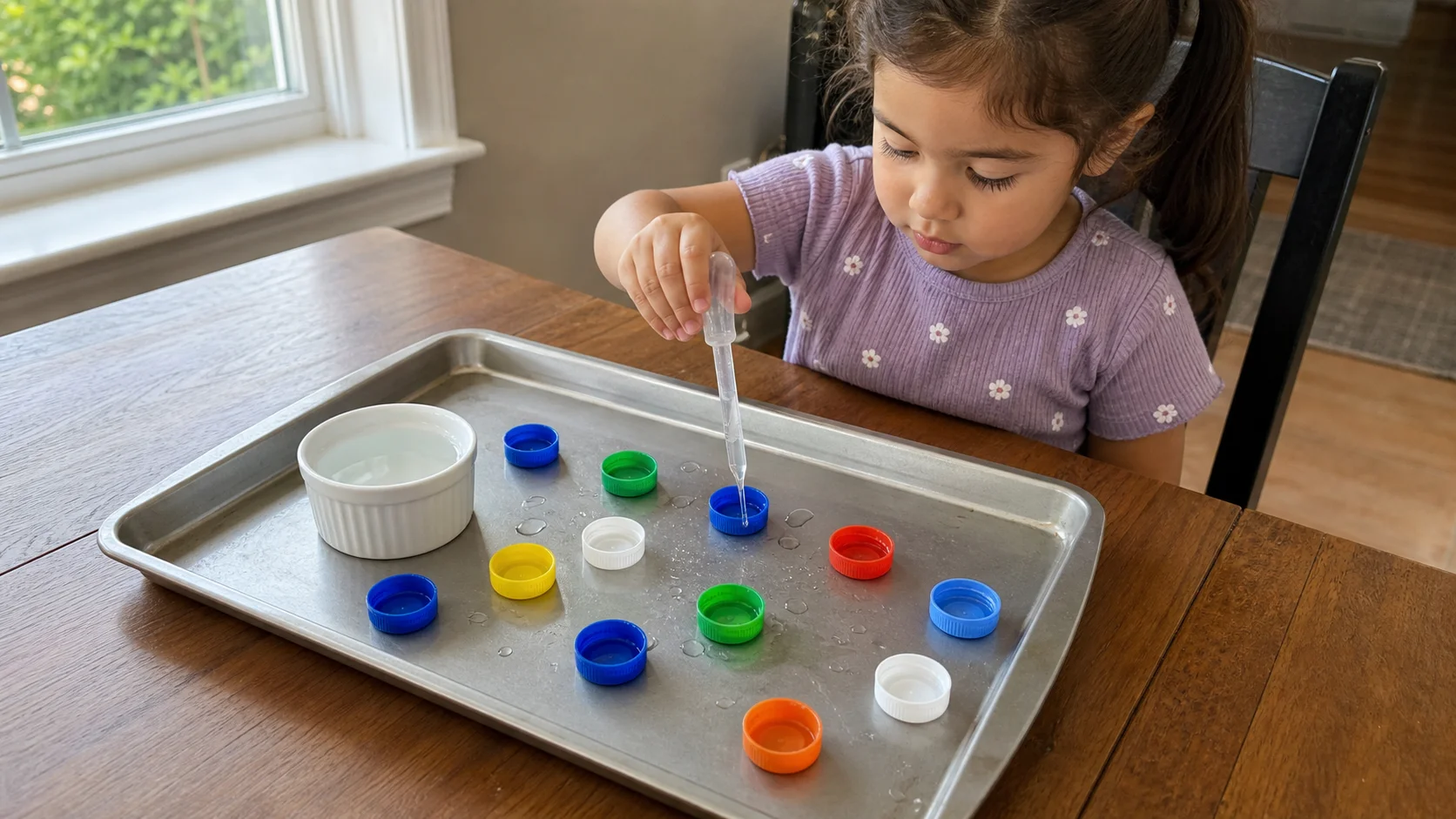
Child using a pipette to squeeze water into bottle caps on a tray.
Fine motorSqueeze And ReleaseIndoor Or Outdoor Water Safe Table Or Floor Surface

Bottle Cap Dropper Fill.

Fill bottle caps with a pipette in a repeatable water tray game that keeps spills contained.

Play time
10-15+ min
Age
3-5 years
Energy
Low
Mess
Medium
Effort
Low
Where
Indoor Or Outdoor Water Safe Table Or Floor Surface
Start here

The recipe.

Low parent effort
5 things

What you need

  • Several clean bottle caps
  • 1 small dish of water
  • 1 child-sized pipette
  • 1 tray or baking sheet
  • 1 adult for direct supervision
10 min minimum

Setup

Then start the loop
Step 01
On a stable water-safe table or floor spot, place the tray or baking sheet so every wet part of the activity stays inside one catch area.
Step 02
On the tray, spread several clean bottle caps with one or two close to your child and a few farther away for later aiming practice.
Step 03
On the tray beside the caps, set the small dish of water within easy reach of the pipette.
Step 04
On the tray next to the water dish, place the pipette.
Step 05
In front of the tray, seat your child where they can reach the closest caps without leaning across the whole tray.
"Squeeze, dip, let go."
The loop

How play unfolds.

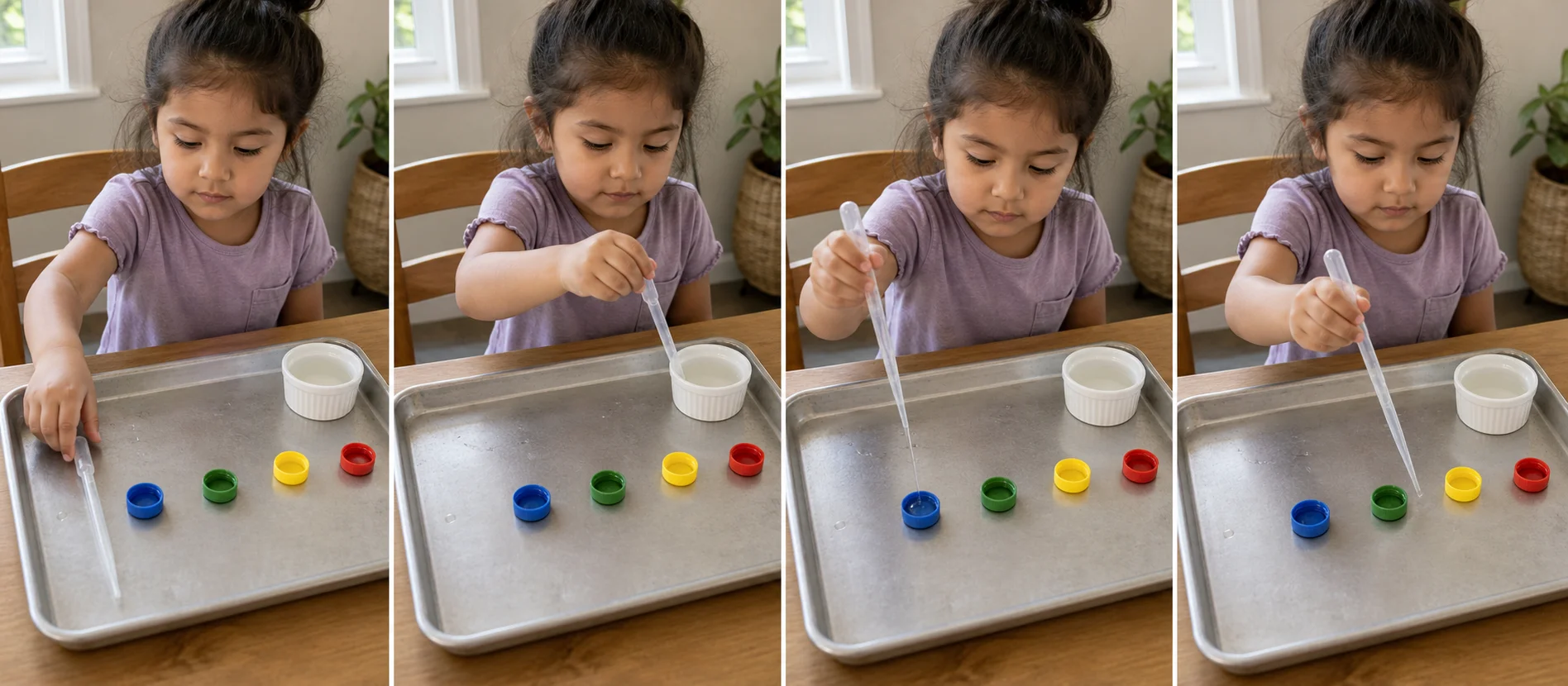
Three-step sequence showing a child loading a pipette, aiming at a bottle cap, and filling caps with water.
  1. 01
    Show how to squeeze the pipette, dip the tip in water, and release to pull water up.
  2. 02
    Aim over the closest cap and say, "Let's fill this little cap."
  3. 03
    Let your child load the pipette, aim at a cap, and squeeze water inside.
  4. 04
    Count one round as complete when water is sitting in a cap.
  5. 05
    Refill the pipette and repeat with the same cap or a new one.

Safety Check

  • Bottle caps and pipettes are small parts that require close adult supervision.
  • Water overspill can make the table or floor slippery.
  • Keep the tray under the whole activity so spills stay contained.
Supporting the play

What to say in the moment

Match what you say to what you see.

Prompt ladder
Level 1 (Start)
Fill the closest cap with one slow squeeze.
Level 2 (Keep going)
Try another cap and watch where the water lands.
Level 3 (Stretch)
Choose a cap that is a little farther away.
Level 4 (Extend)
See if you can make one cap tiny-full and one cap very-full.
If your child seems...
What you'd see
Focused
What to do
Say
"You are watching the water."
Add
Point to one cap with a different fill level.
Extend
Ask, "Which cap has more?"

Make it easier

Younger end
  • -Use only two or three caps so the target choice is obvious.
  • -Keep every cap close enough that the pipette can hover directly over it.
  • -Let the child squeeze water out first, then practice pulling water in after the motion feels easier.

Make it harder

Older end
  • +Invite the child to fill a cap without touching the cap with the pipette tip.
  • +Ask the child to stop squeezing before the cap overflows.
  • +Start with the closest cap, then move to the next farthest cap.

If it's not working

If you see
If child ignores it
Do one quick turn yourself and make the nearest cap the target so the first try looks easy to copy.
If you see
If child misuses it
Keep the tray between the water and the room, move one cap close again, and say, "Water stays on the tray. Let's fill this cap."
If you see
If child gets frustrated
Partly load the pipette for them or hold the target cap steady so they only have to practice one part of the squeeze-and-aim sequence.
Skill spotlight
Squeeze And Release

Squeeze-and-release control

This helps the child control finger pressure for small tools, self-feeding, dressing help, and careful cleanup tasks.

  • Loading and squeezing the pipette gives your child repeated practice changing finger pressure.
  • A tiny bottle cap gives the water a clear target, so misses show your child what to adjust next.
  • Filling, spilling, and refilling keep the loop visible and easy to repeat without extra instructions.
Real-world transfer
  • Using forks, droppers, spray bottles, and other small hand tools.
  • Pouring or filling with less spilling.
  • Buttoning, zipping starts, and other tasks that need careful finger pressure.
  • Wiping or cleaning small spots with controlled hand movement.

Parent questions