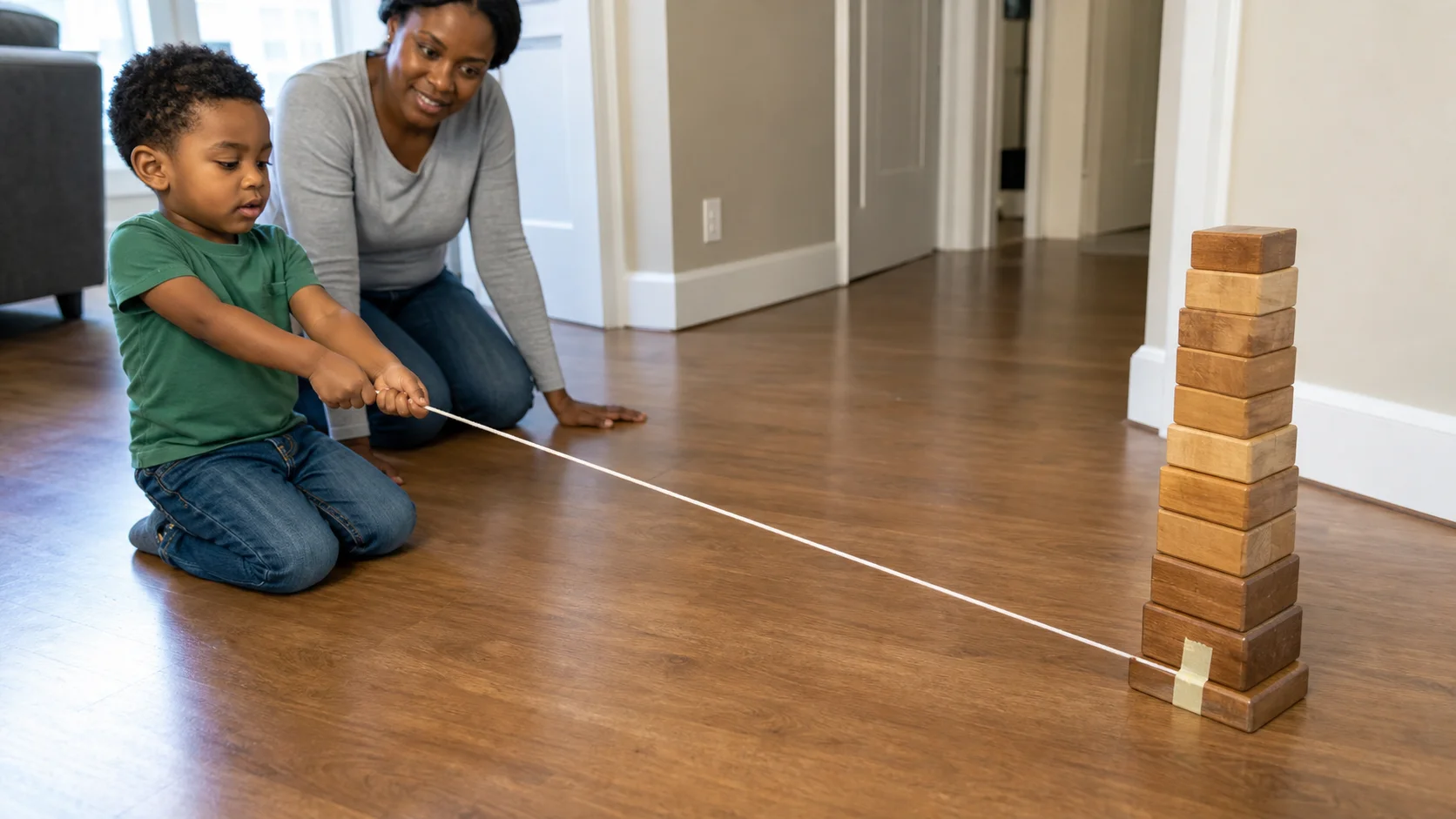
Preschool child kneeling on a smooth floor and slowly pulling a string attached to a block tower.
Gross motorOT-adjacent supportPull Against ResistanceIndoor Smooth Non Carpeted Floor

Block Tower Tug.

A string-towed block tower turns careful pulling into hand-strength and body-control practice.

Play time
5-10+ min
Age
3-5 years
Energy
Medium
Mess
Low
Effort
Medium
Where
Indoor Smooth Non Carpeted Floor
Start here

The recipe.

Medium parent effort
5 things

What you need

  • Heavy blocks
  • Masking tape
  • 1 piece of string or yarn
  • 1 smooth non-carpeted floor space
  • 1 adult for setup and constant supervision
5 min minimum

Setup

Then start the loop
Step 01
On a smooth non-carpeted floor, build one tall tower with the heaviest blocks at the bottom.
Step 02
At the bottom block, tape one piece of string or yarn tightly so the free end can reach your child's hands.
Step 03
On the floor about four feet from where your child will kneel, place the tower with the string trailing in a straight line toward the child.
Step 04
Along the pull path, clear toys, furniture, and any trip hazards.
Step 05
Behind the free end of the string, help your child kneel tall facing the tower.
Step 06
Before starting, give the string one light test pull to check that the tape holds, the tower slides, and no loops can wrap around your child.
"Slow hands."
The loop

How play unfolds.

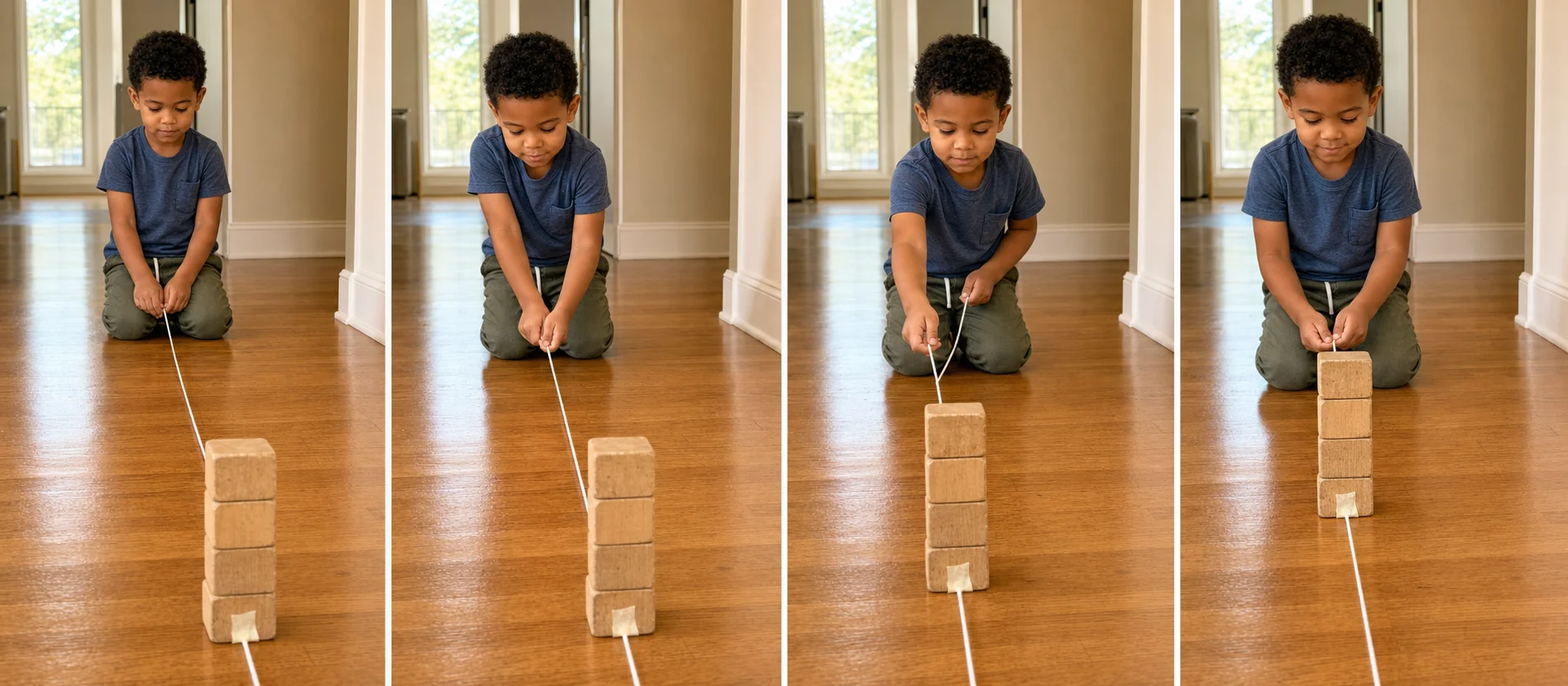
Panels show a grown-up taping string to a block tower, a child pulling slowly, the tower wobbling, and a successful rescue reset.
  1. 01
    Show one slow hand-over-hand pull and say, "Slow hands. Rescue the tower."
  2. 02
    Let your child pull one hand, then the other, trying to slide the tower closer without tipping it.
  3. 03
    Count one rescue round when the tower reaches your child still stacked.
  4. 04
    If the tower tips or the string tangles, stop, clear the string, and restart with a lower tower or shorter distance.
  5. 05
    Rebuild and repeat only if your child wants another rescue.

Safety Check

  • Constant adult supervision is required when string or yarn is in use.
  • Keep the pull path clear of trip hazards.
  • Stop right away if the string wraps around hands, legs, neck, or body.
  • Use a lower tower or lighter blocks if tipping could hit hands or feet.
Supporting the play

What to say in the moment

Match what you say to what you see.

Prompt ladder
Level 1 (Start)
Pull the tower in slowly with one hand, then the other.
Level 2 (Keep going)
Rescue it before it tips.
Level 3 (Stretch)
Make each pull quiet and steady.
Level 4 (Extend)
Rebuild it farther away and try another rescue.
If your child seems...
What you'd see
Focused
What to do
Say
"Keep the tower standing."
Add
Count each hand-over-hand pull as the tower slides.
Extend
Move the tower a few inches farther away for the next round.

Make it easier

Younger end
  • -Start with the tower close enough that three or four slow pulls finish the rescue.
  • -Build a shorter tower so small wobbles do not end the round.
  • -Let your child hold the string while you guide the alternating hand pattern.

Make it harder

Older end
  • +Ask for quiet pulls that move the tower without block sounds.
  • +Add a stop-and-freeze pause halfway through the rescue.
  • +Try one round with the tower starting slightly off-center so your child has to correct the pull path.

If it's not working

If you see
If child ignores it
Do one quick rescue yourself so the tower slides right to your child, then hand over the string and say, "Now you bring it in."
If you see
If child misuses it
If your child jerks the string, stands up, or starts wrapping it, pause right away, straighten the string, return to tall kneeling, and restart with "slow hands, one then the other."
If you see
If child gets frustrated
Put your hands over your child's hands for the first two pulls, coach "slow, slow, pull," and stop after one successful rescue.
Skill spotlight
Resistance Pulling

Pulling with steady force

Steady pulling helps a child organize both sides of the body, hold the trunk stable, and use hand strength for everyday play and self-care tasks.

  • Slow pulling gives your child a clear way to practice steady force instead of quick yanking.
  • Hand-over-hand pulls give both hands a simple pattern to repeat.
  • Tall kneeling asks the body to stay steady while the hands work.
  • The wobbling tower shows your child when a smaller, slower pull works better.
Real-world transfer
  • Pulling clothing, bags, or toy handles with more control.
  • Using both hands together during play and cleanup.
  • Staying steady while the hands work.

Parent questions