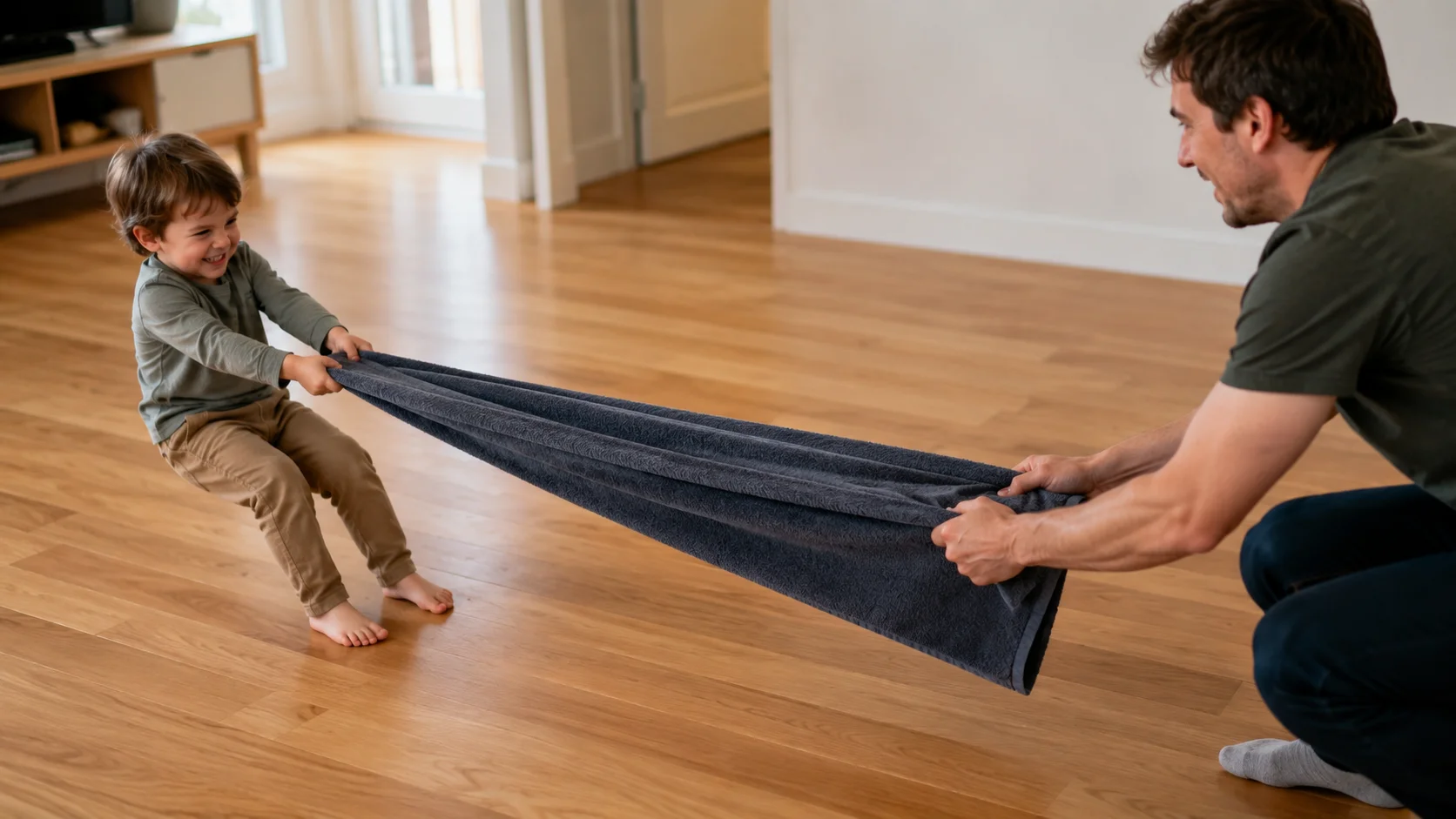
A child and grown-up facing each other on the floor while each holds one end of a soft blanket for a gentle tug.
Gross motorOT-adjacent supportPull Against ResistanceIndoor

Blanket Tug-of-War.

A soft blanket or towel becomes a short pulling game where your child pulls, stops, resets, and repeats.

Play time
1-5+ min
Age
2-5 years
Energy
Medium
Mess
No
Effort
Medium
Where
Indoor
Start here

The recipe.

Medium parent effort
3 things

What you need

  • 1 soft blanket or towel
  • Clear indoor floor space
  • 1 grown-up to hold the other end and control the resistance
1 min minimum

Setup

Then start the loop
Step 01
On the floor, clear a pull space with no hard furniture directly behind your child or behind you.
Step 02
On the floor between you and your child, lay 1 soft blanket or towel.
Step 03
At one end, help your child hold the blanket or towel with both hands if needed.
Step 04
At the other end, hold the blanket or towel low with both hands and stay close enough to soften the pull quickly.
"Ready, pull."
The loop

How play unfolds.

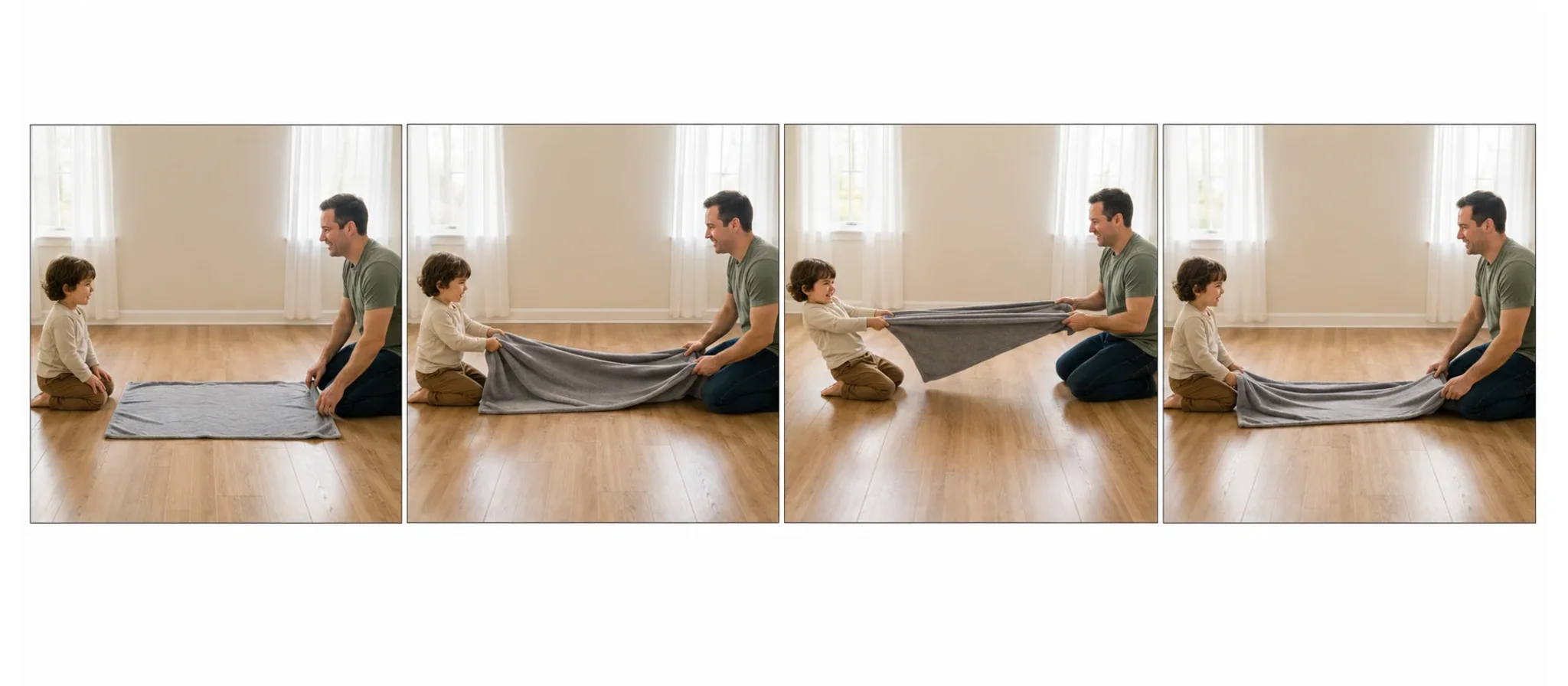
Four panels showing a grown-up clearing floor space, handing over one blanket end, the child pulling gently, and both people stopping to reset.
  1. 01
    Hold your end and say, "Pull, pull, stop."
  2. 02
    Let your child pull while you give steady, gentle resistance.
  3. 03
    Say "stop" and soften your grip so the pull ends.
  4. 04
    Reset the blanket between you, then repeat another short pull or switch roles for one round.

Safety Check

  • Stay with your child the whole time.
  • Keep the blanket or towel in hands only. Do not let it wrap around bodies, arms, or necks.
  • Avoid sudden yanking or competitive pulling.
  • Keep hard furniture out of the fall space behind both people.
  • Stop if your child falls, loses balance, wraps the blanket, becomes agitated, complains of pain, or keeps pulling after the stop cue.
Supporting the play

What to say in the moment

Match what you say to what you see.

Prompt ladder
Level 1 (Start)
"Can you make the blanket move?"
Level 2 (Keep going)
"Pull, stop, reset."
Level 3 (Stretch)
"Try a slow strong pull."
Level 4 (Extend)
"Now you hold steady while I pull."
If your child seems...
What you'd see
Focused
What to do
Say
"Your arms are doing the work."
Add
Name one body part already working, such as hands, arms, shoulders, or feet.
Extend
Switch roles for one round.

Make it easier

Younger end
  • -Sit or kneel so the pulling happens close to the floor.
  • -Start with a loose blanket, then add gentle resistance after your child begins pulling.
  • -Bunch your child's end slightly so it is easier to grip with both hands.

Make it harder

Older end
  • +Try one slow pull where both people keep balance.
  • +Add a clear stop cue after each pull.
  • +Switch roles so your child holds steady while you give one gentle pull.

If it's not working

If you see
If child ignores it
Wiggle your end once and say, "Can you make the blanket move?"
If you see
If child misuses it
Pause and say, "Hands hold the blanket. Bodies stay clear." Restart with one tiny pull.
If you see
If child gets frustrated
Make the pull easier. Say "tiny pull," resist less, and stop after 1 second.
Skill spotlight
Pull Against Resistance

Pulling against steady resistance, Stopping and resetting after a strong movement

This helps children feel body effort, use force on purpose, coordinate both hands with the upper body, and stop a strong movement when the round ends.

  • Pulling against steady resistance gives your child clear body input through the hands, arms, shoulders, core, and feet.
  • The stop-and-reset cue helps your child practice ending a strong movement before starting again.
  • Short repeated rounds keep the activity predictable and easy to run with only a few words.
Real-world transfer
  • Pulling a wagon, blanket, or safe household item with control.
  • Using body force without yanking another person.
  • Stopping a big movement when a grown-up gives a clear cue.
  • Resetting before another turn in active play.

Parent questions

Back to library
Keep playing

Related activities.