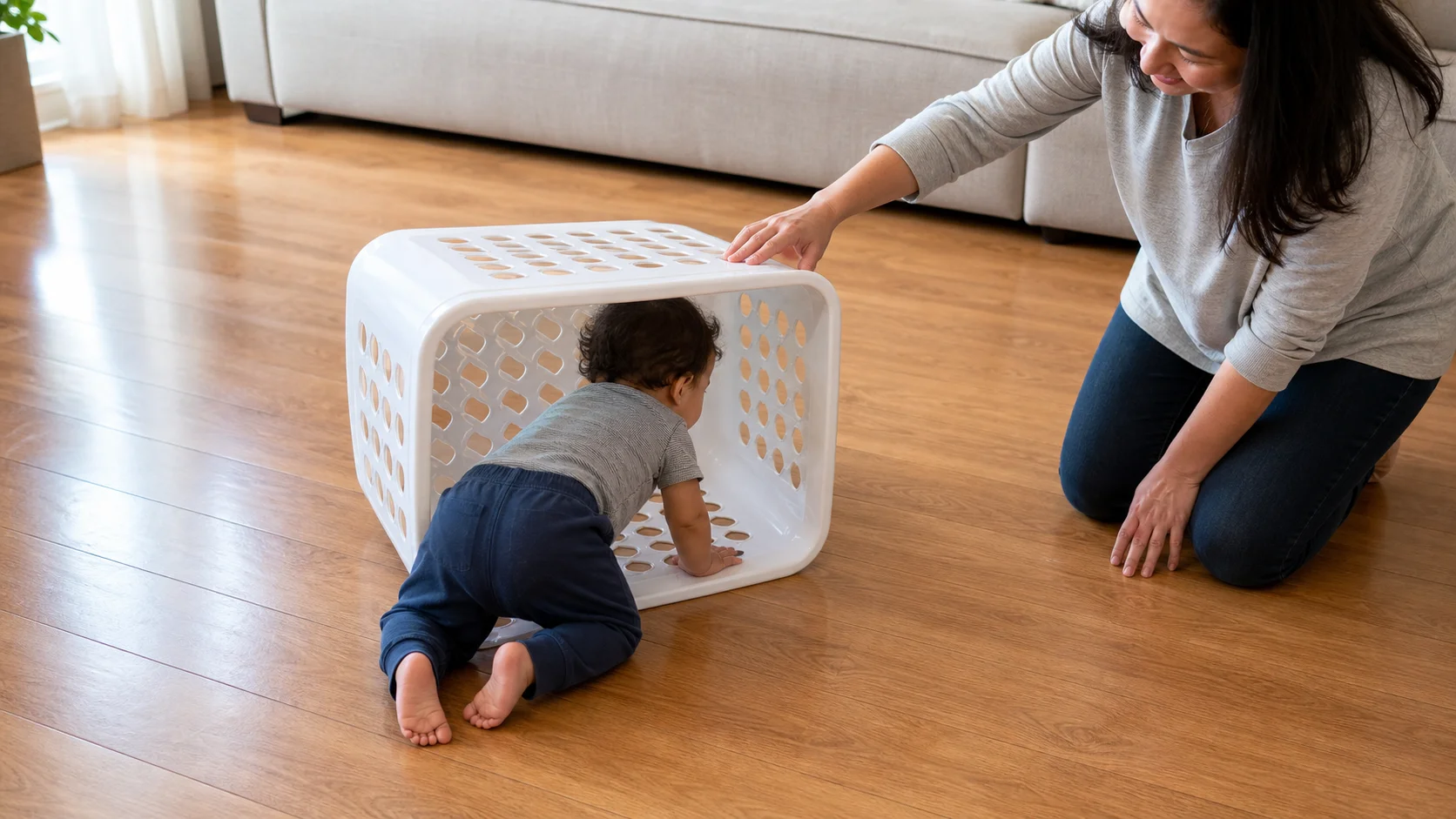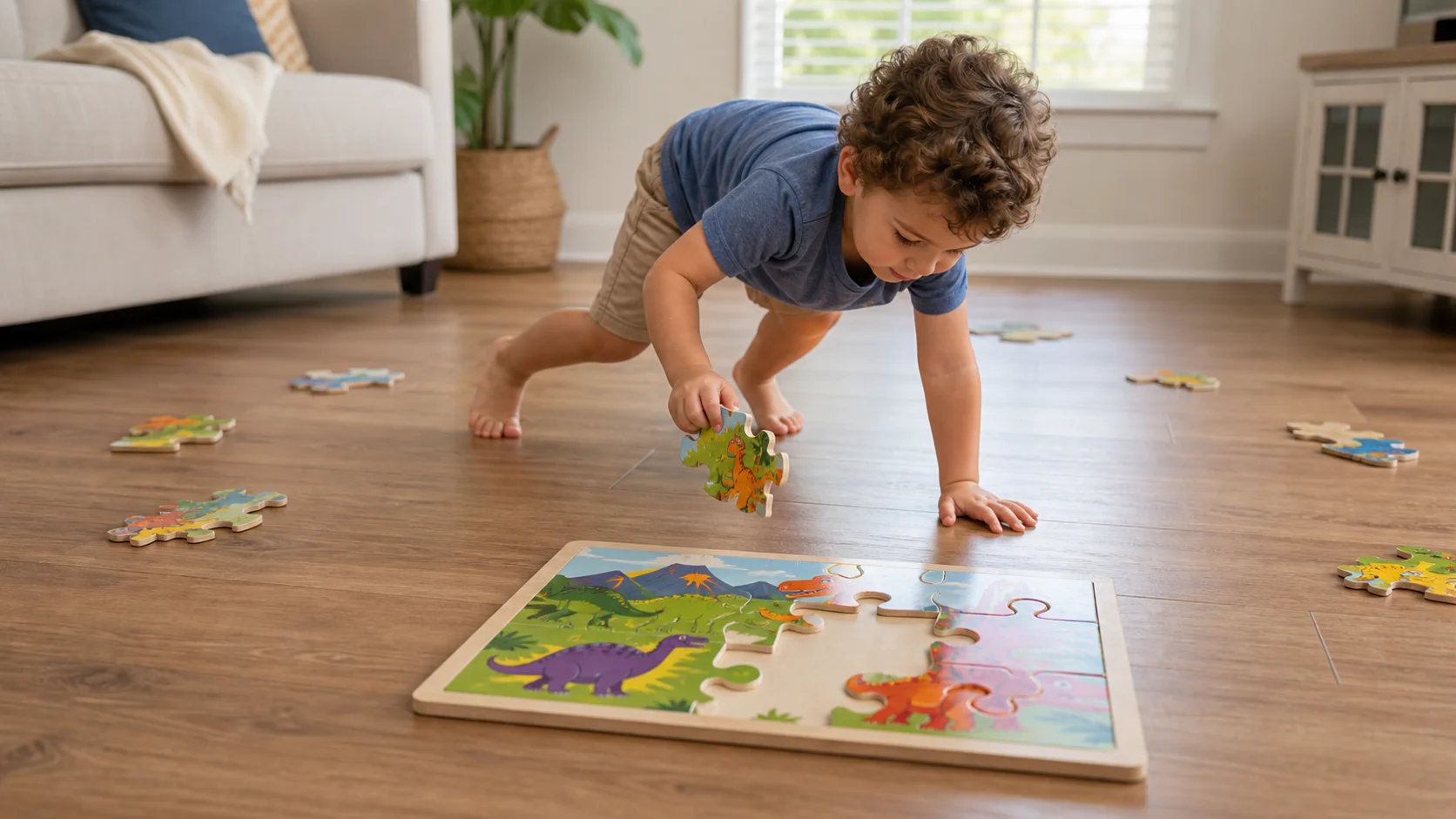
A toddler bear walking across a living room floor while carrying one chunky puzzle piece back to a floor puzzle.
Gross motorOT-adjacent supportNavigate PathIndoor

Animal Walk Puzzle Pickup.

Scatter puzzle pieces around the room and let your child crawl or animal walk to bring them back one at a time.

Play time
5-10+ min
Age
2-4 years
Energy
High
Mess
Low
Effort
Low
Where
Indoor
Start here

The recipe.

Low parent effort
2 things

What you need

  • 1 simple puzzle with loose pieces
  • 1 open floor space in a room
5 min minimum

Setup

Then start the loop
Step 01
Put the puzzle base on the floor in one clear starting spot where your child can kneel or sit to fit pieces in.
Step 02
Scatter the loose puzzle pieces around the room, far enough away that your child has to move out for each one but close enough to stay in sight.
Step 03
Pick one easy movement to start, such as crawling or bear walking, and keep the floor path clear between the puzzle and the pieces.
"One piece."
The loop

How play unfolds.

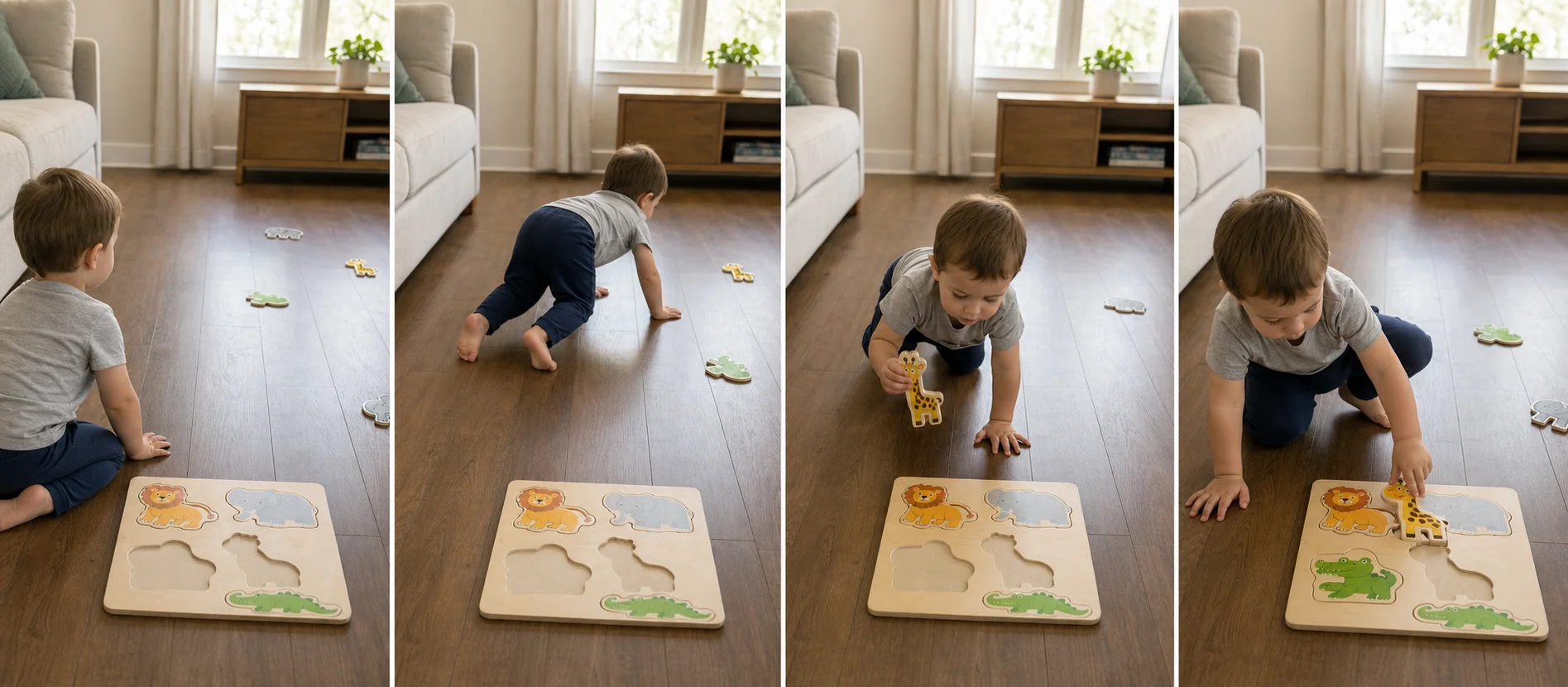
A multi-panel sequence showing puzzle pieces scattered around a room, a grown-up modeling the game, a toddler crawling or animal walking to one piece, and the child fitting it into the puzzle.
  1. 01
    Show your child one piece, bring it back to the puzzle, and say, "Go get one piece and bring it back."
  2. 02
    Let your child crawl or animal walk to one piece, pick it up, and carry it back.
  3. 03
    Help turn the piece once if needed, then let your child fit it into the puzzle.
  4. 04
    Send your child out for another piece and repeat until the puzzle is done or your child is ready to stop.

Safety Check

  • Use a puzzle with pieces large enough for your child's age.
  • Keep the floor path clear and dry.
  • Stay close enough to stop falls, collisions, or rough crashing.
  • Switch to plain crawling or stop if the animal walk is turning into frustration.
Supporting the play

What to say in the moment

Match what you say to what you see.

Prompt ladder
Level 1 (Start)
"Go get one piece."
Level 2 (Keep going)
"Bring it back to the puzzle."
Level 3 (Stretch)
"Can you stay in your animal walk all the way there?"
Level 4 (Extend)
"Pick the next animal."
If your child seems...
What you'd see
Focused
What to do
Say
"You found the next piece."
Add
Name one action already happening, such as crawl, carry, or fit.
Extend
Keep the same movement for one more trip before switching animals.

Make it easier

Younger end
  • -Use plain crawling for the whole round.
  • -Scatter only a few pieces close to the puzzle.
  • -Keep using the same movement instead of switching animals.

Make it harder

Older end
  • +Ask your child to keep the same animal walk out and back.
  • +Let your child choose the next animal movement before each trip.
  • +Scatter the last few pieces a little farther apart while keeping them in sight.

If it's not working

If you see
If child ignores it
Do one out-and-back trip yourself, then hand the next turn over right away.
If you see
If child misuses it
Return to a one-piece rule and say, "One piece, then back."
If you see
If child gets frustrated
Switch to plain crawling, move one or two pieces closer, and help turn a hard piece once.
Skill spotlight
Navigate Path

Moving through a short room path to reach a target and come back, Matching one loose puzzle piece to its place

This helps a child move through space with a plan, carry something back to a clear target, and match one part into a whole.

  • Early. Your child may need you to point to one nearby piece, use plain crawling, or help turn the piece before it fits.
  • Later. Your child starts choosing a movement, completes the out-and-back trip with less help, and keeps the puzzle hunt going piece by piece.
  • Middle. Your child travels out for one piece at a time, comes back to the puzzle, and fits some pieces with a short reminder.
Real-world transfer
  • Moving across a room to get something and bringing it back on purpose.
  • Following a simple out-and-back job with a clear finish.
  • Matching parts into place during puzzles and other fit-together play.
Back to library
Keep playing

Related activities.