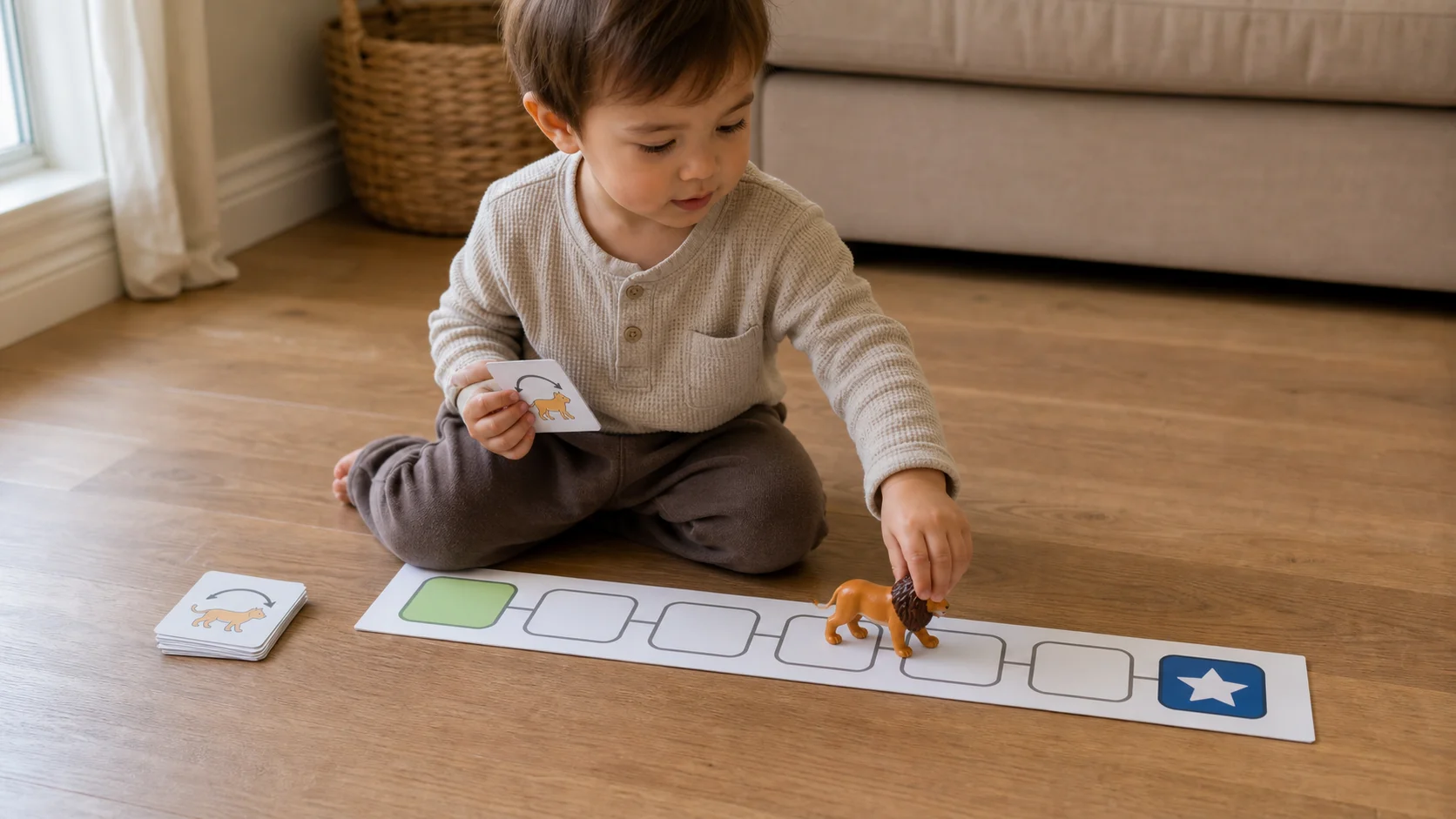
A toddler sitting at a low table and moving a small toy animal along a simple path board with move cards nearby.
ThinkingAutism supportMove Through PathIndoor

Animal Step Path.

A calm visual game where your child picks a card and moves one toy animal along a short path to the finish.

Play time
5-10+ min
Age
1-3 years
Energy
Low
Mess
No
Effort
Medium
Where
Indoor
Start here

The recipe.

Medium parent effort
3 things

What you need

  • 1 toy animal
  • 1 short path board, strip, or page with connected spaces and a visible finished square
  • 1 small set of cards that show how many spaces to move
5 min minimum

Setup

Then start the loop
Step 01
Put the path flat on the floor or low table where your child can see the whole route from start to finish.
Step 02
Place the toy animal on the first space and point to the finished square at the end.
Step 03
Put the movement cards in one small stack beside the path and sit close enough to help count spaces if needed.
"Pick one."
The loop

How play unfolds.

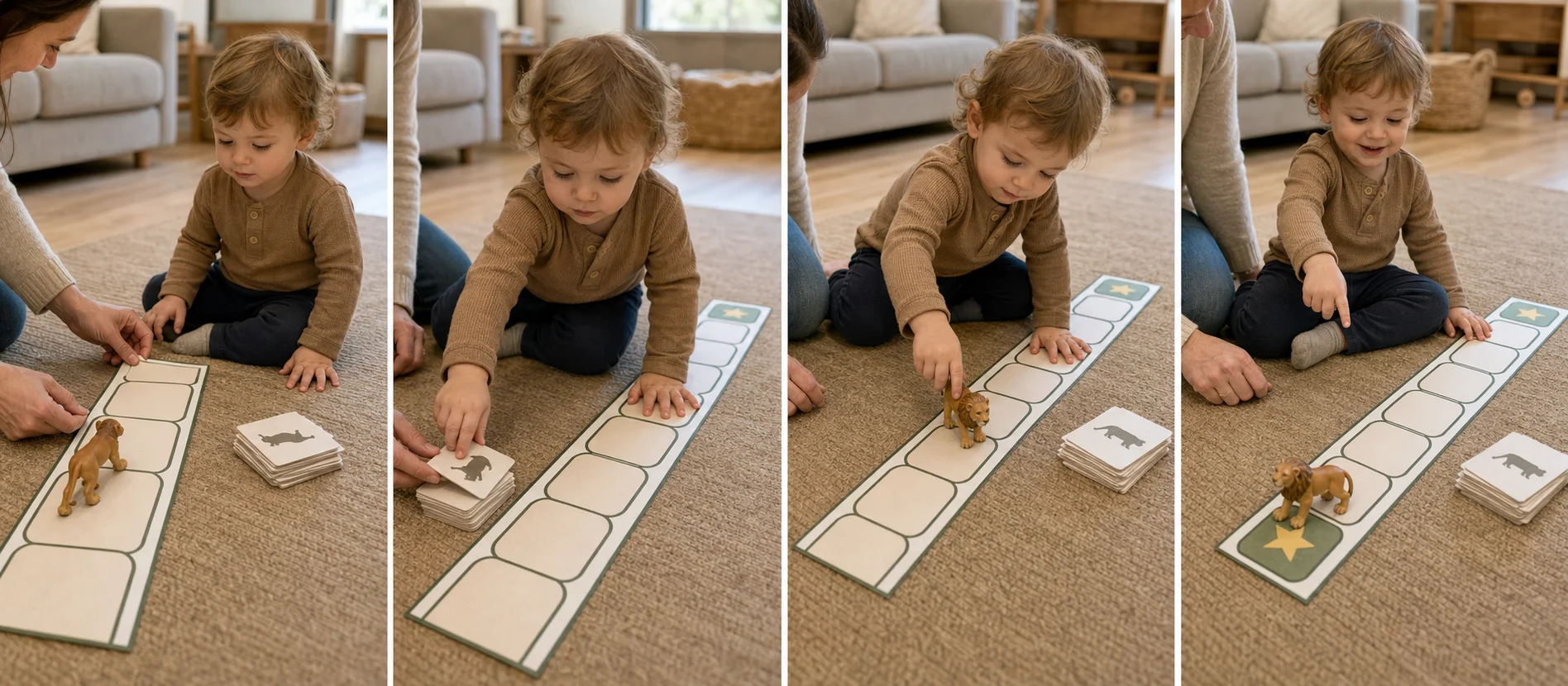
Four panels showing a grown-up setting out a short path and cards, placing the animal at the start, a child choosing a card, and the child moving the animal to the finish.
  1. 01
    Show one quick turn and say, "Pick a card. Let's move the animal."
  2. 02
    Take turns choosing one card and moving the animal forward that many spaces.
  3. 03
    Stop the animal on the last counted space, switch turns, and repeat until the animal reaches the finished square.

Safety Check

  • Use an animal and cards that are too large to mouth.
  • Stop if the animal starts turning into a throwing toy.
  • Keep the number of visible cards small so the turn does not get visually busy.
Supporting the play

What to say in the moment

Match what you say to what you see.

Prompt ladder
Level 1 (Start)
"Pick a card."
Level 2 (Keep going)
"Move the animal."
Level 3 (Stretch)
"How many steps?"
Level 4 (Extend)
"Your turn, then my turn."
If your child seems...
What you'd see
Focused
What to do
Say
"You got the next step."
Add
Name one part already happening, such as card, step, or finish.
Extend
Pause before helping so your child can count or point to the next space.

Make it easier

Younger end
  • -Use only cards that move the animal one step.
  • -Keep the path very short.
  • -Let your child slide the animal instead of lifting it space by space.

Make it harder

Older end
  • +Mix in a card that moves the animal two or three spaces.
  • +Wait to see if your child counts the spaces without your finger.
  • +Ask your child to put the used card in a finished pile after each turn.

If it's not working

If you see
If child ignores it
Move the animal once yourself and make the finish square the interesting part of the path.
If you see
If child misuses it
Say, "One card, then move," take back the extra cards, and offer only one or two cards for the next turn.
If you see
If child gets frustrated
Use only one-step cards for a few rounds or start the animal closer to the finished square.
Skill spotlight
Move Through Path

Following a visible path from start to finish, Taking a short turn in a simple shared game

This helps a child follow a small visual rule, move through a clear beginning-to-end route, and stay in a short shared routine with another person.

  • One visible route helps your child see where the animal starts, where it goes, and when the turn is done.
  • Picking one card and taking one move keeps the game small enough to repeat without a lot of talking.
  • The same turn pattern gives your child practice with waiting, moving, and finishing in a shared routine.
Real-world transfer
  • Following a visible route from beginning to end.
  • Waiting for another person's turn in a simple game.
  • Using a small cue to guide the next action.
  • Repeating a short routine without needing a new explanation each time.

Parent questions

Back to library
Keep playing

Related activities.