
Family communication
How to Give a Daycare Tour That Shows What Children Learn
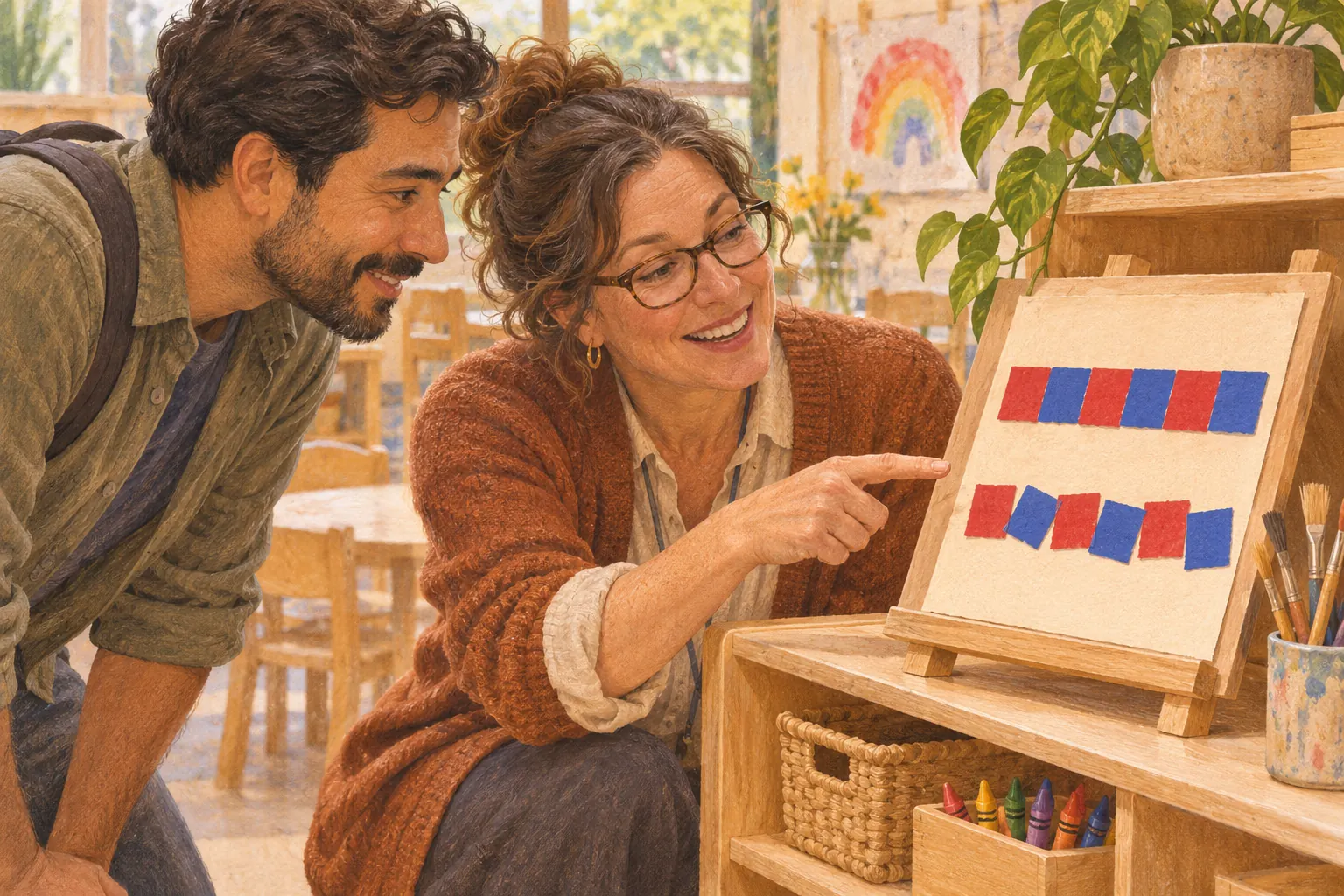
At 10 a.m., the preschoolers are building in the block corner. Your tour is at 12:30, when the lights are dim, the sound machine is humming, and the room is a row of cots. At drop-off the teachers are helping children say goodbye. By pickup the blocks are back on the shelf.
Even a parent who catches morning play can miss the teaching. On one pre-K tour, a parent watching children play with blocks asked what they were learning. “Oh, they’re just playing right now,” the teacher replied.
Before a family arrives, glance at the week’s plan and pick one thing you can show even when the children are asleep. A paper mosaic on the art shelf will do. Point to the pattern the teacher started, then to the row two children made together. Now the parent can see what the children were working out.
Start with one question in the lobby
“What’s your child really into these days?”
If they give you a short answer, try, “Tell me a little more about that.”
A parent might say, “He runs to the window every time he hears the garbage truck.” If you pass a block garage on the tour, that gives you an opening.
“See how the little car fits under here? The garbage truck bumps the roof. We ask the kids, ‘How could we make it fit?’ Then they get to move the blocks and try the truck again.”
How to show learning on a daycare tour: Point, Explain, Connect
If you’ve worked on how to explain play-based learning to parents, you’ve probably had this conversation at pickup. A touring family is seeing the room for the first time. Here’s how to bring them into the activity.
- Point to something the parent can see.
- Explain what the child is trying to do and how the teacher helps.
- Connect what the parent can see to the skill the child is practicing.
Infants (Birth to 1 Year): Listen for the Baby’s Turn
When a baby makes a sound or reaches for something, the caregiver responds and waits for the baby’s next turn. Harvard’s Center on the Developing Child calls this serve and return. Over time, these exchanges strengthen connections in the developing brain that support language and social skills.[1]
“Hear that little ‘ah’ when he kicks the crinkly mat? His teacher says it back and waits. There, he did it again. That back-and-forth helps build the brain connections he’ll use for conversation, even before he has words.”
If the room is asleep, point to the basket of textured balls and wooden rings.
“When a baby reaches for this ball, her teacher might say, ‘Oh, you found the bumpy one,’ then wait. If she rubs it again or babbles, that’s her turn. She’s hearing the word ‘bumpy’ just as she feels the bumps, and she’s learning that her sounds and gestures get an answer.”
Toddlers (1–3 Years): Show How Teachers Let Kids Try First
Skip the doorway rundown of potty training and snack schedules. Look for a small-group table and point out what the children are working on. They might be trying different ways to flatten a ball of playdough.
“Looks like they’re doing a playdough lesson. They’re trying to get a ball of dough flat like a pancake. He’s squeezing his, and his friend’s patting hers against the table. Their teacher gives them time to see what works. Then she shows them how she uses the rolling pin and lets them have another go.”
If the room is asleep, point to the tray and the small rolling pin on the shelf.
“The rolling pin’s on the tray from the start. Some children reach for it. Others squeeze or pat the dough. Once they’ve had a try, the teacher flattens hers with her palm, rolls it back into a ball, and tries the pin. Now they’ve got two ways to try on their own dough.”
Preschool (3–4 Years): Show How Children Take Turns
Dramatic play and art centers are where a parent might think, “Cute, but what are they learning?” Look for something the children are making together. Point out what one child adds and how the next child builds on it.
“See the row of red and blue squares? Their teacher started that pattern. The children are taking turns making a row just like it. One child puts down a red square. When it’s her friend’s turn, the teacher asks, ‘What color comes next?’ He looks back along the row and picks blue.”
If the room is asleep, show the parent a finished mosaic and cover the last square with your thumb.
“Red, blue, red. You can probably guess which color is under my thumb. The children took turns adding squares. Each time, they had to look at what their friend had added and work out which color came next.”
Pre-K (4–5 Years): Show Kindergarten Readiness in the Learning Centers
Parents of 4- and 5-year-olds want to know their child will be ready for kindergarten. Without desks or worksheets in sight, they may wonder whether the children are learning enough. Your learning centers give you something to show them every week, whether the children are busy at 10:00 a.m. or asleep at 1:00 p.m.
Pick one center that’s active or easy to see from the doorway. Point to what’s there, explain how the teacher helps, and name the skill the children are practicing.
- Block area (math and problem-solving). Point to a bridge, ramp, or tower. Children compare lengths, count pieces, and test what holds weight. When a tower falls, the teacher might ask, “What could make the bottom wider?” The children rebuild it and see whether their idea works.
- Dramatic play (focus and people skills). Point to the pretend store, kitchen, or doctor’s office. Children agree on roles and stick with a shared plan. If two children both want to be the cashier, the teacher might ask, “How could you both get a turn?” Each child gets practice listening to the other and working out what to do next.
- Art and writing center (hand strength and early letters). Point to the scissors, markers, and drawings the children have labeled themselves. Cutting paper and guiding a marker give hands and fingers practice. When a child wants to label a drawing, the teacher says the word with them, helps them hear the first sound, and invites them to try writing the letter.[2]
- Small-group table (following directions and building stamina). Point to the table where four or five children join a teacher for a short sorting game, letter activity, or story. In a sorting game, the teacher might say, “First put the buttons in piles by color. Then count the blue ones.” Children practice holding two steps in mind and staying with the group long enough to finish.
When the room is active, stop at the block area.
“See how he’s stacking two short blocks beside that tall one? His bridge kept tipping, so his teacher asked, ‘How could you get both sides the same height?’ Now he’s checking whether the top sits flat. That’s measurement and balance, right there in his bridge.”
If the room is asleep, show a labeled drawing at the writing center.
“See that D under the picture? She wanted to write ‘dog.’ Her teacher said the word slowly with her so she could hear the first sound. Then she tried the D herself. She’s starting to put the sounds she hears on paper.”
Help parents picture what comes next
Parents love seeing how a skill grows with their child. Before you leave the room, go back to the moment you just showed them. What part does the teacher help with now? What might the child start doing on their own with a little more practice?
Give the parent one small change to picture. A child who waits for someone else to start a game might begin inviting others to play. A child who looks to the teacher when an idea doesn’t work might try a second way first. That gives families something they can recognize at home, too.
Back in the office, show one sample family update
Print one family update your center has cleared to share with visitors. Choose one that already pairs a classroom photo with a teacher’s note about what the children tried.[3] Keep that copy in the office to show on every tour.
“Here’s one of the updates we send home. See how he’s squeezing the dough in his fist? His teacher wrote down what he tried first and what he changed after she showed him how she used her palm.”
Give the parent a moment to look.
“What else would you like to know about your child’s day here?”
Before your next tour
Pick one activity from this week’s plan. Leave a photo cleared for visitors or a work sample where anyone giving the tour can find it. A short note beside it can do the rest. For the block bridge, it might read, “He stacked two short blocks to make both sides the same height.”
Playtime Compass weekly plans cover birth through age 5. Each activity lists the materials, what children are practicing, and what the teacher can watch for.
Explore Playtime Compass or ask about a sample week for your center.
Frequently Asked Questions
What is the best time of day to schedule a daycare tour?
If you can choose, tour during your classroom’s usual play time so families can watch children and teachers together. For a nap-time tour, show a finished mosaic or a playdough tray and explain what the children tried. At drop-off or pickup, use the printed family update while teachers help children and families with the transition.
How do you explain play-based learning to parents who want worksheets?
Ask which skill they’re hoping to see. If it’s writing, show them a picture with a child’s first attempt at a label. “This is one way we practice writing here. The kids choose what they want their pictures to say. We say the word together and see if they know a letter for that first sound.”
Should teachers stop what they are doing to talk to touring parents?
Keep one floor rule non-negotiable. Never pull a teacher out of ratio or interrupt a feeding, diaper change, or small group for a tour. If only the lead teacher can answer, give the parent a time they’ll hear back. “Let’s let her finish with the children. I’ll check with her this afternoon and email you before five.”
How can I tell if the tour worked?
Listen for what the family remembers. “I liked how she gave him time to try the rolling pin” tells you the parent noticed a teaching decision. Whether they enroll also depends on openings, tuition, schedules, and what happens after the visit.
Parissa Snider, a childcare marketing advisor, suggests asking the people who give tours which questions they hear most, including the awkward ones. She also recommends asking families during follow-up whether anything worried them or felt like a poor fit.[4] You could open with, “What do you wish you’d had a chance to see while you were here?”
Use the answer to improve one stop on your route. If several families leave asking when children learn letters, put a child’s labeled drawing where the next guide can show it. If they’re still wondering how the day flows, walk them through what happens between arrival and outdoor play.
Why is teaching quality hard to judge from the doorway?
A parent can see a block bridge from the hall. They may have missed the teacher’s question that helped the child get it to stand. In Urban Institute focus groups with 94 parents and guardians across six U.S. sites, families said visiting and asking questions in person helped them get the information they needed. Child Care Aware of America’s center checklist suggests looking for who chooses play partners, how teachers join in, and how the day balances play, stories, and rest. A brief visit gives families only a few chances to see any of that.[5]
Even families who know a room well can find the teaching hard to judge. In a 2018 study of 90 publicly funded Louisiana preschool programs, Daphna Bassok and colleagues found little overlap between enrolled parents’ ratings and either trained observers’ ratings of teacher-child interactions or children’s average learning gains. Taken together, 15 program features explained just 2% to 6% of the differences in how parents rated specific aspects of their programs. When parents named what they liked most, their answers lined up more often with features such as hours and class size.[6]
Those families already had children in the programs. For a first-time visitor, you can fill in the few seconds they missed. “When his bridge tipped, she asked him to check the height on each side. That’s why he’s lining those blocks up.”
Sources
- The Center on the Developing Child at Harvard University explains how responsive exchanges strengthen brain connections involved in communication and social development. Its practice guide describes naming what a baby is attending to and waiting for a response. Serve and Return · 5 Steps for Brain-Building Serve and Return ↩
- Head Start’s Early Learning Outcomes Framework describes noticing initial sounds and using scribbles, letters, or invented spellings to convey meaning (goals P-LIT 1 and 6). Head Start, Literacy Preschool ↩
- Hilary Seitz presents examples of classroom documentation and discusses choosing what to share publicly or privately. The Power of Documentation in the Early Childhood Classroom, Young Children, March 2008 ↩
- Parissa Snider, Child Care Rockstar Radio, episode 229. Questions staff hear on tours, 12:10 · Following up with families, 27:05 ↩
- Urban Institute, Parents’ Experiences with Searching for and Selecting Child Care and Early Education. Child Care Aware of America, Child Care Center Checklist. ↩
- Daphna Bassok, Anna J. Markowitz, Daniel Player, and Michelle Zagardo, Are Parents’ Ratings and Satisfaction With Preschools Related to Program Features?, AERA Open, 2018. The study compared enrolled parents’ survey responses with classroom and program measures. Table 4 reports the results for ratings of specific features. ↩