
Family communication
How to Explain Play-Based Learning to Parents (With Real Examples)
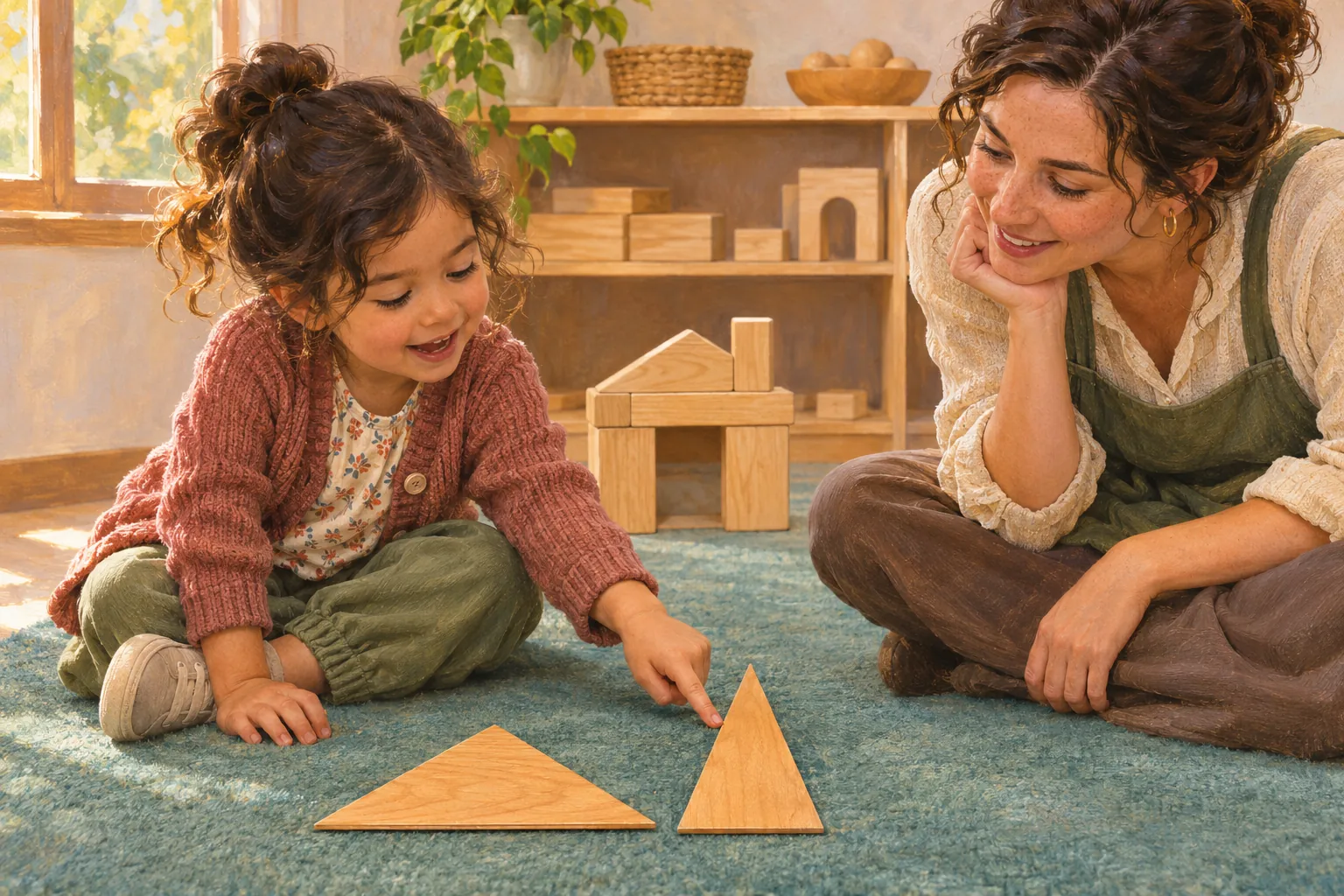
At pickup, a parent sees a block house and asks, “What’s she learning while she plays?” Think back to the moment when their child chose the roof. What did you see that her parent missed?
“She thought this skinny piece couldn’t be a triangle. We traced its three sides together. She’s learning to spot a triangle even when it looks different from the one she usually picks.”
That answer gives a parent three things they can picture. Say what the child did, name the skill they were practicing, and describe how you helped. One moment is usually enough for pickup. At a family conference, you have time to ask what the family has seen, too.
Show what the teacher brought to the play
Imagine a preschool group that has been building houses all week. The children decide what to build. Their teacher puts out a basket of flat wooden shapes for doors, windows, and roofs. She includes broad triangles and long, narrow ones because she wants the children to notice what makes them all triangles.
One child reaches past a narrow piece. “That’s not a triangle. It’s too skinny.” The teacher sets it beside the broad one the child likes. “Let’s look at the sides.” She runs a finger along one edge, then pauses. The child traces the other two and goes back to choosing a roof.
This is guided play. The child has a house in mind. The teacher has a shape in mind. By choosing those pieces and offering one way to compare them, the teacher makes room for both ideas. NAEYC guidance on teaching through play.
With a toddler, the moment might be quieter. “She kept trying to put the blue cup inside the yellow one. I gave her a bigger cup to try, and the blue one slid right in.” A family can see what comparing sizes looks like before their child has words like “bigger.” Head Start guidance on planning for infants and toddlers.
What preschool studies tell us about guided play
In a study by Kelly Fisher and her colleagues, four- and five-year-olds explored shapes with an adult who helped them examine their features. Other children watched an adult demonstrate the same ideas or played freely with the materials. Later, the children who explored with guidance recognized more examples of the shapes they had learned, including unfamiliar versions. That’s the skill the teacher is listening for when a child picks up a skinny triangle. Read the shape study.
Myae Han and her colleagues studied 49 preschoolers with low vocabulary scores. One group received 30 minutes of vocabulary teaching per session. The other had 20 minutes of teaching and 10 minutes of supported play. After four months, the second group made larger gains on a test that asked children to name pictures. On a test of how well they understood spoken words, the researchers found no clear difference between the groups. Read the vocabulary study.
Back in the block area, a teacher might introduce the word “narrow” while the children compare roof pieces. Later, when a child wants a particular piece, she has a reason to use that word herself.
Show a parent what changed
Look for two moments you can put side by side. What did the child need help with the first time? What did they do on their own the next time? For the child making roofs, a teacher might have this to share a week later.
“Last week we counted the sides together. Today she found a long, skinny triangle in the puzzle box. She turned it sideways, traced the edges herself, and told me, ‘Still three!’”
The parent now knows what changed, how much help their child needed, and where she used what she had learned. An observation, a photo you already took, or a piece of the child’s work can help you remember the details. NAEYC guidance on observing children’s learning.
Three questions parents ask about play-based learning
A family asking about letters may want to know what happens during the school day. Another may be thinking about kindergarten in the fall. Ask what they’d like to know, then choose an example you’ve actually seen. These sample conversations show how that can sound.
Are you teaching letters in a play-based program?
“Yes. Today she wanted to put her name on the house she built. We found her name card, and I helped her write the first letter. Then she put the sign by the door.”
How do you know a child is making progress through play?
“Earlier this fall, he used to ask me to tell the other children he wanted a turn. This week I heard him ask them himself twice. I still help when the group gets noisy. What are you noticing at home?”
Will my child be ready for kindergarten with play-based learning?
“We’re helping her practice things she’ll do at school, like working with numbers, following directions, joining a group, and asking for help. Today she was the shopkeeper. I asked for three apples, and she counted them into my bag. Then we checked the order together. Is there a part of starting school you’re wondering about?”
If the family has more to share than pickup allows, arrange a time to talk. NAEYC guidance on working with families.
A five-minute practice for directors and teachers
At your next staff meeting, use one photo a teacher already plans to send home. Ask the person who took it what happened just before the picture. That’s often where the learning is easiest to see.
Suppose the photo shows a finished block bridge. The teacher remembers a child trying two blocks across the gap. Now the caption can say, “His first block fell through. We lined up two blocks to see which was longer, and he chose the one that reached the other side.”
Read the caption aloud. Could you say it at pickup? Keep a few examples like that in mind for program tours, when a family has yet to see what a morning in your classroom looks like. Laurel Bongiorno on talking with parents about play.
The classroom scenes and parent conversations are illustrative. The research paragraphs describe the two preschool studies linked above.