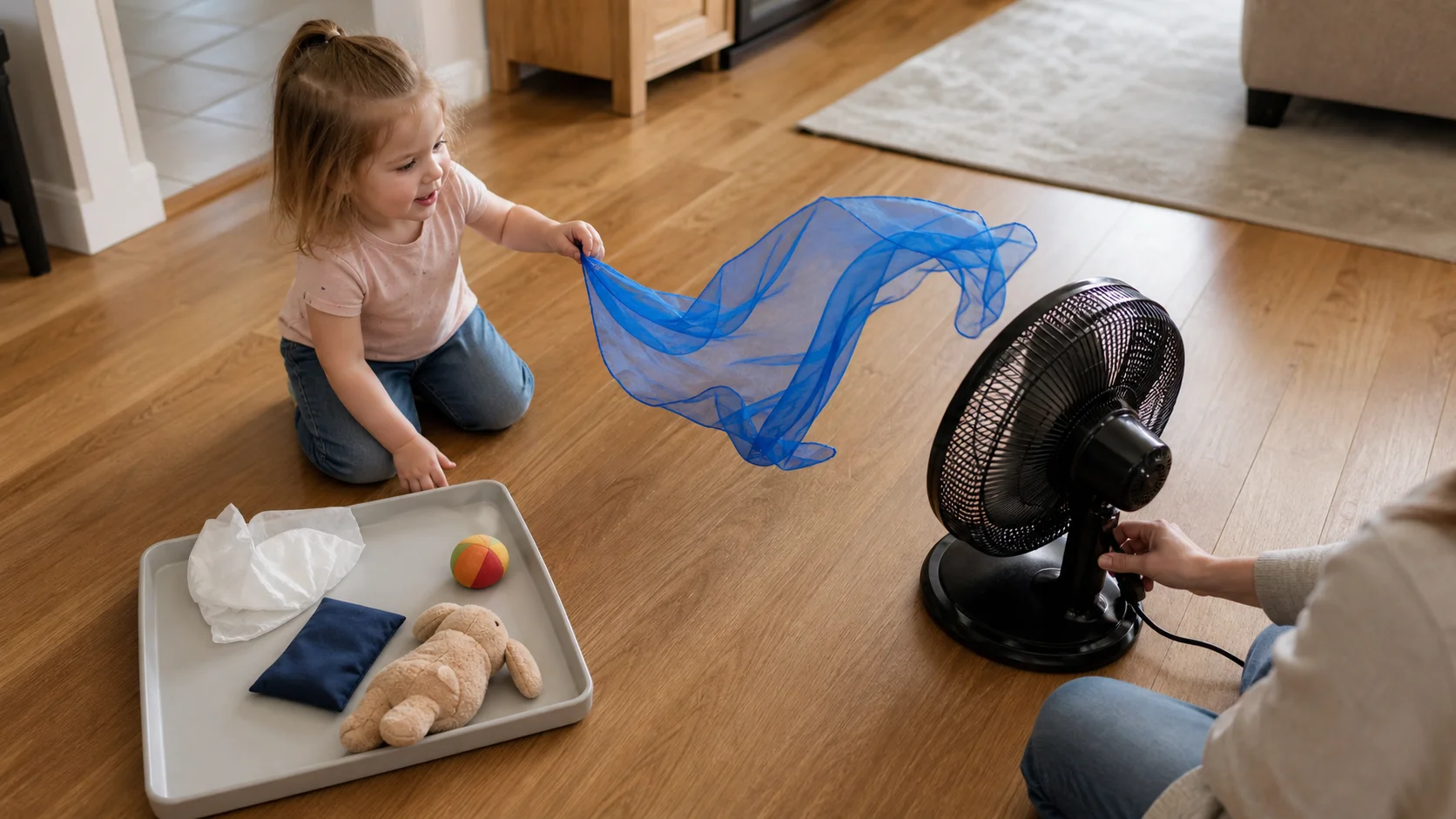
Toddler testing a scarf in front of an adult-controlled fan with other objects waiting in a tray.
ThinkingTest And CompareIndoor Open Floor Or Table Area

Wind Tunnel Exploration.

Use a fan, breath, or straw to test which objects move, roll, float, or stay still.

Play time
10-20+ min
Age
2-6 years
Energy
Medium
Mess
Low
Effort
Medium
Where
Indoor Open Floor Or Table Area
Start here

The recipe.

Medium parent effort
5 things

What you need

  • 1 adult-controlled wind source: hand fan, breath, straw, stable electric fan on low, wind tunnel, or box fan
  • 1 bin or tray
  • 5 or 6 test objects, mixing easy movers such as tissues, scarves, balloons, beach balls, or light fabric with harder movers such as stuffed animals or bean bags
  • Optional labels such as heavy, light, fast, slow, and float
  • Optional streamers, parachute material, appliance-sized cardboard box, or box fan for later extensions
10 min minimum

Setup

Then start the loop
Step 01
On the floor or a low table, clear a testing path where light objects can move without hitting breakable things, the child's face, or the wind source.
Step 02
On the adult side of the testing path, place 1 wind source you can control the whole time.
Step 03
Beside the testing path, put 5 or 6 mixed test objects in a bin or tray within your child's reach.
Step 04
Around the wind source, tuck away cords and keep the child's hands, hair, and loose fabric out of the fan path.
Step 05
Off to the side, keep labels, streamers, parachute materials, or DIY wind-tunnel pieces until your child has tested a few objects first.
"Wind test."
The loop

How play unfolds.

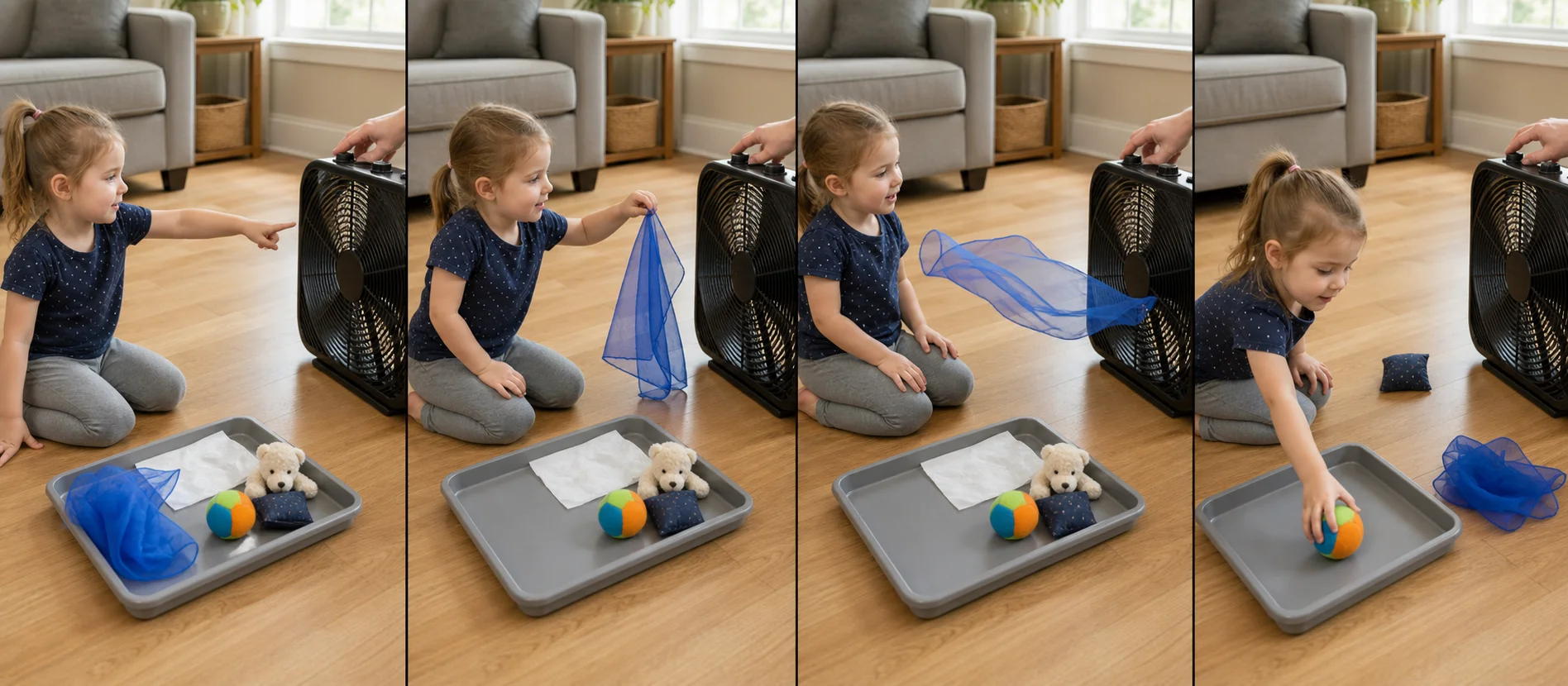
Sequence showing a child choosing an object, guessing what wind will do, testing it in airflow, and sorting the result.
  1. 01
    Hold one light object in the wind and say, "What do you think this will do?"
  2. 02
    Let your child choose one object and make a quick guess: move, roll, fly, float, or stay still.
  3. 03
    Test the object while you control the fan, straw, breath, or wind tunnel.
  4. 04
    Name the result in plain words: "The scarf flew high," "The bean bag stayed still," or "The ball rolled away."
  5. 05
    Move the object to a tested pile or simple label, then repeat with a new object, start spot, or wind strength.

Safety Check

  • Keep electric fans and box fans under adult control, stable, and away from fingers, hair, loose fabric, and the child's face.
  • Remove small pieces, popped balloon bits, sharp objects, or anything your child tries to mouth.
  • Supervise straw or breath-powered testing so the child does not run, poke, chew, or share a straw.
  • Keep a clear landing path so heavier or moving objects do not hit the child, adult, fan, or fragile items.
Supporting the play

What to say in the moment

Match what you say to what you see.

Prompt ladder
Level 1 (Start)
"Pick one thing for the wind to try."
Level 2 (Keep going)
"Watch closely and tell me what it does."
Level 3 (Stretch)
"Try the same thing from a new spot."
Level 4 (Extend)
"Can we make it move a different way?"
If your child seems...
What you'd see
Focused
What to do
Say
"You noticed it move."
Add
Ask one naming prompt about the result, such as "fast or slow?"
Extend
Let the child choose close wind or far wind for the next test.

Make it harder

Older end
  • +Let the child choose a close start or far start before testing.
  • +Test the same object twice and compare which try moved more.
  • +Sort tested objects by what they did, such as rolled, flew, floated, or stayed still.

If it's not working

If you see
If child ignores it
Use a scarf, tissue, or balloon first and make the wind move it dramatically before asking for a prediction.
If you see
If child misuses it
Pause the wind source, move the fan or straw back to adult control, and offer one object to test instead of the whole bin.
If you see
If child gets frustrated
Say, "Let's find one thing the wind can move," then test a tissue or scarf together.
Skill spotlight
Test And Compare

Cause and effect

This helps the child notice what changed, what stayed the same, and what to try next when something does not work the way they expected.

  • Choosing one object and making a guess gives your child a clear cause-and-effect test.
  • Watching what moves, rolls, floats, or stays still helps your child compare visible results.
  • Resetting for another object makes trial and error feel like part of the game, not a mistake.
Real-world transfer
  • Noticing why one thing moves, rolls, or stays put during everyday play
  • Making a simple guess, checking it, and trying a new approach when needed