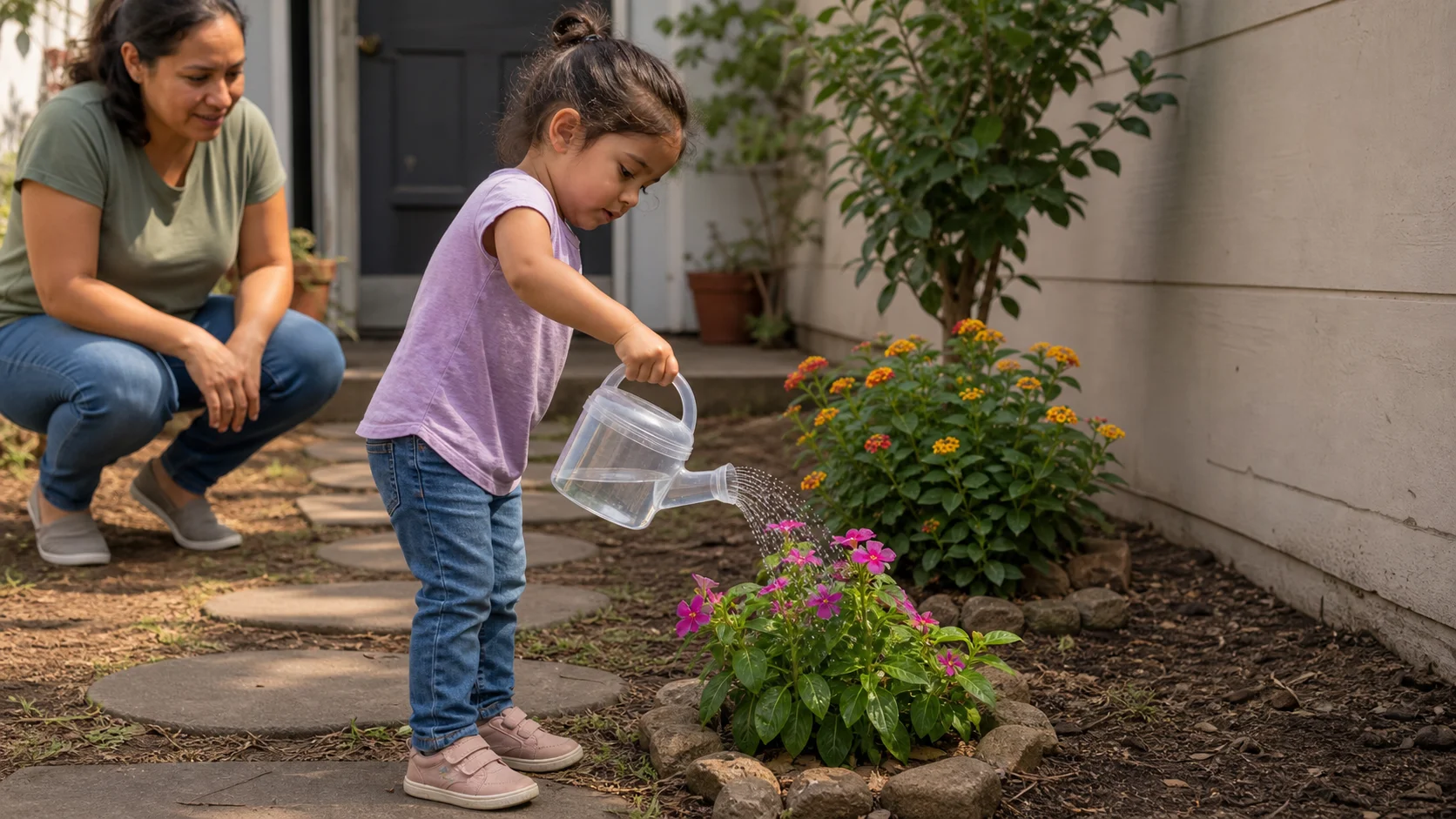
A toddler carries a clear watering can and sprinkles water on a garden plant during a short walk.
Skill builderAutism supportFinish And ResetOutdoor

Watering Walk Finish.

Carry water, sprinkle a few plants, and use the empty clear container as the signal to walk back.

Play time
5-10+ min
Age
2-5 years
Energy
Medium
Mess
Low
Effort
Low
Where
Outdoor
Start here

The recipe.

Low parent effort
3 things

What you need

  • 1 clear watering can or clear bottle
  • Water
  • 1 short outdoor route with at least 1 tree, bush, flower, or garden bed that can safely receive water
5 min minimum

Setup

Then start the loop
Step 01
At the front door, porch, gate, or garden path, pick a short out-and-back route with one clear return point.
Step 02
Along the route, choose the first plant and one or two more plant stops you can point to from the path.
Step 03
At the sink or hose, fill the clear watering can or bottle with only as much water as your child can carry without dragging, tipping, or needing two adult hands.
Step 04
At the starting point, set the filled container where your child can see the water line.
Step 05
At the starting point, point to the first plant before you hand over the container.
"Water walk."
The loop

How play unfolds.

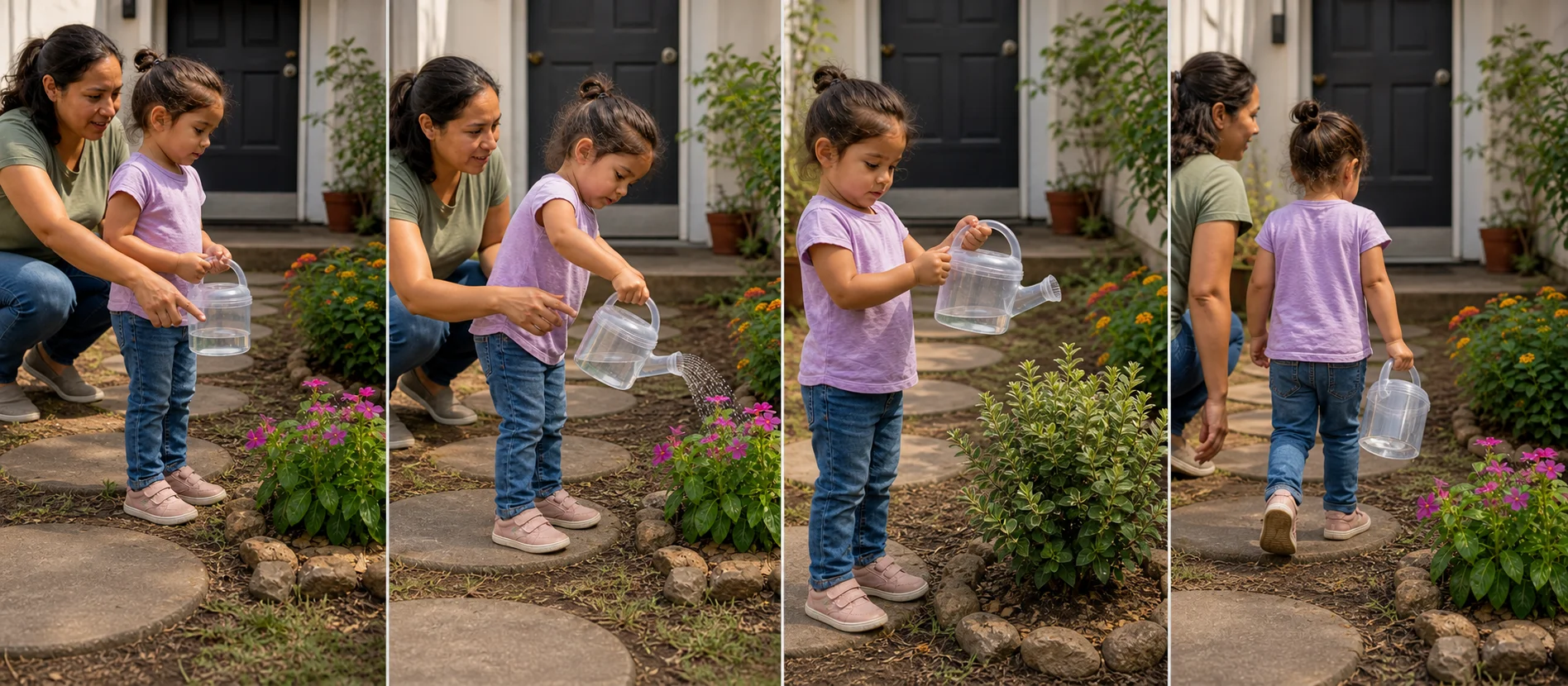
A three-step sequence shows a child watering plants, checking the dropping water line, and walking back with the empty container.
  1. 01
    Hand your child the clear watering can or bottle and say, "This water tells us how long our walk is."
  2. 02
    Walk to the first plant and help your child give it one small sprinkle.
  3. 03
    Check the water line together and move to the next plant.
  4. 04
    Repeat the sprinkle-and-check loop until the container is empty.
  5. 05
    Show the empty container, say, "All done. Empty means back," and walk back together.

Safety Check

  • Keep the container light enough for your child to carry without dragging, tipping, or needing two adult hands.
  • Stay close on routes with traffic, uneven ground, stairs, driveways, or other outdoor hazards.
  • Water only safe, allowed plants. Skip treated, fragile, thorny, or off-limits plants.
  • Watch for spills on paths, steps, or porches. Dry slippery walking spots before continuing.
Supporting the play

What to say in the moment

Match what you say to what you see.

Prompt ladder
Level 1 (Start)
"Give this plant one sprinkle."
Level 2 (Keep going)
"Find the next thirsty plant."
Level 3 (Stretch)
"You choose which plant gets water next."
Level 4 (Extend)
"Lead us back with the empty bottle."
If your child seems...
What you'd see
Focused
What to do
Say
"That one is next."
Add
Ask one quick name prompt, such as "Flower or bush?"
Extend
Let your child choose the next plant before you point.

Make it easier

Younger end
  • -Use one plant stop and then return.
  • -Carry the container together until the first sprinkle is done.
  • -Point to each plant before your child has to choose.

Make it harder

Older end
  • +Let your child pick the next plant without a point.
  • +Ask your child to save enough water for one last plant.
  • +Let your child announce "empty" before walking back.

If it's not working

If you see
If child ignores it
Start at the closest plant and model one tiny pour. Hand the container back and say, "Your turn. One sprinkle."
If you see
If child misuses it
If your child dumps, swings, or sprays the water, pause the walk. Hold the container together for one slow pour, then continue or finish if it is empty.
If you see
If child gets frustrated
Point to the water line, name the next small step, and make the next plant the final stop before walking back.
Skill spotlight
Finish Cue

Finishing a routine with a visible cue

This helps the child handle endings in real routines, such as coming inside, leaving a favorite spot, or stopping one job to start the next.

  • The clear container makes "almost done" visible without a lot of extra explaining.
  • The repeatable walk, sprinkle, check loop gives your child the same small job at each stop.
  • The empty-container finish connects the end of play to a real cue, instead of a sudden grown-up stop.
Real-world transfer
  • Coming inside after outdoor play.
  • Ending a favorite activity without a sudden stop.
  • Following a simple start-repeat-finish routine.
  • Helping with watering or cleanup jobs.
Back to library
Keep playing

Related activities.