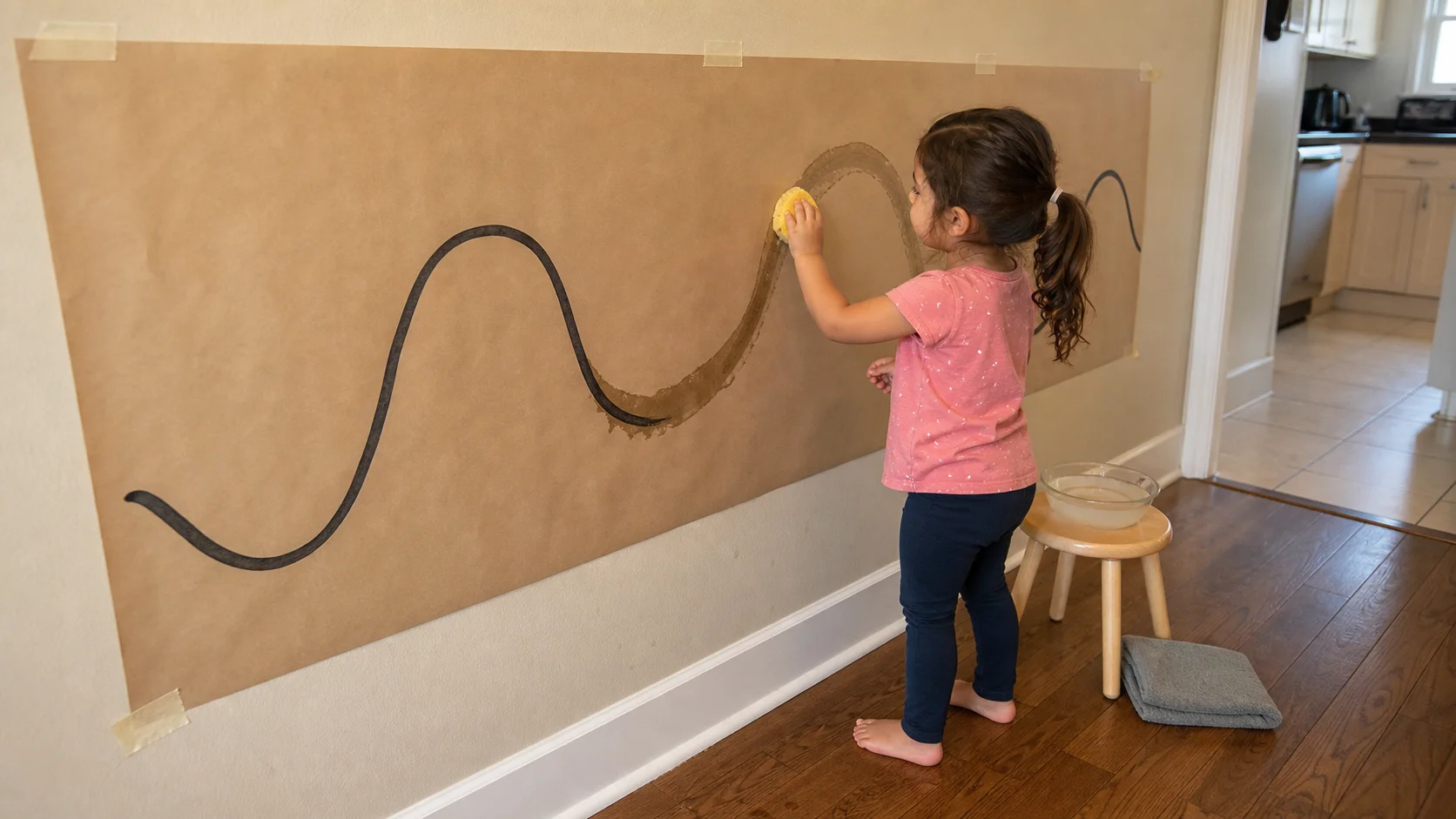

Toddler tracing a winding line on wall paper with a damp sponge while a bowl of water sits nearby.
ThinkingMove Through PathIndoor

Vertical Sponge Trail.

One damp sponge and one winding line turn tracing into a simple standing activity with an easy repeat loop.

Play time
5-15+ min
Age
3-4 years
Energy
Low
Mess
Low
Effort
Medium
Where
Indoor
Start here

The recipe.

Medium parent effort
6 things

What you need

  • 1 long piece of butcher paper
  • masking tape
  • 1 marker
  • 1 bowl partly filled with water
  • 1 sponge
  • 1 towel or paper towel
5 min minimum

Setup

Then start the loop
Step 01
Against a wall at your child's shoulder height, tape the butcher paper flat and draw 1 simple winding line across it.
Step 02
On a nearby table or on the floor beside the wall, set the bowl of water and place the sponge beside or inside it.
Step 03
Under the paper, keep the standing spot dry and clear so your child can reach the whole line safely.
Step 04
Over the bowl, squeeze the sponge once so it leaves a wet mark without dripping, then show your child where the line starts.
`Wet, squeeze, go.`
The loop

How play unfolds.

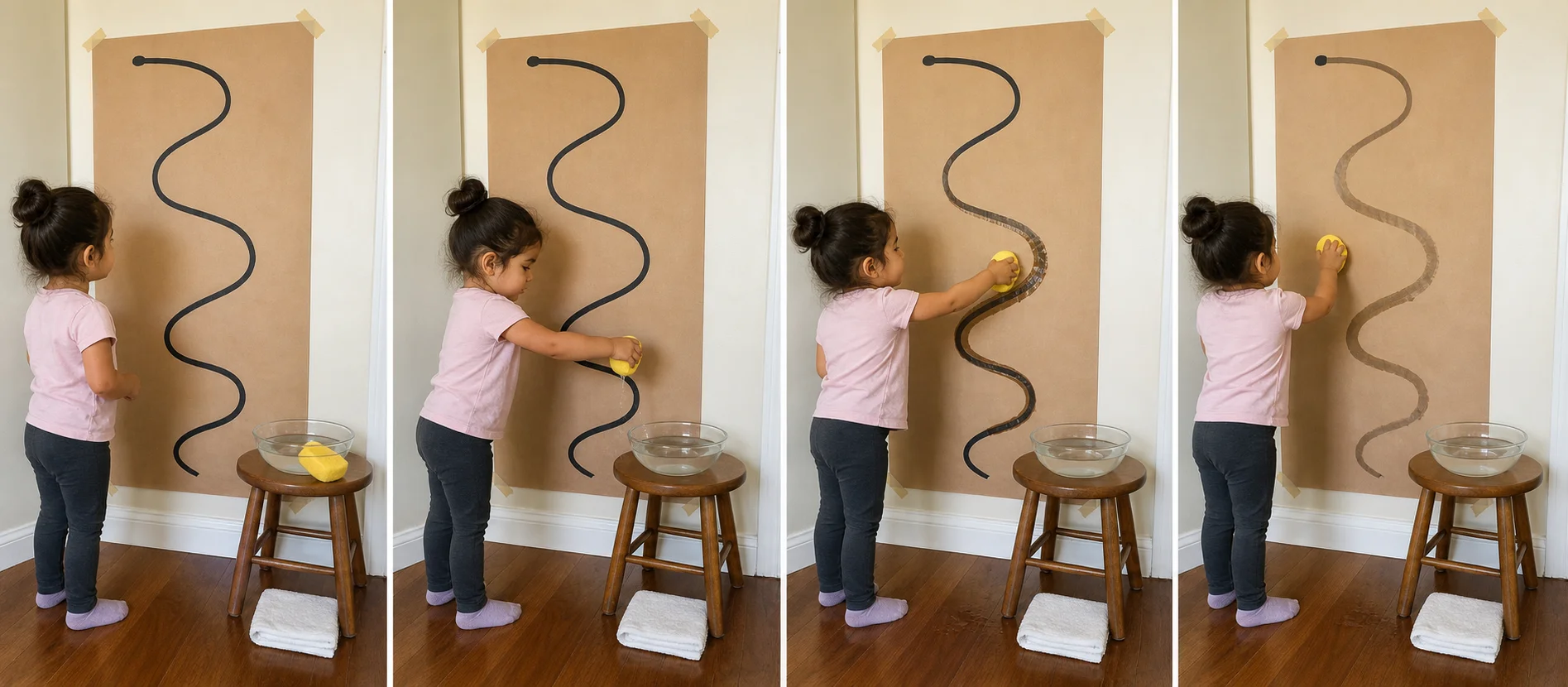
Multi-panel sequence showing paper taped to a wall, a sponge dipped and squeezed over a bowl, a child tracing the line, and the path retraced after a redip.
  1. 01
    Let your child dip the sponge, squeeze it over the bowl, and start at the marked line.
  2. 02
    Your child traces the path with the damp sponge until the wet trail reaches the end or starts to fade.
  3. 03
    If the trail dries out early, redip, squeeze, and keep going from the last wet spot.
  4. 04
    Go back to the start and trace the line again.

Safety Check

  • Stay close so the floor under the paper stays dry and not slippery.
  • Pause if the sponge starts dripping or the paper loosens, then dry the floor or retape the paper before the next turn.
Supporting the play

What to say in the moment

Match what you say to what you see.

Prompt ladder
Level 1 (Start)
`Dip, squeeze, trace the road.`
Level 2 (Keep going)
`Back to the bowl. Follow the next curve.`
Level 3 (Stretch)
`Keep your sponge high through the turn.`
Level 4 (Extend)
`Can you finish 1 more full trail?`
If your child seems...
What you'd see
Focused
What to do
Say
`Your trail is still showing.`
Add
`Where does the line turn?`
Extend
Let your child trace the next round with less pointing from you.

Make it easier

Younger end
  • -Let your child use 2 hands to squeeze the sponge, then switch to 1 hand for tracing.
  • -Start each round on the straightest part of the same line before working up to the tightest curve.
  • -Stand on the bowl side so the trip back to the water stays short and predictable.

Make it harder

Older end
  • +Ask your child to keep the sponge touching the line through the whole path without lifting at the bends.
  • +Pause at each turn and let your child find the next direction before you point.
  • +Try 1 slow-control round and 1 steady-faster round on the same path.

If it's not working

If you see
If child ignores it
Trace the first short curve yourself, then hand the sponge over and ask, `Can you finish my trail?`
If you see
If child misuses it
Keep the bowl beside you, hand the sponge over one turn at a time, and remind, `Sponge stays on the road.`
If you see
If child gets frustrated
Count 1 bend or half the line as enough, praise that finish, and stop there.
Skill spotlight
Path Following

Following 1 visible path with a damp sponge.

This helps your child keep a hand moving along 1 visible route, slow down when the line bends, and hold the arm up through 1 short control job. Those same moves support early shape tracing, drawing, and other careful table work.

  • One visible line gives your child a clear route to follow instead of a blank page or open-ended water play.
  • The dip, squeeze, trace loop repeats hand strength and path following in the same simple order each round.
  • The wet trail shows up fast, so your child gets an immediate result without a big setup or cleanup.
Real-world transfer
  • Following visible lines and shapes during early tracing and drawing
  • Slowing the hand down for turns, curves, and stop points
  • Using squeeze-and-release control during simple sponge, cloth, or art-tool jobs

Parent questions